How Many Calories a British Shorthair Needs a Day
One of the most common worries for British Shorthair owners is how much to feed their beloved chunky companions. It’s a real head-scratcher because these cats are naturally built to look substantial, and they have a well-earned reputation for loving their food a little too much. You want to make sure your British Shorthair is healthy and happy, not battling the bulge or, on the flip side, not getting enough essential nutrients. This guide is going to walk you through exactly how to figure out your British Shorthair's daily calorie needs, taking into account all the unique quirks of this wonderful breed, so you can keep them in tip-top shape.
Understanding Your British Shorthair's Unique Metabolism
British Shorthairs aren't just any cat; they have a very specific set of characteristics that directly impact their caloric needs. If you’ve ever tried to get your BSH to run a marathon, you know exactly what I mean! Their unique blend of calm temperament and dense build means we need to think a little differently about their diet compared to, say, a hyperactive Siamese.
Why British Shorthairs Aren't Your Average Cat
Let’s be honest, our British Shorthairs are the ultimate couch potatoes. They love a good nap, a quiet spot in the sun, and certainly don't exert themselves unnecessarily. This naturally lower activity level is one of the biggest reasons they have distinct calorie requirements. A cat that spends most of its day lounging around simply doesn't burn as many calories as a cat that's constantly climbing curtains or chasing imaginary mice. Their cobby build, that wonderfully solid, rounded body, also plays a role. It can be hard to tell what's muscle and what's just a bit too much fluff! Their dense, plush coat can also cleverly disguise a growing waistline, making it tricky to assess their true body condition without a hands-on approach. Many owners get a British Shorthair expecting a robust, sturdy cat, and while they are, that robustness can easily tip into obesity if their diet isn't carefully managed. It's not their fault; they're just built that way, and they often carry a genetic predisposition to gain weight if given half a chance.
The Impact of Age, Activity, and Sterilization on Calorie Needs
Just like humans, a British Shorthair's calorie needs aren't static throughout its life. A playful kitten, bounding with energy and rapidly growing, needs a significantly higher caloric intake relative to its size than an adult cat. Imagine trying to fuel a tiny construction project versus maintaining a fully built house – vastly different energy demands! As they transition from rambunctious youngsters to serene adults, usually around one to three years of age, their metabolism slows down, and their growth plateaus. This is often when owners accidentally keep feeding kitten-sized portions to an adult-sized cat, leading to creeping weight gain.
Sterilization, meaning spaying or neutering, also dramatically shifts their metabolic gears. It's a common frustration, isn't it? You get your cat spayed or neutered for their health and well-being, and then suddenly, they start packing on the pounds faster than you can say "extra kibble." This is because sterilization can reduce a cat's metabolic rate by a noticeable percentage, meaning they require fewer calories to maintain their weight. If you continue feeding the same amount of food post-surgery, weight gain is almost inevitable. Then, as your British Shorthair enters its senior years, typically after ten years old, their activity levels might decrease even further, and their body composition can change, sometimes requiring adjustments to both calorie count and nutrient profiles to support aging joints or organs. On the flip side, some senior cats might start to lose weight due to underlying health issues, and their caloric needs might even need to increase, but that's a conversation for your vet. Caring for a British Shorthair Past Ten is a good resource for understanding these later stages of life.
Calculating Your British Shorthair's Daily Calorie Intake
Okay, now for the nitty-gritty: how do we actually put a number on those calories? It can feel a bit like rocket science when you’re just trying to feed your cat, but breaking it down makes it much more manageable. We'll start with a basic calculation and then adjust for all those British Shorthair specific factors.
Basal Metabolic Rate and Resting Energy Requirements
Let's talk about the absolute minimum calories your British Shorthair needs just to exist. This is known as their Basal Metabolic Rate (BMR) or, more commonly in veterinary circles, their Resting Energy Requirement (RER). Think of RER as the energy needed to keep their heart beating, lungs breathing, and body temperature regulated while they're just chilling out, completely at rest. It’s the energy for basic survival, even before they lift a paw to move.
A commonly used formula to estimate RER for cats is:RER (in kcal/day) = 70 x (body weight in kilograms)^0.75
Now, before your eyes glaze over with math, let’s simplify. This formula gives you a good baseline. For example, if your British Shorthair weighs 5 kg (about 11 lbs), their RER would be approximately:70 x (5^0.75) ≈ 70 x 3.34 ≈ 234 kcal/day
This 234 kcal is just for resting. It doesn't account for any movement, digestion, or mental activity. It's a starting point, a foundation upon which we build the actual daily caloric needs. Many pet food companies and online calculators will use a similar base, but understanding what that number represents is key to not under or overfeeding your placid feline.
Factors Adjusting the Calorie Equation
Once you have your RER, you need to adjust it based on your British Shorthair's specific circumstances. This is where we factor in their actual activity level, whether they're still growing, or if they need to lose weight. You multiply the RER by an "energy factor" to get their true daily caloric needs. It's not a one-size-fits-all number, and this is where many owners get stuck, especially with a breed like the British Shorthair who can be quite a homebody.
Here's a general guide for common multipliers:
| Life Stage/Activity Level | Energy Factor | Example Daily Calories (for a 5kg BSH with RER of ~234 kcal) |
|---|---|---|
| Neutered Adult (Inactive) | 1.0 – 1.2 | 234 – 281 kcal |
| Intact Adult (Active) | 1.2 – 1.4 | 281 – 328 kcal |
| Weight Loss | 0.8 – 1.0 | 187 – 234 kcal |
| Weight Gain/Underweight | 1.4 – 1.6 | 328 – 374 kcal |
| Kitten (0-4 months) | 2.5 – 3.0 | 585 – 702 kcal |
| Kitten (4 months – adult) | 2.0 – 2.5 | 468 – 585 kcal |
| Senior (Healthy, Less Active) | 0.8 – 1.0 | 187 – 234 kcal |
So, if your 5 kg British Shorthair is a typical neutered adult who enjoys a leisurely life, you might start with an energy factor of 1.2.Daily Calories = 234 kcal (RER) x 1.2 = 281 kcal/day
This gives you a target. Remember, these are guidelines. Your individual cat might have a slightly faster or slower metabolism. The key is to start with this calculation and then monitor their body condition closely, making small adjustments as needed. A highly sedentary British Shorthair might even need closer to the 1.0 factor, while one that does occasionally play chase with a laser pointer might be fine at 1.2. The biggest mistake is often assuming they're more active than they actually are, or not adjusting for the post-neutering slowdown.
The Importance of a Body Condition Score
Relying solely on a number on the scale for your British Shorthair can be incredibly misleading. Their naturally sturdy build means they can easily look "big boned" when they're actually carrying too much extra weight. This is where the Body Condition Score (BCS) comes in as your most valuable tool. A BCS is a hands-on assessment of your cat's fat reserves, giving you a much clearer picture than just their weight in pounds or kilograms. It's a lot like how a doctor might look beyond just your BMI. How to Tell a Chunky British Shorthair From a Fat One goes into this in more detail, but here’s the gist.
To assess your cat's BCS, you need to get your hands on them, literally. Feel their ribs: you should be able to feel them easily with gentle pressure, almost like feeling the knuckles on your hand. If you have to press hard to feel them, or if you can't feel them at all, your cat is likely overweight. Next, look at them from above and from the side. They should have a slight waist tuck-in behind their ribs, and their abdomen shouldn't sag. For a British Shorthair, this can be tricky due to their dense coat and cobby shape, but you should still feel for that subtle narrowing. An ideal BCS is usually considered a 5 out of 9, where ribs are easily palpable, there's a visible waist, and minimal abdominal fat.
If your British Shorthair has a BCS of 6 or higher, it's time to consider reducing their caloric intake. If it's a 4 or lower, you might need to increase it. The beauty of the BCS is that it provides a visual and tactile guide, allowing you to fine-tune your calorie calculations in a way that mere numbers cannot. It helps you see beyond the fluff and really understand what's happening beneath that magnificent coat. Always keep in mind that a British Shorthair's round face and substantial appearance can make an overweight cat seem "normal" if you're not regularly checking their BCS.
Practical Strategies for Feeding Your British Shorthair
Now that you know how to calculate the calories, let's talk about the practical side of making sure your British Shorthair actually gets the right amount. It's not just about the numbers; it's about the execution, especially with a breed that often has a strong affinity for food.
Choosing the Right Food and Measuring Portions
The market is flooded with cat food, and it can feel overwhelming to pick the "best" one. For a British Shorthair, particularly one prone to weight gain, focusing on high-quality, protein-rich food is often a good strategy. Protein helps them feel fuller and supports lean muscle mass, which is important for their overall health and metabolism. Which Food Suits a British Shorthair dives deeper into food types. Always check the caloric density of the food you choose – this is usually listed on the packaging as "kcal per cup," "kcal per can," or "kcal per gram." This number is crucial because it allows you to accurately measure the precise amount of food that delivers your calculated daily calorie target.
Once you have your food, precision is paramount. Eyeballing amounts is a surefire way to overfeed a British Shorthair. Invest in a digital kitchen scale to weigh out dry kibble, or use accurate measuring cups designed for pet food, not your kitchen set that might have slightly different volumes. For wet food, measure by the gram or clearly defined portions. If you use a combination of wet and dry, remember to calculate the calories from each source and ensure their sum doesn't exceed the daily target. Many reputable pet supply retailers like Chewy or even Amazon offer a wide range of high-quality cat foods, including options specifically formulated for weight management, which can make your job easier by already having a lower caloric density.
Avoiding Overfeeding and Encouraging Movement
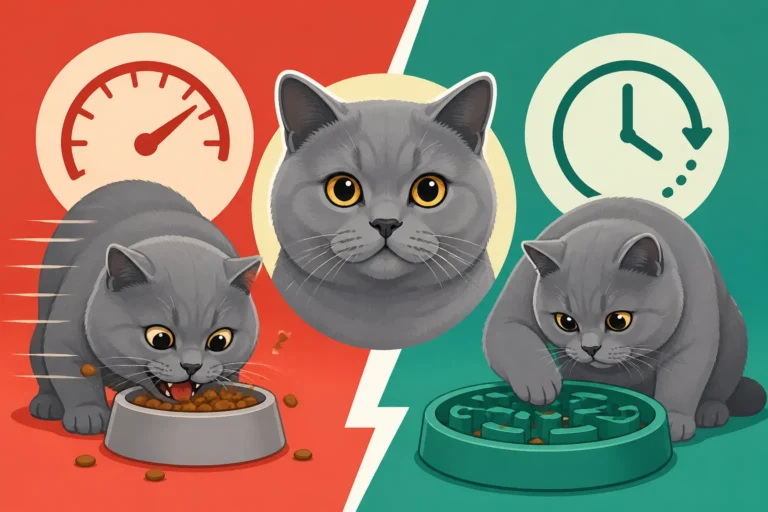
For a British Shorthair, free-feeding is almost always a recipe for disaster. Why Free Feeding Ruins a British Shorthair explains this perfectly. Leaving a bowl of kibble out all day allows them to graze endlessly, and their natural inclination to eat means they will almost certainly consume more calories than they need. Instead, portion control is your whole job. Divide their total daily calorie allowance into two or three smaller meals throughout the day. This can help manage their hunger and metabolism more effectively.
Beyond controlled portions, actively encouraging your British Shorthair to move is vital for calorie expenditure and overall health. We know they're not exactly Olympic athletes, but even short bursts of play can make a difference. Interactive toys, like wand toys that mimic prey, can often tempt even the laziest BSH off the sofa. Puzzle feeders are another fantastic tool; they make your cat "work" for their food, slowing down consumption and providing mental stimulation. Scatter feeding, where you hide small portions of their kibble around the house, can also turn mealtime into a mini-hunt, burning a few extra calories and engaging their natural instincts. Remember, a British Shorthair might not initiate play often, so it's up to you to be their personal trainer! Getting a Low Energy British Shorthair to Move offers great tips on this.
Adjusting Calories for Weight Management
Whether your British Shorthair needs to lose a few pounds or gain a bit of healthy mass, making caloric adjustments requires patience and consistency. For weight loss, the goal is to create a moderate calorie deficit. This usually means reducing their current intake by about 10-20%. Drastically cutting calories can be dangerous for cats, potentially leading to hepatic lipidosis (fatty liver disease), which is a serious condition. Always aim for slow, steady weight loss, ideally no more than 1-2% of their body weight per week. How Many Weeks a British Shorthair Diet Should Take explains this timeline.
Start by calculating their ideal weight, then use that ideal weight in your RER calculation and apply the weight loss multiplier. For instance, if your BSH is 6 kg but should be 5 kg, calculate their RER based on 5 kg, then multiply by a weight loss factor (e.g., 0.8). Monitor their weight weekly and adjust as needed. If they’re losing too quickly, increase food slightly; if too slowly, reduce it a bit more. How to Put a British Shorthair on a Diet provides a step-by-step guide.
Conversely, if your British Shorthair is underweight and needs to gain, you'll want to increase their calories by using a higher energy factor (1.4-1.6) for a short period. This should always be done under veterinary guidance to ensure there isn't an underlying health issue causing the low weight. For both scenarios, regular check-ins with your vet are indispensable to ensure your cat is getting proper nutrition and maintaining good health.
When to Consult Your Veterinarian
Sometimes, despite your best efforts, things don't go as planned, or you just need an expert opinion. Your veterinarian is your best partner in managing your British Shorthair's diet and health, and knowing when to reach out to them is crucial.
Recognizing Signs of Under or Overfeeding
It’s easy to get caught up in the numbers and forget to look at the whole picture. Your British Shorthair's body will tell you a lot about whether your feeding plan is working. Signs a British Shorthair Is Unwell can give you a broader view, but specifically for diet:
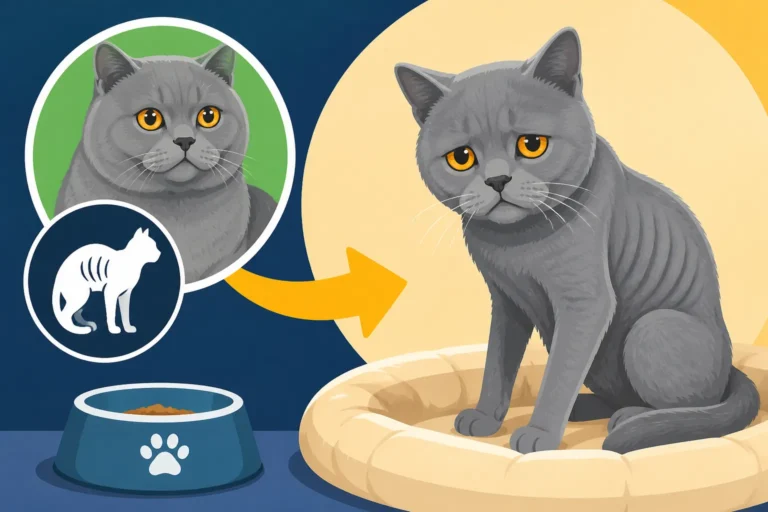
If your British Shorthair is underweight, you might notice their ribs, spine, and hip bones becoming very prominent, even without much palpation. Their coat might lose its luster, and they might appear more lethargic or even anxious around meal times, constantly looking for food. Any unexpected or rapid weight loss in an adult cat is a major red flag and warrants immediate veterinary attention, as it can be a sign of serious underlying health issues like hyperthyroidism or even cancer.
On the other hand, if your British Shorthair is overweight or obese, you'll struggle to feel their ribs, their waist will be non-existent, and they might have a noticeable saggy belly pouch that isn't just primordial skin. You might observe them struggling with daily activities like jumping onto furniture, or having difficulty grooming themselves, especially their back or tail area. Labored breathing after minimal exertion, or even during rest, is a very serious sign of obesity-related stress on their cardiovascular system and requires urgent veterinary assessment. Remember, the goal is a healthy, active cat, not just one that looks "fluffy."
Tailoring Diet for Health Conditions
This is where individualized care truly shines. Many health conditions in British Shorthairs, both common and rare, directly impact their dietary needs and calorie requirements. For example, if your British Shorthair is diagnosed with Diabetes in a British Shorthair, managing their blood sugar often involves a specific diet with controlled carbohydrate levels and precise caloric intake to help achieve and maintain remission. Similarly, if they develop kidney disease, a common concern in older cats, their diet will need to be adjusted to support kidney function, typically involving controlled protein and phosphorus levels, and calorie requirements might shift based on their appetite and body condition.
Obesity itself isn't just a cosmetic issue; it's a disease that can lead to a host of other problems. What Obesity Does to a British Shorthair's Liver is a prime example, as excessive fat accumulation can lead to hepatic lipidosis. Whether an Overweight British Shorthair Gets Diabetes is another critical consideration, as obesity significantly increases the risk. Your vet can recommend prescription diets specifically formulated to address these conditions. These specialized foods, often available through your veterinarian or online pet pharmacies associated with trusted retailers like Chewy or Amazon, are designed to provide optimal nutrition while managing the disease. Never try to guess these dietary changes on your own; always follow your vet's specific recommendations. They are the best resource for tailoring a diet that supports both their overall health and any specific medical needs. For example, Signs a British Shorthair Is Diabetic will require immediate vet intervention.
The Value of Regular Wellness Exams
You might think that if your British Shorthair seems fine, a vet visit is unnecessary, but for managing their calorie intake and overall health, regular wellness exams are absolutely invaluable. Think of them as preventative maintenance for your beloved companion. These routine check-ups, ideally once a year for adult cats and twice yearly for seniors, allow your veterinarian to thoroughly assess your British Shorthair's overall health, including their weight, body condition score, and muscle mass. How Often a British Shorthair Needs a Wellness Exam is a good guide.
During these visits, your vet can catch subtle changes that you might miss at home, or discuss any concerns you have about your cat's appetite, energy levels, or litter box habits. They can also offer personalized dietary advice, taking into account your cat's age, activity level, current health status, and any existing medical conditions. They can help you calculate calorie needs, recommend appropriate food types, and track progress if your cat is on a weight management plan. These exams are also a chance to address any health concerns early, before they become serious problems. Regular professional guidance ensures your British Shorthair receives the best possible care throughout their life, allowing them to truly thrive.
Disclaimer
This article is for general informational purposes only and does not constitute professional advice. Laws, prices and regulations vary by location and change over time. Consult a qualified professional for guidance on your specific situation.