How to Score a British Shorthair’s Body Condition
One of the biggest struggles British Shorthair owners face is simply telling if their beloved furball is truly fit or if that adorable chunkiness is actually excess weight. Their naturally dense, plush coats and cobby build make it incredibly difficult to assess their true physical condition by sight alone. This guide will walk you through how to use the Body Condition Score (BCS) system to accurately evaluate your British Shorthair's health, ensuring you can make informed decisions about their well-being.
Understanding the British Shorthair Build Versus Body Fat
It's a common misconception, isn't it? You look at your British Shorthair, all round and plush, and think, "That's just how they're built!" And you're not wrong, to a certain extent. British Shorthairs are designed to be substantial, with a sturdy frame and a naturally robust appearance. But this very characteristic can be a stealthy trap for owners trying to gauge their cat's weight.
The British Shorthair's Deceptive Appearance
Let's be honest, those round faces, thick necks, and broad chests are part of what makes the British Shorthair so endearing. They are a cobby breed, meaning they have a short, stocky body. Couple that with their famously dense, short coat that literally stands away from their body, and you've got a cat that can hide a significant amount of extra padding without looking obviously fat. It's a real frustration for owners who are trying their best to keep their cats healthy but can't trust their eyes. You're trying to figure out How to Tell a Chunky British Shorthair From a Fat One, and it feels like a guessing game.
This unique physical build means that traditional visual cues for assessing a cat's weight often fail. You might expect to see a tucked-up waist or feel a distinct ribcage, but the British Shorthair's natural conformation and luxurious fur make these signs less obvious. It’s easy to dismiss a rounded belly as part of their natural "teddy bear" look, when in reality, it might be an indicator of creeping weight gain. Why a British Shorthair Is Built to Look Heavy really gets into this, highlighting just how challenging it is.
Why Visual Assessment Alone Fails
Relying solely on your eyes for a British Shorthair's weight assessment is like trying to guess the size of a fruit by looking at it through a thick sweater. Their dense, plush coat obscures the natural contours of their body, making it incredibly hard to see a waistline or the definition of their ribs. Unlike some sleek, short-haired breeds where you can clearly see a dip behind the ribs or the ripple of muscles, a British Shorthair's fur acts like a padded suit, smoothing over any subtle changes in their physique.
This visual camouflage means that by the time you see that your British Shorthair is overweight, they might already be significantly so. It can lead to owners underestimating the problem, thinking their cat is just "big-boned" or "fluffy" when a closer, hands-on examination would reveal a different story. This is precisely why a more tactile, systematic approach like the Body Condition Score is not just helpful, but essential for this particular breed. You can also explore Why a British Shorthair's Coat Hides Its Waist for more on this common visual challenge.
The Body Condition Score System
So, if looking at them isn't enough, what's the secret? The answer lies in the Body Condition Score (BCS) system, a widely accepted tool used by veterinarians that helps you objectively assess your cat's fat reserves by feeling them, not just seeing them. It's a game-changer for British Shorthair owners.
What is a Body Condition Score?
The Body Condition Score (BCS) is essentially a standardized, hands-on assessment tool that helps you determine if your cat is underweight, ideal weight, or overweight. It usually works on a scale of either 1 to 5 or 1 to 9, with the middle score (3/5 or 5/9) representing the ideal body condition. Think of it as a physical report card for your cat's fat levels. It considers key areas where fat tends to accumulate or where bones become prominent.
The beauty of the BCS system, especially for a British Shorthair, is that it bypasses the visual deception of their luxurious coat. By relying on touch, you get past the fluff and feel what's truly underneath. This objective method allows you to track changes over time, identify potential weight issues early, and discuss your cat's health more accurately with your veterinarian. It’s a proactive step in preventing many health issues linked to inappropriate weight.
How to Perform a Hands-On Assessment
Performing a hands-on assessment might sound daunting, but it’s actually quite simple and can become a regular bonding experience with your British Shorthair. The key is to be gentle and systematic, focusing on three main areas: the ribs, the waist, and the spine. This tactile examination will tell you much more than simply looking at your cat from across the room.
First, let's talk about the ribs. Gently place both your hands on your British Shorthair's sides, just behind their front legs. Use your fingertips to feel along their rib cage. You should be able to feel the ribs individually with slight pressure, almost like feeling the knuckles on your hand. If you have to press hard to feel them, or can't feel them at all, that's a red flag. On the flip side, if the ribs feel very prominent and sharp without any pressure, your cat might be underweight. You can find more detailed guidance on How to Feel a British Shorthair's Ribs Through the Plush.
Next, move your hands to their waist. For cats, the "waist" is usually a slight indentation between the rib cage and the hips when viewed from above. On a British Shorthair, this might be less pronounced than on other breeds, but you should still feel a gentle taper. If your cat has a perfectly straight line from ribs to hips, or even bulges out, they are likely carrying too much weight. Now, for the spine: run your fingers gently down your cat’s back, along their backbone. In an ideal body condition, you should be able to feel the individual bumps of the vertebrae without them feeling sharp or too cushioned by fat. If you can feel them too easily and distinctly, they might be too thin; if you can't feel them at all, they're likely overweight.
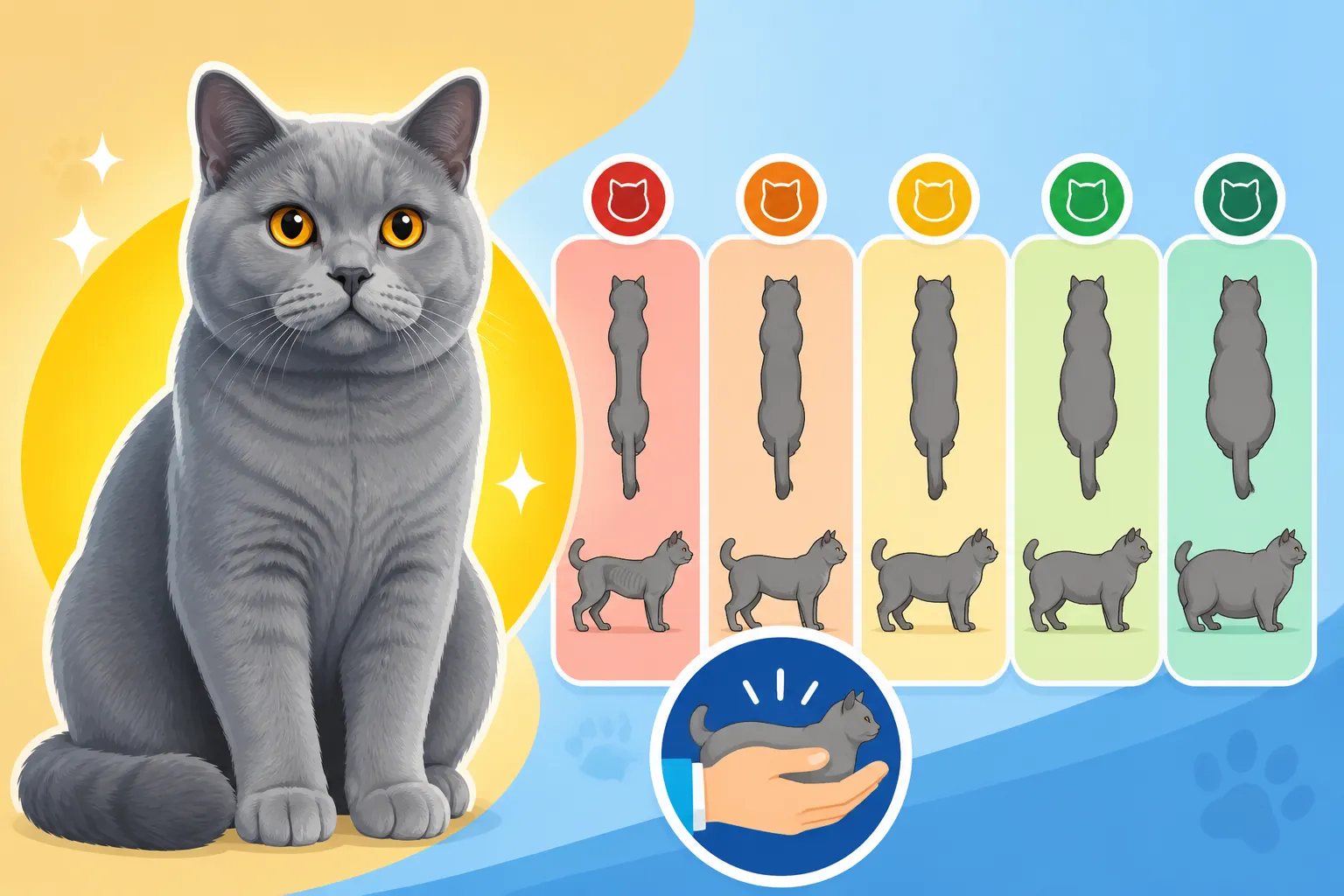
Here's a quick reference table for the BCS (on a 1-5 scale, which is often easier for owners to use):
| BCS Score | Ribs (Feel) | Waist (View from above) | Abdominal Tuck (View from side) | Overall Impression |
|---|---|---|---|---|
| 1 (Emaciated) | Easily visible & palpable; no fat cover | Extreme hourglass shape; severe abdominal tuck | Severe | Bones prominent; obvious muscle loss; unhealthy |
| 2 (Underweight) | Easily palpable; minimal fat cover | Obvious hourglass shape; noticeable abdominal tuck | Noticeable | Thin, but minimal muscle loss |
| 3 (Ideal) | Easily palpable with slight fat cover | Well-proportioned; visible tuck | Slight | Lean, muscular, healthy |
| 4 (Overweight) | Palpable with moderate fat cover; difficult to feel distinctly | Slightly rounded; minimal to no tuck | Minimal | "Chunky" appearance; loss of definition |
| 5 (Obese) | Difficult to palpate; heavy fat cover | No waist; broadened back; distended abdomen | None | Rounded, large; excess fat visible & palpable |
Interpreting the British Shorthair BCS
Once you've done your hands-on assessment, it's time to interpret what those findings mean for your British Shorthair. Remember, the goal isn't to make them look skinny, but to ensure they're at a healthy weight that supports their longevity and quality of life.
The Ideal Score for a British Shorthair
For most cats, an ideal Body Condition Score is a 3 out of 5, or a 5 out of 9 on the expanded scale. For a British Shorthair, this translates to being able to feel their ribs with just slight pressure, but without them feeling sharp or bony. You should be able to discern a gentle taper at their waist when looking from above, even if their dense coat still makes it look somewhat straight. When you run your hand down their spine, you should feel the individual vertebrae, but they shouldn't protrude or feel like sharp knobs.
It’s crucial to understand that "ideal" for a British Shorthair doesn't mean "scrawny." They are naturally a solid, well-muscled breed. An ideal weight allows them to move comfortably, jump without strain, and minimizes the risk of weight-related health issues. A healthy weight for a British Shorthair will vary, but typically falls within a certain range depending on gender and build, which you can read more about in What a Healthy British Shorthair Weighs on the Scale.
Recognizing Underweight Signs
While less common than overweight issues in British Shorthairs, being underweight can be just as serious. A cat with a BCS of 1 or 2 (on a 5-point scale) is too thin. If you gently feel your cat's ribs and they are very prominent, almost sharp, with no fat padding over them, and you can easily see or feel their hip bones and shoulder blades, they are likely underweight. You'll also notice a very obvious hourglass shape to their waist and a severe abdominal tuck from the side.
Underweight British Shorthairs often show signs beyond just thinness, such as a dull coat, reduced energy, or changes in eating habits. It's a sign that they might not be getting enough calories, or worse, that an underlying health issue is at play. It's important to consult your vet immediately if you suspect your British Shorthair is underweight, as conditions like hyperthyroidism or dental problems could be the cause.
Identifying Overweight and Obese Signs
This is where many British Shorthair owners struggle the most, thanks to that fluffy deception we talked about earlier. If your cat scores a 4 or 5 on the BCS, they are carrying too much weight, and a 5 means they are frankly obese. When you try to feel their ribs, you'll have to press down quite firmly to discern them, if you can feel them at all. The ribs will feel cushioned and indistinct. From above, instead of a gentle waist, your cat will likely have a straight line or even bulge out around the middle. The spine will also be difficult to feel, hidden under a layer of fat.
Overweight British Shorthairs might also have a noticeable "primordial pouch" that swings when they walk, which can be normal to some extent, but becomes exaggerated with obesity. They might move less, groom themselves less effectively (especially around their back, as discussed in Why an Overweight British Shorthair Stops Grooming Its Back), and generally seem more lethargic. Ignoring these signs can lead to serious health problems like diabetes, arthritis, and heart disease. Signs a British Shorthair Is Overweight outlines many of these visual and behavioral cues, and What Obesity Does to a British Shorthair's Joints explains the painful consequences of carrying too much weight. It's truly shocking How Much Obesity Shortens a British Shorthair's Life.
Tools and Tips for Regular Monitoring
Keeping your British Shorthair at an ideal weight isn't a one-and-done task; it's an ongoing commitment. Regular monitoring, combined with smart feeding and appropriate activity, is key to their long-term health.
Incorporating Regular Checks into Your Routine
Making BCS checks a routine part of your cat's care is surprisingly easy. Aim to do a quick hands-on assessment every few weeks, perhaps when you're already enjoying some cuddle time or during their regular grooming session. You don't need to turn it into a wrestling match; gentle strokes along their ribs, spine, and sides are usually enough. The more often you do it, the more familiar you'll become with what their "ideal" feels like, making it easier to notice subtle changes over time.
Consider keeping a small notebook or a note on your phone to track your cat's BCS. Jot down the date and your score. This way, you can spot trends. If you notice a gradual increase in their BCS, even if it's just from a 3 to a 4, it's an early warning sign that you might need to adjust their diet or encourage more activity. For example, if you notice they are becoming less active, thinking about How to Get a British Shorthair to Move might be your next step. Small, consistent efforts make a huge difference in managing their weight effectively. You might also find it helpful to look at How Often an Old British Shorthair Needs Weighing for ideas on frequency.
The Role of Your Veterinarian
While your home assessments are invaluable, nothing replaces the professional eye and experienced hands of your veterinarian. During your British Shorthair's annual wellness exams, your vet will perform a thorough physical, which always includes a Body Condition Score. They have been trained to accurately assess BCS and can provide an objective, expert opinion on whether your cat is at a healthy weight.
If your vet identifies that your British Shorthair is overweight, they can help you develop a safe and effective weight loss plan. This might involve recommending specific calorie-controlled foods, suggesting appropriate portion sizes, and advising on safe exercise routines. Many specialty weight-management cat foods recommended by vets are available, as are fresh, portion-controlled meals tailored to your cat's needs. Your vet can also rule out any underlying medical conditions that might be contributing to weight gain or loss, giving you peace of mind and a clear path forward. They can also advise you on How Many Calories a British Shorthair Needs to help you accurately portion their food.
Disclaimer
This article is for general informational purposes only and does not constitute professional advice. Laws, prices and regulations vary by location and change over time. Consult a qualified professional for guidance on your specific situation.