How a British Shorthair Differs From a Scottish Straight
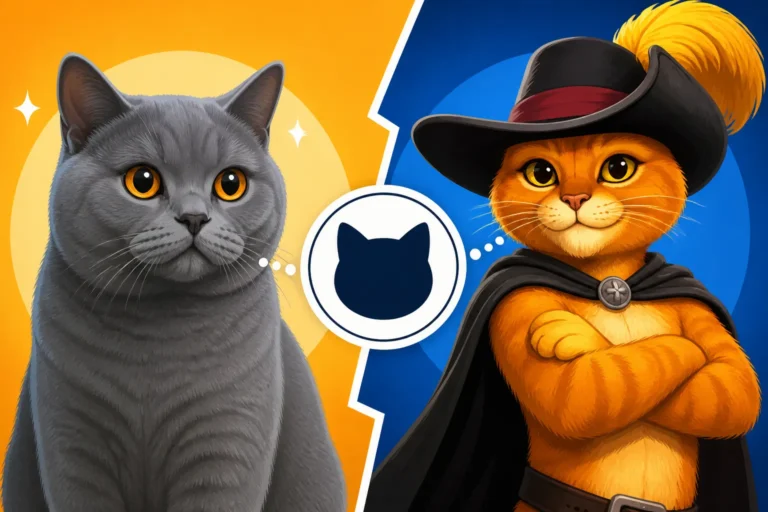
A British Shorthair and a Scottish Straight can look remarkably alike: both may have round faces, plush coats, and upright ears. That resemblance makes it easy to assume they are the same kind of cat, but breed history, body type, coat, and health considerations can differ. This guide explains what to look for and what matters more than appearance when choosing between them.
British Shorthair and Scottish Straight at a glance
| Feature | British Shorthair | Scottish Straight |
|---|---|---|
| Breed background | An established British breed with its own standard | The straight-eared variety associated with the Scottish Fold breed group |
| Ears | Upright, set fairly wide apart | Upright; littermates may have folded ears |
| Typical build | Stocky, broad, and strongly cobby | Often rounded too, but build can vary and may be less heavy |
| Coat | Short, dense, and springy in the classic shorthair | May be short or long, depending on coat variety |
| Main identification clue | Overall body shape and breed type, not just blue coloring | Scottish lineage and the particular registry or breeder’s terminology |
They share looks, but not the same breed identity
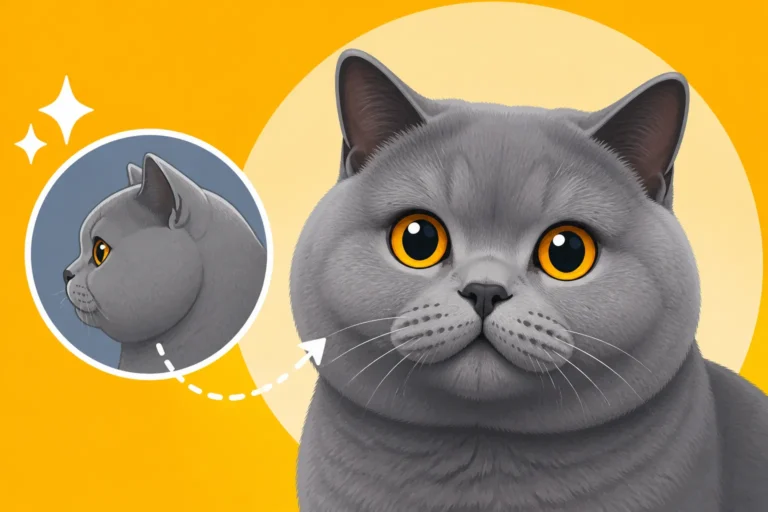
The British Shorthair is known for a broad, solid body, a rounded head, and a dense coat that stands away from the body. Its familiar blue coat is only one of many colors. A round face alone does not confirm that a cat is a British Shorthair, and a blue coat does not make a cat a British Blue.
A Scottish Straight is the straight-eared variety associated with Scottish Fold breeding. Scottish Folds have ears that bend forward because of a cartilage-related genetic trait. Scottish Straights have ears that remain upright. They can still have the round head and large, expressive eyes often associated with Scottish cats, so photos can be misleading.
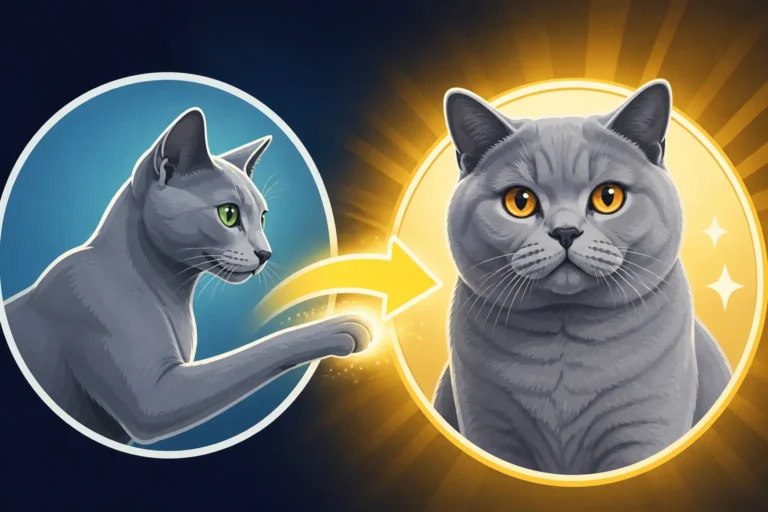
There is also some shared ancestry. British Shorthairs have been used in Scottish Fold breeding, and that history contributes to the resemblance. But shared ancestry does not make the breeds interchangeable. If you are comparing a cat’s overall shape, What Shape a British Shorthair's Head Should Be and How Big a British Shorthair Gets offer helpful details about the British Shorthair’s characteristic proportions.
The name can depend on a registry and breeder
“Scottish Straight” is a commonly used name, but the labels and recognition used for Scottish cats can depend on the registry and region. Some breeders may describe straight-eared cats as Scottish Straights or Scottish Shorthairs. Ask what the kitten’s parents are registered as, which registry the breeder uses, and what the registration documents will say.
This is worth clarifying before you pay a deposit. A listing may lean heavily on a familiar appearance—round cheeks, a plush coat, or upright ears—without clearly explaining the cat’s pedigree. Ask for the kitten’s registration information and a written contract, and make sure the breed name on the paperwork matches what you were told.
The comparison with a Scottish Fold is especially relevant because “fold” and “straight” describe ear type, not simply two unrelated breeds. For the specific distinction between the Fold and British Shorthair, see How a British Shorthair Differs From a Scottish Fold.
How to tell them apart by appearance
Look at the whole body, not just the face
British Shorthairs tend to look substantial and compact, with a broad chest, sturdy legs, and a thick tail. Their bodies mature slowly, and they may take several years to fill out. A young cat can appear leggier or less rounded than the adult breed picture people have in mind, so age matters when judging build.
Scottish Straights can also have a rounded outline, but the range of body types is broad. Some look quite compact; others appear a little finer or less heavily built than a typical British Shorthair. That overlap means body shape can be a useful clue, but it cannot reliably establish breed on its own.
Weight is not a dependable shortcut either. A heavy cat is not automatically a British Shorthair, and a lean cat is not automatically a Scottish Straight. Adult size depends on sex, family lines, age, and body condition. If a cat looks unusually round, assess its waist and overall condition rather than assuming that extra weight is simply part of its breed. What a British Shorthair Weighs and How Big It Gets explains why the breed’s sturdy frame can be easy to confuse with excess weight.
Compare the ears and coat texture
Both breeds have upright ears, so the ears may not settle the question at a glance. Scottish Straight kittens are particularly easy to mistake for British Shorthairs because Scottish Fold kittens can start life with upright-looking ears before the fold trait becomes apparent. A breeder familiar with the litter and its parents can explain the kitten’s ear type and ancestry more reliably than a casual photo comparison.
Coat texture can offer another clue. The British Shorthair’s short coat is famously dense and crisp, with a springy feel rather than a close, flat lay. A Scottish Straight may have a short coat, but longhaired varieties also occur. Coat length and texture can differ between individuals, so ask the breeder what coat type the kitten is expected to have as it matures. For more on the British Shorthair texture, see What a British Shorthair's Coat Is Like.
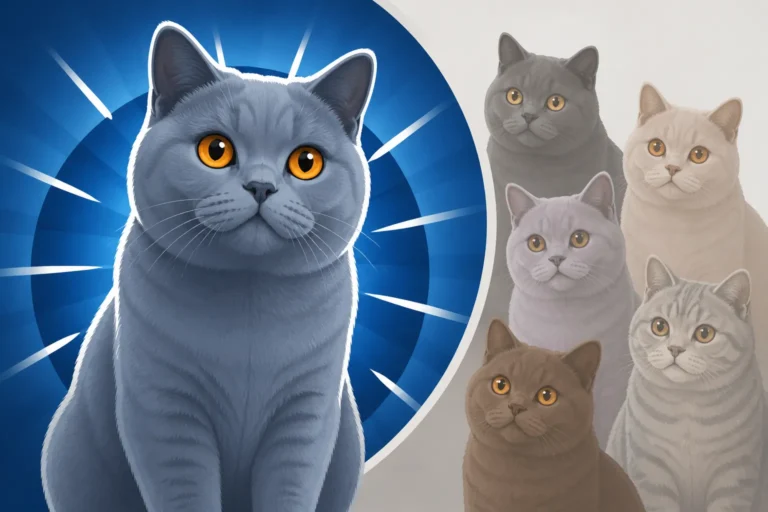
Color is a poor way to distinguish the two. Blue cats are strongly associated with British Shorthairs, but both breeds may appear in a range of colors and patterns depending on their breeding and registry. A blue kitten with a round face may resemble the classic British Shorthair image without being one. Pedigree documents are more useful than color labels in an advertisement.
Temperament and everyday care
Breed tendencies are not a personality guarantee
British Shorthairs are often described as calm, steady, and companionable without being constant lap cats. Many like to sit near their people rather than be carried around or held for long stretches. A cat may follow you from room to room, then settle on the next chair instead of climbing onto your lap. That is not necessarily aloofness; it can simply be the cat’s preferred way of being close.
Scottish Straights are also often described as sociable and adaptable, but individual temperament depends on genetics, early handling, household experience, and the cat’s own preferences. A confident kitten raised around gentle people may be outgoing, while a cat with the same breed label may need more time to settle in. Meet the kitten if possible, and ask how it reacts to ordinary handling, visitors, and household sounds.
If affection style is important to you, ask specific questions rather than relying on a breed description such as “sweet” or “cuddly.” Find out whether the kitten chooses human company, how it responds when picked up, and what it does when it wants space. What a British Shorthair's Temperament Is Really Like gives a fuller picture of the British Shorthair’s typical social style.
Daily needs overlap more than the labels suggest
Both cats need appropriate meals, clean litter, play, scratching options, and routine veterinary care. Neither should be expected to exercise itself just because it has a particular breed name. Short, regular play sessions and food portions measured for the individual cat can help support a healthy routine.
A British Shorthair’s plush coat usually needs regular combing, particularly when shedding increases. Scottish Straight grooming needs depend partly on whether the cat is shorthaired or longhaired. For either cat, begin handling gently and gradually. A few calm minutes with a comb or nail-care routine can be easier than trying to complete an unfamiliar task all at once.
Food shopping can feel confusing when bags make broad claims about age, activity, or body type. If you are comparing ingredient panels and feeding directions, a retailer such as Chewy can be one convenient place to review product information; the right choice still depends on your cat’s health, preferences, and veterinarian’s advice. Treats and extras count too, so build them into the overall daily ration rather than adding them on top without a plan.
Health, breeding, and choosing responsibly
Ask about the Scottish Fold connection
The key health conversation around Scottish Fold breeding concerns the cartilage and bone condition associated with the folded-ear trait. The mutation that causes folded ears can affect cartilage beyond the ears, and affected cats may develop painful skeletal problems. A Scottish Straight’s upright ears do not, by themselves, prove that it has the mutation or that it will develop the same condition. Its pedigree and genetic status matter, so ask the breeder how they assess risk and what information is available for the kitten and its parents.
Be cautious if a breeder dismisses all questions with “the kitten has straight ears, so there is nothing to consider.” Ask whether the breeder can explain the kitten’s parentage, whether folded-ear cats are part of the line, and what health documentation is provided. A responsible breeder should be willing to discuss those details without pressuring you to make a quick decision.
British Shorthairs have their own health considerations, including hypertrophic cardiomyopathy, or HCM. A DNA test is not a universal shortcut for ruling out HCM in the breed, so ask what screening the breeder uses and how recently the parent cats were assessed. You can read more in Whether the British Shorthair Is a Healthy Breed and Why There Is No British Shorthair HCM Gene Test.
Compare evidence, not just promises
A careful breeder should be able to talk clearly about veterinary care, family history, and the purpose of any health checks. Ask to see records, clarify what each test can and cannot tell you, and confirm that documents refer to the actual parent cats. A general claim such as “health checked” is less informative than a clear explanation of which checks were done and what the results mean.
For a British Shorthair, ask about heart screening and relevant inherited conditions in the family line. Depending on the lineage and the breeder’s program, kidney disease screening may also be part of the discussion. For a Scottish Straight, ask specifically about its Scottish Fold ancestry and how the breeder considers the fold-associated cartilage condition. Do not assume that a single certificate covers every possible health concern.
A kitten’s early behavior and appearance are only part of the decision. Consider the home you can provide, the grooming and play routine you can maintain, and whether the breeder is open about both strengths and limitations. A responsible breeder will welcome thoughtful questions. What a British Shorthair Breeder Should Have Tested is a useful companion read when preparing those questions.
Choose the cat whose needs fit your home
If you want a particularly solid, compact cat with a dense coat and a typically independent style of affection, a British Shorthair may suit your expectations. If you are drawn to the Scottish cat’s look and are considering a straight-eared kitten, focus on the breeder’s documentation, the kitten’s family background, and whether its temperament fits your household.
Think beyond the first impression. Ask how much brushing the cat is likely to need, how it responds to handling, what veterinary records come with it, and what support the breeder offers after the kitten goes home. If comparing food, litter, or grooming supplies feels like one more task during the search, Chewy may help you review available options in one place, but product selection should be guided by the individual cat’s needs rather than breed stereotypes.
In the end, appearance can point you toward the right questions, but it cannot confirm a cat’s identity or health. Verify the pedigree, meet the cat when possible, review the records, and choose based on the individual animal rather than the promise of a perfectly round face. If you are still weighing whether the breed’s personality and care needs fit your life, Whether a British Shorthair Is Right for You can help you think it through.
Disclaimer
This article is for general informational purposes only and does not constitute professional advice. Laws, prices and regulations vary by location and change over time. Consult a qualified professional for guidance on your specific situation.