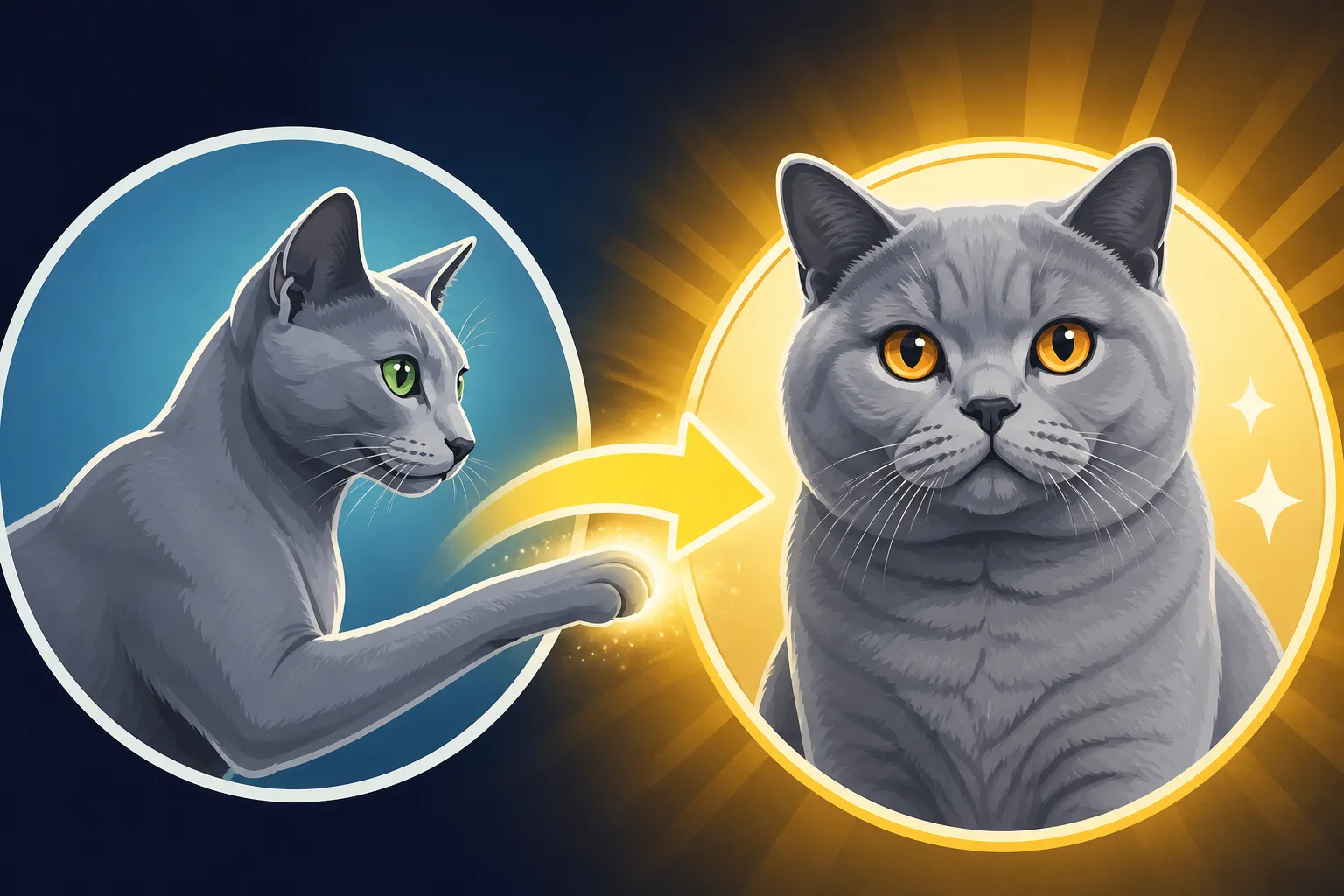
Whether a Russian Blue Rebuilt the British Shorthair
A Russian Blue may have contributed to the British Shorthair’s recovery after its numbers fell, but it was not the breed’s sole or defining foundation. Breeders used several outcrosses to restore and strengthen British Shorthair lines, with the Persian playing a particularly important role. Here’s what the Russian Blue may have added, what remains uncertain, and why a blue coat alone doesn’t prove Russian Blue ancestry.
Why British Shorthairs Needed Rebuilding
War and breeding bottlenecks reduced the population
The British Shorthair developed from cats kept in Britain for practical purposes and later became a pedigreed show breed. But the breed’s population and breeding options were disrupted by the world wars. With fewer cats available, breeders had a smaller pool of suitable animals to work with, making it harder to maintain healthy, consistent lines.
This kind of population bottleneck can affect a breed’s future in more than one way. There may be fewer unrelated cats to pair, and breeders can find it difficult to preserve desired traits while avoiding close inbreeding. British Shorthair breeders faced the practical challenge of increasing numbers and rebuilding the breed’s appearance from the animals still available.
The breed’s recovery was not a simple matter of finding one replacement cat. Breeders had to make careful choices across generations, selecting cats that could contribute to the population while producing offspring that still fit the developing British Shorthair type. For more background, see Why British Shorthair Numbers Collapsed in the Wars.
Rebuilding meant using more than one outcross
An outcross is a mating between cats from different breeds or populations. In a period when British Shorthairs were scarce, outcrossing could give breeders access to a wider gene pool and help them continue breeding. Accounts of the breed’s reconstruction describe the use of several kinds of cats, including Persians, Russian Blues, Chartreux, and other shorthaired cats.
Each outcross had different qualities to offer, and breeders did not simply blend breeds indiscriminately. They selected offspring over time, aiming to bring the population back toward a recognizable British Shorthair form. That meant the rebuilding process involved multiple generations of decisions, not one cross that instantly produced the modern breed.
The relative importance of individual outcrosses is not always described consistently. Records and breed histories may emphasize different parts of the story, and the contribution of one breed should not be mistaken for the whole reconstruction. The broader account is explored in Which Breeds Rebuilt the British Shorthair.
What the Russian Blue May Have Contributed
A useful outcross, not a replacement foundation
The Russian Blue is generally described as one of the breeds used during the British Shorthair’s rebuilding. It may have provided additional breeding options at a time when the British Shorthair population was limited. But it would be misleading to say that Russian Blues alone rebuilt the breed or that the British Shorthair is simply a Russian Blue cross.
The two breeds are distinct, with different histories and breed characteristics. A Russian Blue has its own recognized type and characteristic coat, while the British Shorthair was developed toward a sturdy, rounded, dense-coated form. Any contribution from Russian Blues was absorbed through selective breeding over generations, rather than remaining as a visible, unchanged “Russian Blue half” in today’s cats.
This distinction matters because an outcross can help a breed recover without defining its final identity. A breeder may retain offspring with useful qualities, then breed those cats selectively toward the established standard. The specific history of this possible contribution is covered in Whether Russian Blue Rebuilt the British Shorthair.
The Persian played a particularly visible role
The Persian is often given more attention in accounts of the British Shorthair’s reconstruction. Persian outcrosses helped breeders expand the available population and influenced some features associated with the modern British Shorthair, including its rounded appearance and dense coat. This does not mean that every British Shorthair has a recent Persian ancestor, or that the two breeds became interchangeable.
The long-term result came from selection. Breeders chose cats that fit the desired British Shorthair type and continued breeding toward that type across generations. Different outcrosses could contribute different things, but the breed was shaped by the choices made afterward—not merely by the identity of the first cross.
That is why it is more accurate to describe the British Shorthair as a breed rebuilt using several sources, with the Persian especially influential, than as a breed rebuilt by one specific outcross. For a closer look at that influence, read Why British Shorthair Breeders Reached for Persian and What the Persian Cross Gave the British Shorthair.
| Question | Careful answer |
|---|---|
| Was the Russian Blue used in rebuilding the British Shorthair? | It is described as one of the outcrosses used during the breed’s recovery. |
| Did Russian Blues rebuild the breed by themselves? | No. The reconstruction involved several breeds and generations of selective breeding. |
| Was the Persian also important? | Yes. The Persian is often described as a particularly influential outcross. |
| Does a blue British Shorthair prove Russian Blue ancestry? | No. Blue is a coat color, not proof of a particular breed ancestry. |
| Is a British Shorthair the same breed as a Russian Blue? | No. They are distinct breeds with different histories and type. |
Why a Blue Coat Does Not Prove Russian Blue Ancestry
“Blue” describes color, not breed
The word “blue” in cat breeding refers to a gray-looking coat color. Both British Shorthairs and Russian Blues can have blue coats, but that shared color does not make them the same breed and does not establish a recent family connection. A blue British Shorthair can simply be a British Shorthair with the blue color variety.
This is an easy mix-up because the familiar blue British Shorthair is often pictured as a gray cat with a round face and plush coat. The Russian Blue is also associated with a blue-gray coat, but breed identification depends on more than color. Body shape, head type, coat texture, and documented pedigree all matter.
So if someone sees a blue British Shorthair and assumes it must have Russian Blue ancestry, the appearance alone cannot support that conclusion. Historical outcrossing tells us that Russian Blues may have played a role in rebuilding the breed; it does not let us trace an individual cat’s ancestry by looking at its coat. See Why the Blue Is the Best Known British Shorthair for more on how the color became so closely associated with the breed.
Breed type is shaped over generations
A cross between breeds can produce kittens with a mixture of traits, but the direction of later breeding matters. If breeders repeatedly select cats that conform to the British Shorthair standard, the characteristics of that breed become more established across generations. The initial outcross does not permanently determine what every descendant looks like.
This is also why a modern British Shorthair may not show an obvious feature that someone associates with a Russian Blue. Selective breeding can emphasize particular qualities and reduce the visibility of others. Without reliable pedigree records, appearance alone is a poor tool for identifying distant ancestry.
The British Shorthair’s rounded head, substantial build, and dense coat are part of its established breed type. These traits reflect a long history of breeding and selection, rather than a single outcross. For an overview of the breed’s development, see The British Shorthair Started as a British Street Cat and How a British Shorthair Differs From a Russian Blue.
What the Russian Blue’s Role Means Today
Separate breed histories can include shared ancestry
It is possible for modern cat breeds to have historical connections through outcrossing while remaining distinct breeds. The Russian Blue may be part of the British Shorthair’s reconstruction story, but the two breeds developed along separate paths. Their shared history does not make one a variety of the other.
When reading breed histories, it helps to distinguish between three ideas: a breed used in an outcross, a breed’s lasting influence, and the identity of the breed as recognized today. These are related, but they are not interchangeable. A breed may contribute to recovery without becoming the foundation that defines the finished breed.
The British Shorthair’s history is therefore best understood as a process of recovery and selection. Russian Blues are part of that story, alongside other outcrosses, but the breed’s modern identity reflects many generations of breeding choices. The related history of another proposed outcross is discussed in Whether a Chartreux Rebuilt the British Shorthair.
How to interpret claims about ancestry
If you come across a claim that a British Shorthair is “part Russian Blue,” ask what the claim is based on. A documented pedigree may show specific ancestors, while a general breed-history statement refers to an outcross used in the past. Those are different levels of evidence. A shared blue coat, a similar-looking photograph, or a broad statement about the breed’s history cannot establish a particular cat’s family tree.
For a prospective owner, the practical takeaway is that breed history is interesting, but it should not replace attention to a cat’s health, temperament, and reliable records. If you are buying a pedigree kitten, ask the breeder about the kitten’s documented lineage and how they describe its breed. If you are adopting an adult cat, a resemblance to a Russian Blue or British Shorthair does not by itself confirm pedigree.
The most balanced answer is that Russian Blues were one of the outcrosses associated with the British Shorthair’s recovery, but the breed was rebuilt through multiple influences and generations of selective breeding. The Russian Blue mattered to the story; it did not single-handedly create the British Shorthair we recognize today.
Disclaimer
This article is for general informational purposes only and does not constitute professional advice. Laws, prices and regulations vary by location and change over time. Consult a qualified professional for guidance on your specific situation.