Which Blue Breeds Get Mistaken for a British Shorthair
A solid-blue cat in a photo can look like a British Shorthair at first glance, especially when the picture shows only a round face and plush coat. Russian Blues, Chartreux, Korats, Nebelungs, and blue domestic cats can all be confused with one. This guide explains the differences to look for—and why appearance alone can’t confirm a cat’s breed.
Why blue cats are so easy to confuse
“Blue” is a cat-coat color term, not a breed name. It generally describes a gray coat with a cool, bluish cast. Several breeds can have this color, and ordinary mixed-breed cats can, too. Lighting, coat condition, age, and camera settings can make the same cat look more silver, charcoal, or blue-gray from one photo to another.
The British Shorthair is particularly likely to come to mind because blue is its best-known color. But a blue British Shorthair is still a British Shorthair, not a separate breed. If you’re comparing a cat with the classic British Blue look, What a Blue British Shorthair Looks Like gives more detail on that familiar appearance.
Color is a clue, not proof
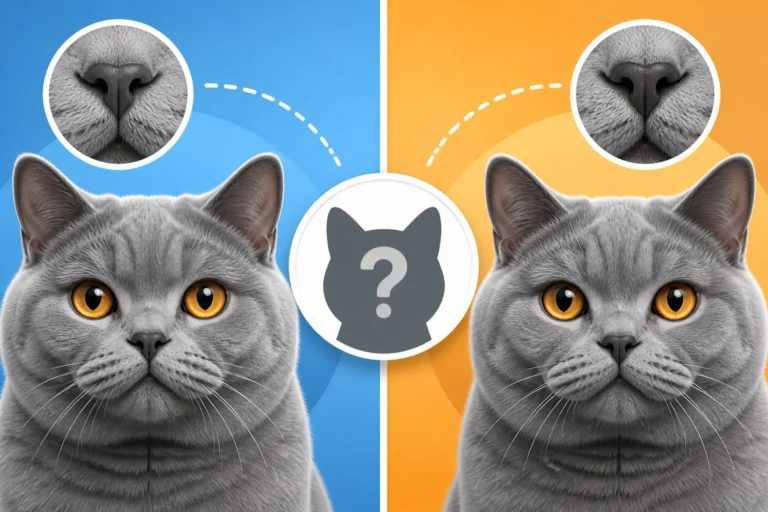
Breed identification is often harder than it looks online. A close-up of a gray face may hide the cat’s body shape, coat length, and overall proportions—the very clues that help distinguish one type from another. A kitten can be especially difficult to identify by looks because its adult head shape and coat are still developing.
A pedigree and reliable records from a breeder provide much stronger evidence of breed than color or a resemblance in a photograph. Without that documentation, it’s more accurate to describe a cat as a blue or gray domestic cat, or as having features that resemble a particular breed, rather than confidently assigning a breed.
This matters when adopting, too. A shelter cat may have a rounded face or dense coat that looks British Shorthair-like, but appearance alone does not establish ancestry. For a closer look at the distinction, see How to Tell a British Shorthair From a Moggy and Whether a Shelter Cat Can Be a British Shorthair.
The British Shorthair silhouette
A typical British Shorthair has a compact, sturdy build, a broad chest, and a round head. The coat is short and dense, often standing away from the body rather than lying flat. The overall impression is solid and rounded—not simply “a gray cat with a round face.”
The blue coat is only one part of the breed’s range. British Shorthairs come in many colors and patterns, and appearance can vary among individual cats. Which Colors a British Shorthair Comes In explains why the breed is much more varied than its famous blue image suggests.
Blue breeds commonly mistaken for a British Shorthair
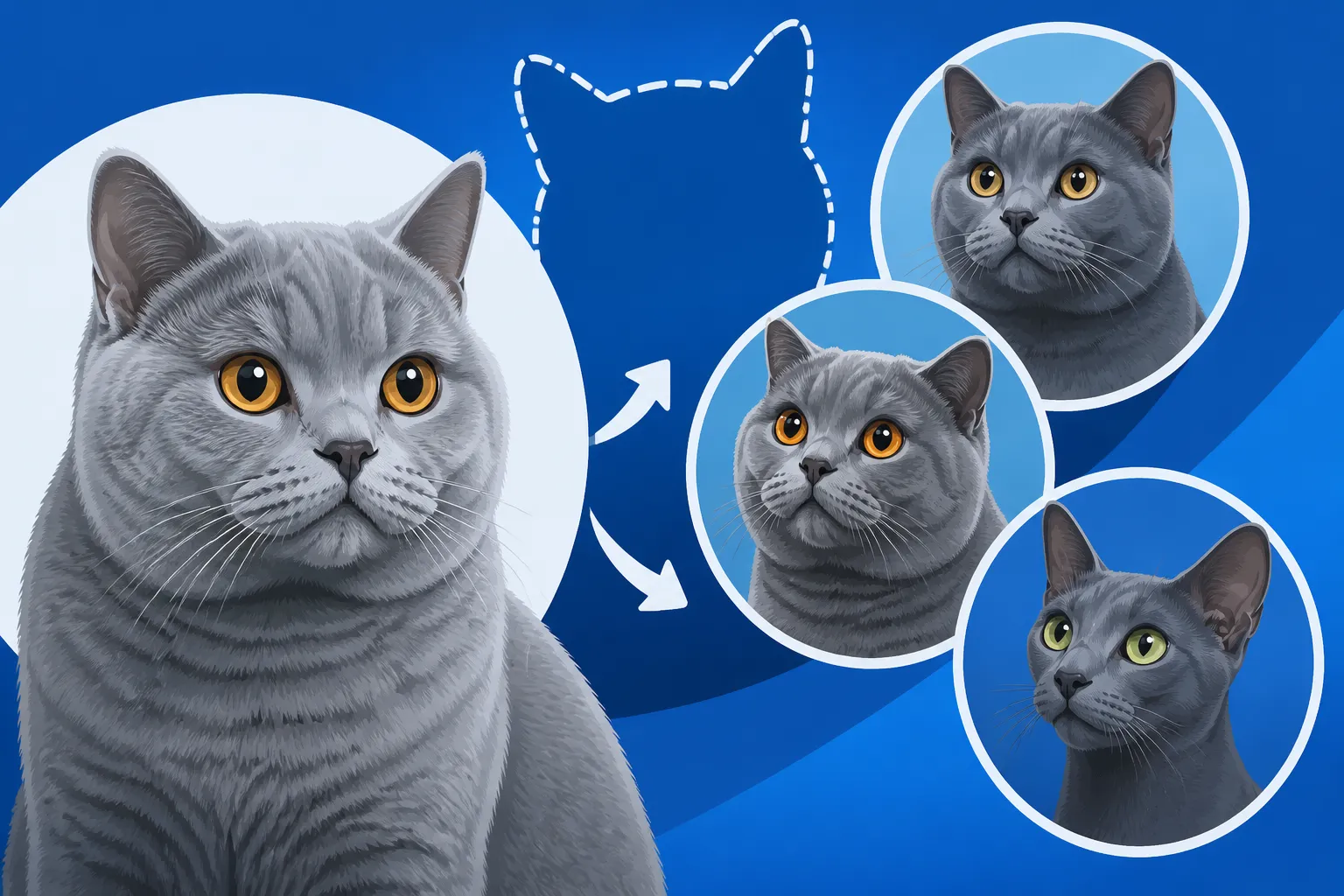
Some look-alikes share the British Shorthair’s blue coat but differ in outline, coat texture, or facial shape. It helps to assess the whole cat rather than fixating on one feature, such as copper-colored eyes or a plush-looking coat.
| Breed or cat type | Features that can cause confusion | Clues that may help distinguish it |
|---|---|---|
| Russian Blue | Blue-gray coat and bright eyes | More slender build, wedge-shaped head, and a short, fine double coat |
| Chartreux | Dense blue coat and sturdy body | Often a more tapered head and a woolly-feeling coat |
| Korat | Blue coat with silver sheen | Heart-shaped head, large eyes, and a more moderate, muscular outline |
| Nebelung | Blue coloring and greenish eyes | Longer coat, neck ruff, and a plumed tail |
| Blue domestic shorthair | Blue coloring and a wide range of faces | No single breed-specific outline or coat texture |
These are general tendencies, not a checklist that proves breed. Individual cats differ, and mixed ancestry can blur familiar features.
Russian Blue
The Russian Blue is one of the best-known blue-coated breeds, so it’s an easy cat to mistake for a blue British Shorthair in a quick snapshot. Both can have a solid blue-gray coat, and both may look elegant and plush under flattering lighting.
Look at the overall shape. Russian Blues are generally more fine-boned and slender, with a more angular or wedge-shaped face than the broad, rounded British Shorthair. Their short coat is often described as fine and dense, while the British Shorthair’s coat tends to look especially thick and stand-off from the body. Russian Blues are also commonly associated with vivid green eyes, though a photo may distort eye color.
The contrast is easier to see when the cats are standing side by side. If you want a fuller comparison of build, face, and coat, read How a British Shorthair Differs From a Russian Blue. A single feature—blue fur, in particular—won’t settle the question.
Chartreux
The Chartreux can resemble a British Shorthair because it often has a dense blue coat and a solid, muscular body. Both breeds can look substantial, and their coats may appear plush in photographs. This is one reason people sometimes use “blue cat” as if it referred to one specific breed.
A Chartreux may have a more tapered head shape and a coat with a woolly or crisp texture. Its body can look sturdy without having exactly the same rounded, cobby outline associated with a British Shorthair. Breed standards and individual cats vary, so these differences are best treated as clues rather than guarantees.
For a detailed comparison, see How a British Shorthair Differs From a Chartreux. If you’re making a practical decision—such as choosing a comb for a cat with a thick coat—focus on the individual cat’s coat and grooming needs rather than relying on a guessed breed label. A retailer such as Chewy may offer a range of grooming tools, but the right choice depends on the cat’s coat and comfort, not the name attached to it.
Korat
A Korat is another blue-coated breed that may be mistaken for a British Shorthair, especially in a photo that emphasizes its rounded eyes and silver-blue fur. Its coat can catch the light in a way that gives it a silvery sheen, making the color look similar to a British Blue.
The head shape can offer a useful clue. Korats are often described as having a heart-shaped face, with prominent eyes and a more moderate, muscular body. A British Shorthair, by comparison, typically gives a broader, rounder impression through the cheeks and head. Coat color can overlap; the outline may be more revealing.
Don’t use eye color as a final test. Lighting, age, and individual variation can affect how eyes appear in pictures, and a cropped image may not show the shape of the face clearly. Look for several features together, and treat any visual match as a resemblance rather than a pedigree confirmation.
Nebelung
The Nebelung is a blue-coated, longhaired breed, so it is less likely to be confused with a British Shorthair when the full body is visible. The mistake can happen in close-up images, where the coat’s length and the cat’s plumed tail are outside the frame.
A longer coat, a noticeable ruff around the neck, and a bushier tail are useful clues. The British Shorthair has a short coat, even though its dense fur can look very plush. If a cat’s coat falls away from the body in longer strands, that’s a meaningful difference from the classic British Shorthair look.
Some cats have longhair ancestry without being Nebelungs. A coat alone does not prove a specific breed, and a blue longhaired cat may simply be a domestic cat with that coloring. For British Shorthairs specifically, Whether a Longhaired British Shorthair Exists explores why coat length can raise questions about ancestry.
How to compare a blue cat with a British Shorthair
A useful comparison starts with the cat’s whole outline. Take a step back rather than zooming in on the face: note whether the body looks compact or slender, whether the head is broad or tapered, and whether the coat is short or long. Then consider those observations together instead of treating any one of them as decisive.
Check the head, body, coat, and eyes together
Start with the head shape. British Shorthairs are known for a broad, rounded head and full cheeks. A Russian Blue may look more wedge-shaped, while a Korat may have a more heart-shaped outline. These descriptions are broad tendencies, not rigid rules, and cats with mixed ancestry may not fit them neatly.
Next, look at the body and coat. A British Shorthair often appears sturdy and compact, with a dense, short coat. A slimmer build can point away from the classic British Shorthair outline, while a long coat can rule out the shorthaired look. Keep in mind that body condition affects shape: a cat may look larger or rounder because of weight, not because of breed.
Finally, treat eye color as one supporting detail. British Shorthairs are associated with copper or gold eyes in some color varieties, but eye color differs across the breed and can vary with age. A camera flash or warm indoor lighting can also change how eyes look in a picture. The blue coat and eye color together still don’t establish breed.
Use more than one photo
If you’re comparing a breeder’s listing, adoption post, or family photo, try to see the cat from several angles. A full-body side view can show proportions and coat length; a clear, natural-light face photo can make head shape easier to assess. A short video can also reveal how the coat sits and how the cat moves.
Beware of making a confident identification from a single close-up. A round face can look rounder from a low camera angle, and a thick coat can hide the outline of the body. If a description claims a cat is a specific breed, ask what documentation supports that claim rather than relying only on photographs.
It can also help to compare adult cats rather than kittens. Young cats often have proportions that change as they grow, and their final coat and head shape may not yet be obvious. If you’re considering a purchase, ask the breeder to explain the cat’s pedigree and show any relevant records. Whether a British Blue Is a Separate Breed From the British Shorthair clears up a common point of confusion in listings.
What a visual match can and cannot tell you
Recognizing likely breed traits can be fun and useful, but it has limits. A cat that looks like a British Shorthair may share some of the breed’s appearance without being a pedigreed British Shorthair. And a pedigreed cat may not perfectly match the image people have in mind, particularly when it is young or photographed from an unusual angle.
Don’t assume breed determines care
A breed guess should not replace attention to the individual cat. Coat condition, body shape, appetite, energy, and comfort are more useful for day-to-day care than a label based on appearance. If you’re buying supplies, choose them for the cat in front of you: a carrier should fit the cat’s size, and grooming tools should suit its coat. Chewy is one place owners may browse for pet supplies, but product choices are best guided by your cat’s actual needs.
The same goes for food. Don’t assume that a cat needs a particular diet just because it resembles a breed known for a certain body type. Ask a veterinarian about appropriate nutrition and portions, especially if you’re concerned about weight or a change in appetite. When comparing products at Chewy or another retailer, use your vet’s guidance and the food label rather than a guessed breed identity.
For more on the familiar blue appearance, Why the Blue Is the Best Known British Shorthair explains how this color became closely associated with the breed. But being the most recognizable color does not make it exclusive to British Shorthairs.
When the answer matters, ask for records
If breed identity affects a decision—such as choosing a kitten, understanding its background, or evaluating a breeder—ask for documentation. A responsible breeder should be willing to explain how the kitten’s ancestry is recorded and what health information is available. Visual resemblance is not a substitute for those records.
For an adopted cat, you may not be able to establish an exact breed, and that’s perfectly fine. It is still possible to appreciate the cat’s blue coat, rounded face, or sturdy build without assigning a label that cannot be confirmed. If your goal is simply to choose appropriate food, grooming supplies, or a carrier, the cat’s size, coat, health, and preferences matter more than a breed name. Chewy and other pet retailers can be useful places to compare everyday supplies, but they can’t verify a cat’s ancestry.
When you’re unsure, use careful language: “blue domestic shorthair,” “blue cat with British Shorthair-like features,” or “possibly mixed breed” is more honest than presenting a visual guess as fact. It leaves room for what you can actually observe while avoiding a promise that looks alone cannot support.
Disclaimer
This article is for general informational purposes only and does not constitute professional advice. Laws, prices and regulations vary by location and change over time. Consult a qualified professional for guidance on your specific situation.