Whether a British Shorthair’s Nose Should Have a Break
A British Shorthair’s nose should look short and broad, but not pushed flat into the face. The profile is usually expected to show a small, gentle change in direction rather than a deep, sharp stop. That distinction can be hard to judge in a fluffy, round-faced cat, so this guide explains what the nose profile means, how standards describe it, and when a nose concern is about health rather than appearance.
What a nose break means on a British Shorthair
The break is a small change in the profile
When people discuss a British Shorthair’s “nose break,” they mean the slight dip or change in contour where the forehead transitions toward the nose. Seen from the side, the nose should not look like a perfectly uninterrupted straight line, but it should not have a deep, abrupt indentation either.
The wording can be confusing because “break” sounds as though the nose should be sharply bent. That is not the usual idea. Think of a gentle transition: a modest dip that helps define the face, while the nose itself remains broad and relatively straight. The exact wording and emphasis can differ between cat registries, so a breeder or exhibitor should check the standard used by the registry they follow.
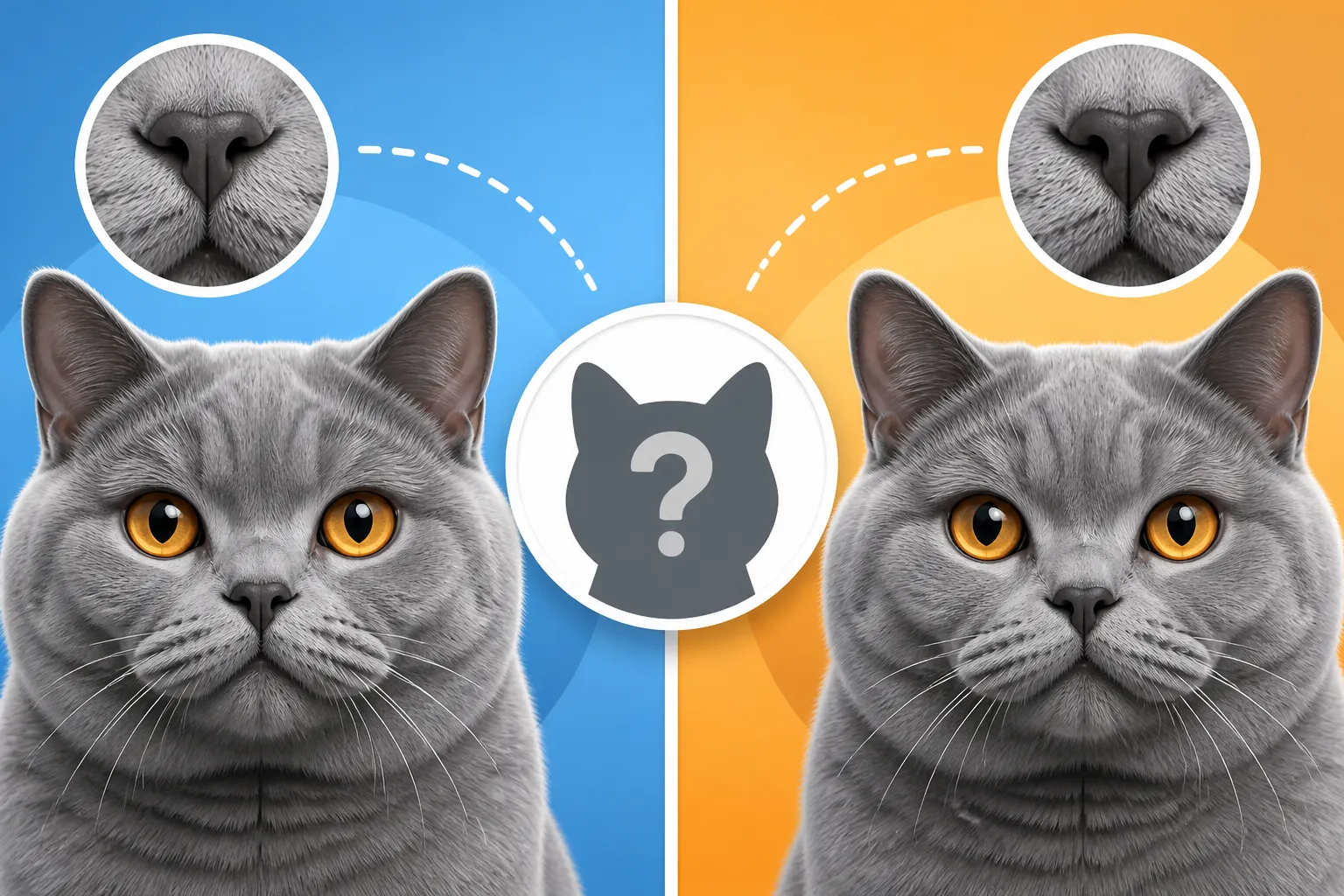
A side-on photo can help you see the profile, but it can also mislead. Fur, camera angle, facial expression, and the cat’s posture may make a gentle contour look flatter or more pronounced. If you are assessing a cat for showing or breeding, compare the profile in person with the relevant standard rather than relying on one photograph.
How the nose fits into the whole face
A British Shorthair’s nose is only one feature in a larger head shape. The breed is known for a rounded head, full cheeks, and a broad, balanced appearance. The nose should fit that structure rather than look excessively long, pinched, or pushed inward. A good overall impression is sturdy and rounded without becoming extreme.
That balance matters because a cat may have a noticeable nose profile but still have a head that looks quite different from the breed ideal. Conversely, a round face can make the nose appear shorter than it is. Judges assess the cat as a whole, not as a collection of isolated features. For a closer look at how the head and expression work together, see The Round Head and Copper Eye a British Shorthair Is Judged On and What Shape a British Shorthair's Head Should Be.
It is also useful to separate breed appearance from health. A particular dip or contour is a matter of conformation; noisy breathing, persistent discharge, or difficulty breathing are not desirable “breed traits.” Appearance should never be used to excuse symptoms that deserve veterinary attention.
A quick guide to common profile descriptions
| Description | What it generally means | What to keep in mind |
|---|---|---|
| Short and broad | The nose is not long or narrow in profile | Short does not mean flattened |
| Straight | The bridge remains fairly even rather than sharply curved | A gentle break may still be present |
| Slight break | A small dip marks the transition from forehead to nose | It should not look like a deep stop |
| Pronounced stop | A conspicuous indentation makes the face look flatter | This can be outside the intended British Shorthair look |
| Flat face | The nose appears pushed inward, often with a compressed profile | Ask whether the cat has breathing or other health concerns |
These descriptions are guides, not a substitute for the standard used by a particular registry. They are most helpful when you are trying to describe what you see clearly to a breeder, judge, or veterinarian.
What the British Shorthair nose should not look like
A British Shorthair is not meant to have an extreme flat face
The British Shorthair has a short, broad nose, but that does not mean it should have the very compressed facial profile associated with some extremely short-faced cats. A dramatic indentation between forehead and nose can give the face a noticeably flattened appearance. That is different from the modest break usually meant in descriptions of the British Shorthair profile.
It is easy to be drawn to an exaggeratedly round face in a photo, especially when the cat’s eyes and cheeks make it look especially teddy-bear-like. But a more extreme look is not automatically a better example of the breed. A useful question is whether the head looks balanced and whether the cat breathes and functions comfortably—not simply whether the face looks extra short.
If you are comparing breeds, remember that a short face is not the only feature that distinguishes them. The How a British Shorthair Differs From an Exotic Shorthair guide can help explain why two cats with plush coats and round faces may still have different breed types. The related article Whether a Short Faced British Shorthair Is Correct focuses more specifically on how a short profile fits the British Shorthair standard.
Don’t judge the nose from the front alone
A head-on view shows the width and general placement of the nose, but it does not tell you much about the break. To judge the profile, look at the cat from the side at a relaxed angle. The cat should be standing or sitting naturally, not lifting its chin or turning away from the camera.
Photos can make the same cat look different from one image to another. A close-up taken with a phone may distort proportions, and a very fluffy coat can visually soften the transition between forehead and nose. If you are considering a kitten, ask for clear side-profile photos and, where possible, a chance to see the kitten and its parents in person. You can learn more about recognizing breed features in How to Tell a British Shorthair From a Moggy.
A kitten’s face also changes as it grows. Its adult head shape and coat may take time to develop, so avoid treating a very young kitten’s profile as a final verdict on adult conformation. A responsible breeder should be able to explain what they see in the kitten without promising that its nose, head, or overall appearance will develop in one guaranteed way.
How to assess a British Shorthair’s nose fairly
Use the breed standard, not a social media trend
If you are buying a British Shorthair, showing one, or comparing cats for breeding, start with the written standard for the relevant registry. Standards may use slightly different language or place emphasis on features in different ways. A description repeated in online discussions may be an oversimplification, even if it sounds confident.
When reading a standard, focus on the relationship between the nose, forehead, muzzle, and overall head. Don’t isolate one word—such as “break”—and interpret it as a demand for a sharp angle. If the wording is unclear, ask an experienced breeder or judge to explain it while looking at the cat’s profile. The broader discussion in What People Get Wrong About the British Shorthair is useful when online claims make the breed sound more uniform or extreme than it really is.
If a breeder describes a kitten’s nose as “perfect,” ask what they mean and which standard they are using. A thoughtful answer should explain the cat’s qualities and limitations in context, rather than relying on a dramatic sales phrase. Good questions are especially important if you are trying to understand how a young cat may mature.
Consider comfort before cosmetic details
A nose’s outline does not diagnose a breathing problem. Watch how the cat breathes while resting and after ordinary activity. Persistent noisy breathing, open-mouth breathing, repeated sneezing, ongoing nasal discharge, or obvious effort with each breath should be discussed with a veterinarian. Sudden or severe breathing difficulty needs urgent veterinary care.
Also notice whether the cat can eat, groom, and sleep comfortably. A cat may have a naturally short muzzle without having obvious problems, while another cat with a less dramatic profile may still have an unrelated medical issue. Only a veterinary examination can assess an individual cat’s health; photographs and breed descriptions cannot do that.
If you are already arranging a veterinary visit, keep the cat calm and safely contained in a secure carrier. Some owners browse Chewy when looking for a carrier, but the important part is choosing one that is sturdy, appropriately sized, and easy to secure in the car. Chewy is also a place some owners use to compare basic cat-care supplies; whichever retailer you use, avoid putting products into or around the nostrils unless your veterinarian specifically recommends them.
Nose care and when to ask for help
Normal appearance versus a symptom
A healthy-looking nose can vary in shade and may feel cool or warm at different times of day. A dry nose by itself does not reliably show that a cat is ill. What matters more is a change from that cat’s normal appearance, especially when it comes with other symptoms.
Contact a veterinarian if you notice persistent discharge, crusting that keeps returning, swelling, bleeding, a sore that does not heal, or a sudden change in the shape of the nose. Discharge from one nostril, repeated sneezing, or signs that the cat is struggling to breathe also deserve attention. Avoid picking at crusts or applying human creams, essential oils, or medicated products without veterinary direction.
If there is a small amount of ordinary debris on the outside of the nose, ask your veterinary team whether gentle wiping with a soft, damp cloth is suitable for your cat. Chewy listings and other retail product pages can include many kinds of wipes and cleaners, but a product marketed for pets is not automatically safe for use on a cat’s nose. Check the intended use and ask your veterinarian before using anything beyond a plain damp cloth.
Make a useful record for your veterinarian or breeder
When a nose looks different from what you expect, take a clear side photo and a front-facing photo in good light. Note when you first noticed the change and whether it is constant or comes and goes. If there are symptoms, write down when they happen—for example, during sleep, after play, or around a particular household irritant. These details are more useful than repeatedly checking the nose without recording what changes.
For a conformation question, ask the breeder or a knowledgeable judge to view the cat from the side in a relaxed position. For a health concern, arrange a veterinary examination rather than relying on a breeder’s opinion or an online image comparison. These are different questions, and the right person to answer depends on whether you are asking about breed type or your cat’s wellbeing.
If you need to transport your cat for an examination, Chewy may be one of several places to compare carriers and related supplies. The carrier should be secure and comfortable, but it will not resolve a breathing problem or replace an appointment. Chewy is a shopping option—not a source of diagnosis—so let your veterinarian guide decisions about symptoms and treatment.
A British Shorthair’s nose is generally expected to be short and broad, with a subtle rather than dramatic break. Look at the profile as part of the whole head, check the relevant registry standard when conformation matters, and keep health concerns separate from cosmetic judgments. A distinctive nose shape may be part of the breed’s look; breathing difficulty or persistent nasal symptoms should not be dismissed as simply how the breed is made.
Disclaimer
This article is for general informational purposes only and does not constitute professional advice. Laws, prices and regulations vary by location and change over time. Consult a qualified professional for guidance on your specific situation.