Which Scratching Post a British Shorthair Uses
We've all been there: you invest in a beautiful scratching post, something that looks perfect for your beloved British Shorthair, only to find them completely ignoring it in favor of your sofa arm or that antique rug. It's incredibly frustrating, but often, the issue isn't your cat's stubbornness, it's that the post simply doesn't meet their unique needs. This guide will walk you through exactly what makes a scratching post a hit with a British Shorthair, ensuring your furniture stays intact and your furry friend gets the satisfying scratch they crave.
Understanding Your British Shorthair's Scratching Needs
Before we dive into specific types of scratching posts, it’s essential to understand why your British Shorthair scratches in the first place and how their distinctive physique influences this natural behavior. It’s not about being naughty; it’s instinct.
Why British Shorthairs Scratch
Scratching is a fundamental and utterly non-negotiable part of being a cat, British Shorthair or otherwise. They don't do it to spite you, even if it feels that way when they're eyeing your favorite armchair. Firstly, it's about claw maintenance. Cats need to shed the outer layers of their claws to reveal the sharp, new ones underneath. Think of it like a manicure and pedicure combined – essential for their well-being. Without a proper outlet, those old claw sheaths will build up and can become uncomfortable or even problematic for their paws.
Beyond nail care, scratching is a vital form of communication. When your British Shorthair scratches, they're not just leaving visible marks; they're also depositing scent from glands in their paws. This scent-marking is a way of claiming territory and signaling their presence to other cats, even if those "other cats" are just you and the dog. It's a reassuring ritual that tells them, "This is my home, and I feel safe here." Finally, a good scratch is an excellent stretch! Cats love to stretch out their entire bodies, from their toes to their shoulders, and a sturdy scratching surface allows them to get that satisfying full-body extension. When you combine all these factors, it becomes clear why finding the right scratching post is so important.
The British Shorthair's Physical Build and Its Impact on Scratching
British Shorthairs are magnificent, substantial cats. They are known for their "cobby" build, meaning they have a stocky, muscular body, broad chest, and powerful legs. This isn't a delicate, airy breed that will delicately perch on a flimsy, small post. No, your British Shorthair needs something equally substantial to truly get a good, satisfying scratch. Their claws, while not overly sharp when retracted, are quite thick and strong, designed for grip and pulling against resistance.
Consider a British Shorthair stretching out to scratch. They need to extend their entire body vertically, reaching as high as possible. If the post is too short, they can't achieve this full stretch, which defeats a significant purpose of scratching. Furthermore, their solid body means they put a lot of weight and force into their scratching. A wobbly or lightweight post is not just ineffective; it can actually be dangerous or at least off-putting. If the post tips over even once, your British Shorthair might decide it's not a reliable surface and go back to your sturdy furniture. Think about how much A British Shorthair Will Not Be Picked Up without a fight; they like to feel grounded and secure in their environment, and that extends to their scratching surfaces. The post needs to withstand their robust nature.
Types of Scratching Posts and Why They Matter for British Shorthairs
Not all scratching posts are created equal, especially when it comes to accommodating the unique preferences and physical needs of a British Shorthair. Choosing the right material, height, stability, and even orientation can make all the difference in whether your cat embraces their new scratching station or continues to eye your sofa suspiciously.
Material Matters: Sisal, Cardboard, and Carpet
When it comes to the actual scratching surface, you'll primarily find three main materials: sisal, cardboard, and carpet. Each has its pros and cons, and your British Shorthair will likely have a strong preference, so it's often best to offer a variety initially.
Sisal is arguably the gold standard for scratching posts. It's a natural fiber that's incredibly durable and provides excellent resistance, allowing your British Shorthair to really sink their claws in and get a satisfying shred. Sisal can come in a woven rope form or a flat fabric mat. For a British Shorthair, the flat sisal fabric often proves more resilient and offers a larger, more consistent scratching area than rope that can unravel over time. It mimics tree bark, which is a natural scratching surface for felines. The texture is rough enough to effectively remove those old claw sheaths and give them a good workout. Many British Shorthairs absolutely adore sisal, and it's usually the first material I recommend.
Cardboard scratchers are another popular option, often coming in various shapes and sizes, from flat pads to inclined wedges. They are fantastic for cats who love to really tear into their scratching surface, offering a unique sensation. They are also usually quite affordable, making them great for scattering around the house or for trying out different orientations without a huge investment. The downside is that they wear out much faster than sisal, becoming shredded and messy, requiring frequent replacement. However, their disposability means you can always have a fresh surface available, and many British Shorthairs find the corrugated texture irresistible.
Carpeted posts are a bit of a mixed bag. While some cats will use them, carpet is often too soft to provide the necessary resistance for effective claw shedding. More importantly, offering a carpeted post can inadvertently encourage your British Shorthair to scratch your carpet, which is probably exactly what you're trying to prevent! Unless the carpet is a very specific, rough weave that truly stands out from your home's flooring, it's generally best to avoid carpeted posts to prevent confusion and protect your own floors.
Height and Stability: Crucial for the British Shorthair
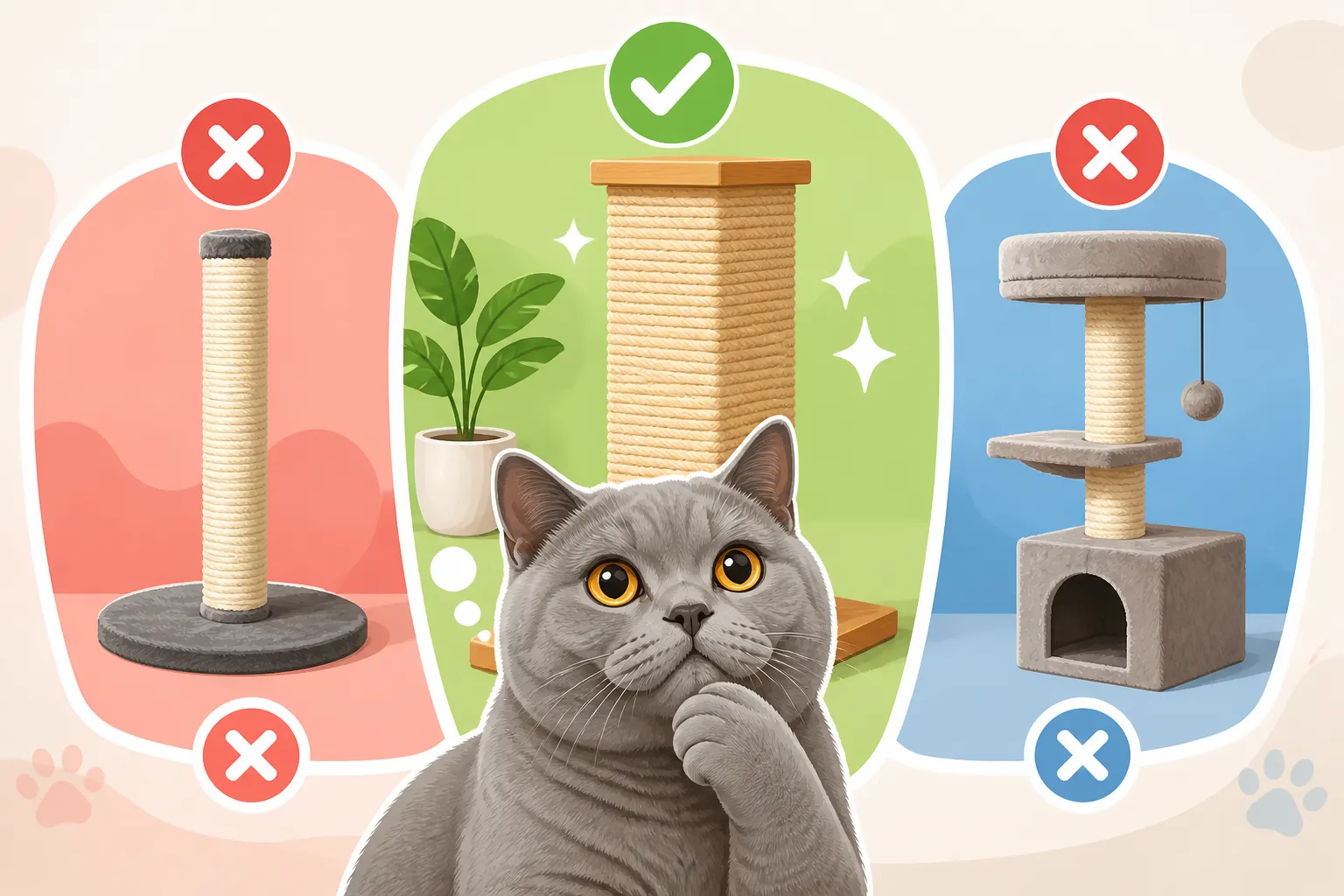
This is where many scratching posts fail the British Shorthair test. Given their substantial size and robust build, a British Shorthair absolutely must have a scratching post that is both tall enough for a full-body stretch and incredibly stable.
Imagine your British Shorthair, with their wonderfully What a British Shorthair Weighs and How Big It Gets, attempting to stretch up and scratch. They need to be able to extend their body to its full length, ideally with their front paws reaching the very top of the post while their hind paws remain firmly on the ground. This means a vertical post needs to be at least 30-36 inches (75-90 cm) tall, if not more for particularly large males who develop those impressive What Jowls Are on a Male British Shorthair. Anything shorter, and they won't get that satisfying full-body stretch, making the post less appealing.
Equally, if not more, important is stability. A wobbly post is a terrifying prospect for a large, heavy cat like a British Shorthair. If it teeters or, worse, topples over while they're using it, they'll quickly learn to distrust it. This leads them right back to your sturdy furniture, which, from their perspective, offers far more security. Look for posts with a wide, heavy base that prevents tipping, even when your cat is enthusiastically pulling and leaning against it. Some posts are designed to attach to a wall for extra security, which can be an excellent option if you have an especially powerful scratcher. Always prioritize a solid, unmoving structure; it's the foundation of a good scratching experience for your British Shorthair.
Orientation: Vertical, Horizontal, and Inclined
Cats have different preferences when it comes to the angle at which they scratch. Some love to stretch upwards, others prefer a flat surface, and some enjoy a gentle incline. For British Shorthairs, understanding these preferences can help you choose the ideal scratching solution.
Vertical scratching is often the most important for British Shorthairs. This allows them to get that full-body stretch, engage their back and shoulder muscles, and deposit scent at a visible height, mimicking how they would mark a tree in the wild. A tall, sturdy sisal post is the perfect example of a vertical scratcher. This orientation is crucial for maintaining flexibility and providing a complete physical workout. If your British Shorthair frequently scratches the arms of couches or doorframes, they're likely expressing a strong preference for a vertical scratching surface.
Horizontal scratchers, typically flat cardboard pads or sisal mats, appeal to cats who prefer to scratch while lying down or by pushing their claws along a flat surface. These are excellent for quick claw sharpening sessions and for cats who enjoy sprawling out. If your British Shorthair sometimes scratches your floor rugs or the carpet, a horizontal scratcher placed nearby might be just what they need. These can also be great for older British Shorthairs who might find it harder to stretch as high as they once did due to Arthritis in an Older British Shorthair or other mobility issues.
Inclined scratchers offer a compromise between vertical and horizontal. They are typically wedge-shaped cardboard or sisal surfaces that give a slightly different angle for scratching. Some British Shorthairs enjoy the varied sensation and the opportunity to lean into their scratch. These can be a good supplementary option, especially if you're not entirely sure of your cat's specific preference or if they seem to enjoy scratching at odd angles. Ultimately, offering a variety of orientations can help you discover what truly makes your British Shorthair happy.
Choosing the Best Scratching Post for Your British Shorthair
Now that we understand the 'why' and 'how' of British Shorthair scratching, let's talk about making the best choice for your particular cat. It's about matching their natural instincts and physical needs with the right product and then encouraging them to use it.
Features to Look For
When you're browsing for a scratching post, either online through retailers like Amazon or at your local pet store, keep these critical features in mind specifically for a British Shorthair.
First and foremost, durability is key. British Shorthairs are robust, and they will put a scratching post through its paces. Look for posts made with high-quality, tightly woven sisal fabric or dense, corrugated cardboard. Avoid anything that looks like it will unravel or fall apart quickly, as a worn-out post is just as unappealing to a cat as an unstable one. A post that needs replacing frequently can also become surprisingly expensive over time.
Next, size and stability are non-negotiable. As discussed, a vertical post should be tall enough for your British Shorthair to stretch fully, ideally 30-36 inches or more. The base should be wide and heavy – think a solid, weighted platform that resists tipping. Some larger cat trees incorporate scratching areas, and these can be excellent, provided they are sturdy enough for a British Shorthair to climb and scratch without wobbling. You don't want your substantial cat to fear their scratching spot. A good way to gauge this is to try to wobble it yourself. If it barely budges when you push it, it's likely a winner.
Finally, consider replacement parts or multi-functionality. Some scratching posts, especially the cardboard ones, are designed to be entirely replaceable. For sisal posts, check if the scratching surface can be replaced or re-wrapped when it eventually wears out, rather than having to buy a whole new unit. If you're looking at a cat tree, ensure the scratching sections are strategically placed and robust. For example, a Which Cat Tree a British Shorthair Uses might have scratching surfaces integrated, offering vertical options alongside climbing.
Placement and Encouragement
Even the best scratching post won't do much good if it's hidden away in a corner or not presented correctly. Strategic placement and positive reinforcement are vital for getting your British Shorthair to adopt their new scratching station.
Think like your cat: where do they currently scratch? Place the new, appropriate scratching post directly in those problem areas, or very close by. If your British Shorthair is currently tearing up the corner of your sofa, put a sturdy sisal post right next to that corner. This makes it a convenient and obvious alternative. British Shorthairs are creatures of habit, and offering a desirable alternative where they already feel the urge to scratch is far more effective than trying to redirect them across the room. Consider placing scratchers in high-traffic areas, like near their favorite napping spots or by a window where they like to observe the world. These are places where they feel comfortable and might want to stretch or mark their territory.
Encouragement is also key. When your British Shorthair investigates the new post, offer praise and maybe even a small treat. You can sprinkle catnip on the post to make it more appealing or dangle a favorite wand toy around it to encourage playful interaction. Gently take their paws and guide them through a scratching motion if they are amenable, but never force them if they resist, as this can create a negative association. The goal is to make the scratching post an irresistible, rewarding experience. If you notice your cat starting to scratch Why a British Shorthair Scratches Furniture, gently redirect them to their post with a positive tone and reward them when they engage with it. Consistency is the most important tool in your kit here.
Common Scratching Post Mistakes to Avoid
Even with the best intentions, it's easy to make mistakes when choosing and introducing a scratching post. Knowing what pitfalls to sidestep can save you frustration, money, and potentially your furniture.
Too Small or Flimsy Posts
This is perhaps the most common and easily avoidable mistake when it comes to British Shorthairs. As we've extensively discussed, your British Shorthair is a substantial cat. They require a scratching surface that can accommodate their full body length for a proper stretch and withstand their considerable weight and power.
A post that is too short prevents that satisfying, full-body extension, making it less appealing than a taller, sturdier piece of furniture. A flimsy post, one that wobbles, tips, or feels unstable, will be immediately rejected. Imagine trying to get a good stretch or a solid grip on something that threatens to fall over every time you use it – it's unsettling and ineffective. British Shorthairs, with their calm and collected demeanor, still value security. A wobbly post undermines that security and sends them running back to the stability of your couch or carpet. Investing in quality from the start will save you from multiple ineffective purchases and continued furniture damage. For example, a post designed for a smaller, lighter cat simply won't cut it for the hefty build of your British Shorthair.
Forcing a Preference
It's tempting to buy one type of scratching post that you think your cat should like, but forcing a preference is often a recipe for failure. Cats are individuals, and while there are general guidelines for British Shorthairs, your particular cat might have unique quirks.
If your British Shorthair isn't using the sisal post you bought, don't give up and assume they just don't like scratching posts. Instead, consider offering alternatives. Perhaps they prefer the shredding sensation of cardboard, or they might prefer a horizontal scratcher over a vertical one. Offer different materials, different orientations, and place them in various locations. This might mean having a tall sisal post near a window, a cardboard wedge by their favorite sleeping spot, and a flat sisal mat in another frequented area.
The key is to observe your cat's natural scratching behavior. Where do they scratch now? What kind of surface do they seem to gravitate towards (even if it's your rug)? Use these clues to inform your choices. Patience is also paramount. It might take time for your British Shorthair to discover and adopt a new scratching post, especially if they've developed strong habits with your furniture. Don't remove the "unloved" posts immediately; give them time. Some British Shorthairs can be a little slow to embrace new things, and it might just take a while for them to warm up.
Ignoring Maintenance
Just like any other pet accessory, scratching posts need attention and eventual replacement. Ignoring maintenance is another common reason why cats abandon their designated scratching areas.
A scratching post that is completely shredded, with sisal ropes unraveling or cardboard bits littering the floor, becomes less effective and less appealing over time. The loose fibers don't provide the same resistance for claw maintenance, and the messy appearance can be off-putting. For sisal posts, when the material is visibly worn down to the core or completely shredded in places, it's time to either re-wrap it (if possible) or replace the post entirely. For cardboard scratchers, replace them once they are heavily used and no longer provide a good scratching surface.
Beyond physical wear, a scratching post can accumulate your cat's scent, but also dust and grime. While scent marking is good, a genuinely dirty post might be less inviting. Give it a wipe down occasionally, and vacuum around it to keep the area tidy. If your British Shorthair seems to be losing interest in a post, even a relatively new one, try refreshing it with a sprinkle of fresh catnip or moving it to a slightly different, more prominent location. Keeping the scratching area clean, well-maintained, and effective will ensure your British Shorthair continues to see it as their go-to spot for a satisfying scratch, ensuring their continued use and your furniture's safety. After all, a British Shorthair will prefer a well-kept routine, whether it's around their food bowls or their scratching posts.
Essential Scratching Post Features for Your British Shorthair
To help you make an informed decision, here's a quick overview of different scratching post types and their suitability for your British Shorthair.
| Feature / Type | Vertical Post (Sisal) | Horizontal Mat (Cardboard/Sisal) | Inclined Scratcher (Cardboard/Sisal) |
|---|---|---|---|
| Height | Must be 30-36+ inches for full stretch | Flat on the floor | Varies, but usually 10-15 inches at highest point |
| Stability | CRUCIAL: Heavy, wide base; wall-mount if possible | Generally stable due to floor placement | Needs a solid, non-slip base to prevent shifting |
| Material | Tightly woven sisal fabric or thick rope preferred | Corrugated cardboard (disposable) or dense sisal mat | Corrugated cardboard or sisal fabric |
| Durability | High, especially with sisal fabric; invest in quality | Moderate (cardboard) to High (sisal); needs replacement | Moderate (cardboard) to High (sisal); needs replacement |
| Primary Use | Full-body stretch, territory marking, claw maintenance | Quick claw sharpening, sprawling scratch, floor-scratch redirect | Varied scratch angle, good for leaners, floor-scratch redirect |
| BSH Suitability | Excellent and essential for their physique | Very good supplementary option, especially for floor scratchers | Good supplementary option, adds variety and different angles |
| Recommendation | Your primary scratching solution; have at least one | Have several scattered around, especially by floor-scratch spots | Consider if your BSH shows interest in angled surfaces |
Remember that a British Shorthair often takes How Long a British Shorthair Takes to Fill Out, meaning they'll grow into a truly substantial cat. Ensure any scratching solutions you choose can accommodate their future size and weight. A happy, well-exercised British Shorthair, even one that prefers to sit A British Shorthair Sits Near You, Not On You, is one that has appropriate outlets for all its natural instincts.
Disclaimer
This article is for general informational purposes only and does not constitute professional advice. Laws, prices and regulations vary by location and change over time. Consult a qualified professional for guidance on your specific situation.