Which Outcrosses Saved the British Shorthair
A British Shorthair’s round face and dense coat can make the breed seem unchanged across generations, but its survival depended on careful rebuilding. After the disruption of the Second World War, the remaining breeding population was too small to restore the cat reliably on its own. This guide explains which breeds were used as outcrosses, what they contributed, and why the story is more complicated than a simple list.
Why the British Shorthair needed outcrosses
The breeding population was badly reduced
British Shorthairs developed from domestic cats in Britain, including cats valued for practical work around farms and homes. Over time, breeders selected for a sturdy body, a dense coat and a rounded head. But war brought food shortages, upheaval and interruptions to organised breeding. The number of cats available for planned matings fell sharply, leaving breeders with fewer options for preserving the type they had built.
A small breeding population creates a difficult trade-off. Breeding only from the cats that remain can preserve familiar features in the short term, but it also narrows the gene pool and increases the chance of relatives being paired. Outcrossing—mating a cat with one from another breed or population—can introduce variation and help breeders continue a line when suitable unrelated cats are scarce.
That did not mean breeders could simply cross any two cats and expect a British Shorthair. They still had to select offspring over generations, retaining cats that matched the developing breed’s look and temperament. The broader history of that rebuilding is explored in Why British Shorthair Numbers Collapsed in the Wars and Which Breeds Rebuilt the British Shorthair.
Outcrossing was a tool, not a shortcut
An outcross can contribute useful traits, but it can also make a breeding programme less predictable. A kitten from an outcross may inherit a coat, body shape or head that differs from the established British Shorthair type. Breeders then have to decide which offspring should continue in the programme and which are better suited to other homes or breeding plans.
This is one reason breed histories can sound inconsistent. A source may name a breed used by some breeders, while another emphasises the main outcross or describes a different period of the recovery. Records and breeding practices were not necessarily identical across countries, organisations or catteries. It is more accurate to think of reconstruction as a process than as a single planned cross.
It is also helpful to separate historical outcrossing from modern breed identity. A British Shorthair’s ancestry may include cats from other breeds without making today’s British Shorthair a crossbreed in the everyday sense. Breed populations are shaped by selection over time, and the recognised breed is defined by its established standards and breeding practices, not by one ancestor alone.
The outcrosses most often associated with rebuilding
The Persian was the major influence
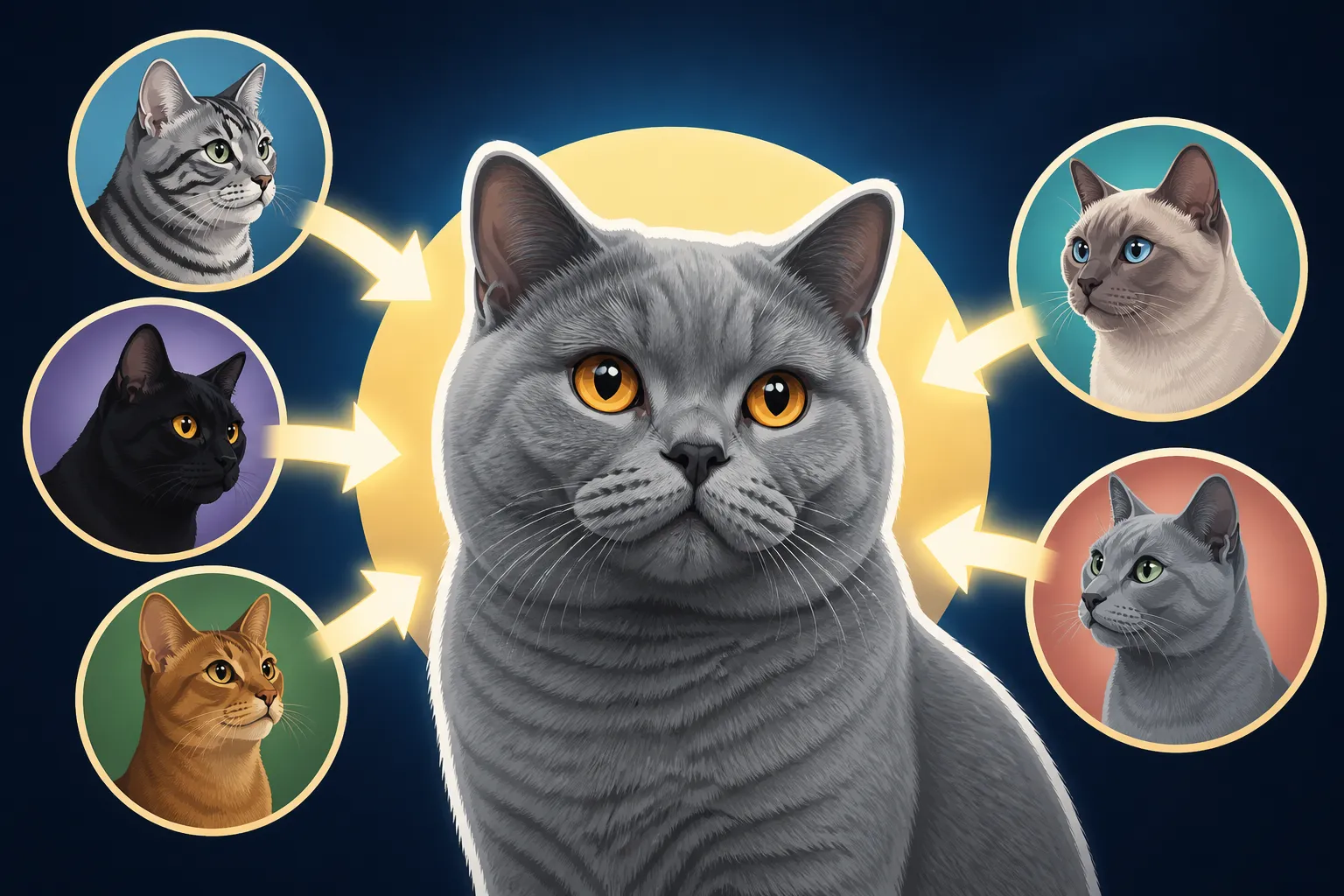
The Persian is the outcross most consistently associated with rebuilding the British Shorthair after the war. Breeders used Persians to help restore numbers and strengthen features that suited the desired rounded, substantial appearance. Persian ancestry also influenced the development of the British Shorthair’s head and coat, although those features were shaped by continued selection rather than appearing automatically in every crossbred kitten.
The Persian’s contribution came with trade-offs. A cross could bring qualities breeders wanted, but it could also introduce traits that did not fit the British Shorthair standard or breeding goals. The work therefore involved choosing which descendants to keep and mating them thoughtfully over succeeding generations. It was not a matter of adding Persian blood once and immediately producing the modern breed.
The influence is especially important when discussing the British Shorthair’s appearance, but it should not be reduced to “the Persian made the British Shorthair.” The British Shorthair had its own history before the reconstruction, and breeders were working to preserve and rebuild that identity. For more on the specific legacy, see What the Persian Cross Gave the British Shorthair and Whether the Persian Cross Brought PKD Into the British Shorthair.
Russian Blue and Chartreux are also cited
Russian Blues and Chartreux are also named in some accounts of post-war rebuilding. They are often discussed as additional sources of cats or traits during periods when breeders were trying to maintain or restore numbers. However, they should not be presented as having played the same role, to the same extent, in every breeding programme. The Persian is generally the clearest and most widely noted influence in accounts of the British Shorthair’s recovery.
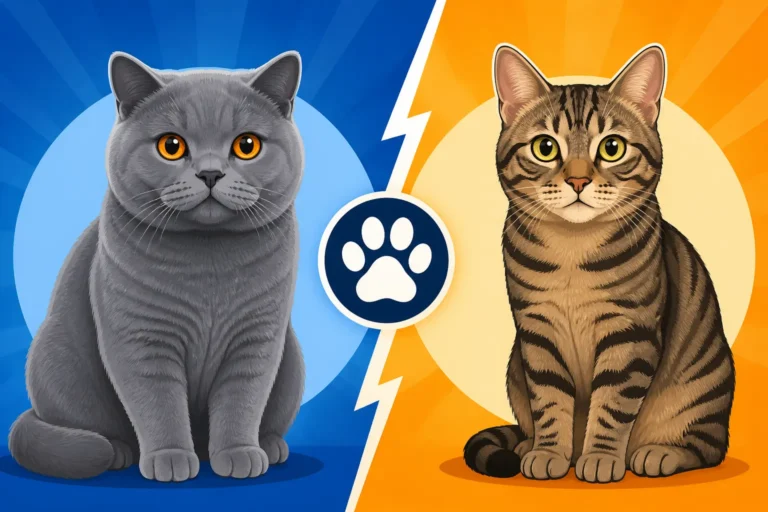
The Chartreux is a particularly easy source of confusion because it is itself a blue, sturdy-looking shorthaired cat. Similarities in colour or general build can encourage people to assume that the two breeds are interchangeable or have a simple shared origin. They are distinct breeds, and a blue coat alone cannot tell you whether a cat is a British Shorthair, a Chartreux or a mixed-breed cat.
Russian Blues are likewise a distinct breed, with their own characteristic features. Their appearance differs from the British Shorthair’s rounded, cobby build, even though individual cats may share a blue-grey coat colour. If you are comparing the breeds, How a British Shorthair Differs From a Russian Blue and How a British Shorthair Differs From a Chartreux offer useful points of distinction.
| Breed named in historical accounts | How it is usually described in the rebuilding story | Important qualification |
|---|---|---|
| Persian | The most consistently cited major outcross; helped breeders restore numbers and shape selected features | Its influence was refined through later selection and was not a one-generation transformation |
| Russian Blue | Mentioned in some accounts as part of broader efforts to rebuild or support breeding populations | Its role is not described consistently as equal to the Persian’s |
| Chartreux | Also cited in some accounts, particularly in discussions of blue, sturdy shorthaired cats | It is a separate breed, not another name for the British Shorthair |
| Other cats and populations | Some histories refer more broadly to domestic or available cats used during recovery | Details can vary by breeder, location and period |
What the outcrosses contributed to the breed
A rounder head and a denser, plush-looking coat
The Persian cross is often connected with changes to the British Shorthair’s head and coat. The modern breed is known for a rounded head, full cheeks, a compact, substantial body and a thick coat that stands away from the body. These traits are not simply a direct inheritance from one outcross; they reflect choices made by breeders over time, selecting cats that best fitted the breed they were trying to preserve.
That distinction matters when looking at an individual cat. A British Shorthair kitten does not come with a guaranteed adult head shape, coat texture or overall size just because a certain breed appears in its deeper ancestry. Traits depend on the particular parents and family line, and the breed’s appearance develops as the cat matures. The Persian Cross Gave the British Shorthair's Head and The Persian Cross Gave the British Shorthair's Coat examine those features in more detail.
A plush-looking coat also needs routine care, but history does not prescribe a special grooming method. For a present-day owner comparing basic coat-care supplies, Chewy is one retailer they may browse alongside local pet shops and veterinary recommendations. A comb suited to a dense coat is more relevant to day-to-day care than assumptions based on an ancestor’s breed. Chewy may also be a place to compare grooming tools, but the best choice depends on the individual cat’s coat and tolerance for grooming.
The recognisable blue is not proof of a particular ancestry
The blue British Shorthair became the best-known version of the breed, but a blue-grey coat does not establish that a cat is a British Shorthair or prove that it descends from a Russian Blue or Chartreux. Coat colour is only one visible feature. Body shape, head, coat texture, pedigree and the standards used by a registry all matter when identifying a registered breed.
The British Shorthair also comes in many colours and patterns beyond blue. The familiar blue cat is prominent in popular images, which can make the breed seem more limited than it is. A cat with a blue coat could belong to another breed or be a mixed-breed cat, while a British Shorthair can have a colour or pattern that is less familiar to the casual observer. Why the Blue Is the Best Known British Shorthair and Which Colors a British Shorthair Comes In explain how colour fits into the breed’s identity.
Outcross history is not a reliable way to identify an individual cat from a photograph. If someone is considering a kitten and wants to understand its background, asking about pedigree documentation and the breeder’s selection goals is more useful than guessing from coat colour. A retailer such as Chewy can help an owner browse everyday food and care supplies, but it cannot establish a cat’s breed ancestry; that comes from appropriate records and, where relevant, expert assessment.
How to understand the history as a modern owner
Why accounts of the outcrosses differ
Historical breed summaries often compress decades of work into a sentence. One may say that breeders turned to Persians; another may list Persians alongside Russian Blues and Chartreux. Those accounts are not necessarily describing the same breeders, place or phase of recovery. Nor does a list alone tell you how frequently a breed was used or how much it influenced the final population.
For that reason, avoid treating every named outcross as equally important or assuming there was one universal plan. The strongest, most consistent point is that the British Shorthair’s breeding population needed support after wartime disruption, and the Persian was a major part of the recovery. Other breeds appear in some accounts, but the details are less uniform.
If you are reading about the breed’s origins, it can help to distinguish three things: the cats present in the original population, the outcrosses used during rebuilding, and the cats later selected to represent the established breed. These are related parts of the story, but they are not interchangeable. The British Shorthair Started as a British Street Cat covers the earlier foundation, while Whether the British Shorthair Is Genetically Diverse Now addresses a different question about the breed’s population.
What the history does and does not tell you about a cat
The outcrosses help explain how the breed survived and how some of its familiar traits became prominent. They do not tell an owner what a particular cat will be like, whether it will have a specific health condition, or exactly how much it will weigh as an adult. Those questions depend on individual health, development, family background and care.
Nor does a historical outcross automatically mean a modern British Shorthair is unhealthy or “not pure.” Breed populations have histories, and the relevant question for a prospective owner is whether a breeder or rescue can explain the cat’s background honestly and provide the records they have. If a breeder makes broad claims about ancestry or health, ask what documentation supports them rather than relying on a story about a famous outcross.
For ordinary care, focus on the cat in front of you: its body condition, coat, eating habits and behaviour. Chewy is one option some owners use when browsing food or basic care items, but product choice should follow the cat’s needs and veterinary advice rather than assumptions about Persian, Russian Blue or Chartreux ancestry. The history is fascinating; it is not a substitute for a health record or a practical care plan.
Disclaimer
This article is for general informational purposes only and does not constitute professional advice. Laws, prices and regulations vary by location and change over time. Consult a qualified professional for guidance on your specific situation.