What the Persian Gave a British Shorthair’s Coat
The Persian influence on the British Shorthair is easy to oversimplify: people often assume the breed simply inherited a Persian’s coat. The real story is more interesting. Persian cats helped rebuild British Shorthairs after the breed’s numbers fell, contributing to the rounded, substantial look breeders prized, while also introducing a longhair gene that can still appear in shorthaired lines.
Why Persian cats were crossed with British Shorthairs
A breed in need of rebuilding
British Shorthairs developed over generations from cats in Britain, and their short, practical coats suited life in a cool, changeable climate. But the breed did not remain untouched by history. Cat numbers and breeding programs were badly disrupted by the two world wars, leaving breeders with fewer cats to work with and making it difficult to preserve a healthy, consistent population.
To restore the breed, breeders used suitable cats from other lines, including Persians. This was not simply an attempt to create a new coat type. The aim was to rebuild a recognizable British cat while restoring traits that had become harder to maintain. Persian cats offered features breeders valued, and the crossbreeding influenced the British Shorthair’s appearance and gene pool.
For a fuller account of that recovery, see The Persians That Rebuilt the British Shorthair After the War. The important context is that the British Shorthair was not designed from scratch by crossing it with Persians. It was an established breed whose numbers had suffered, and Persian cats formed part of a broader effort to rebuild it.
What breeders valued in the Persian
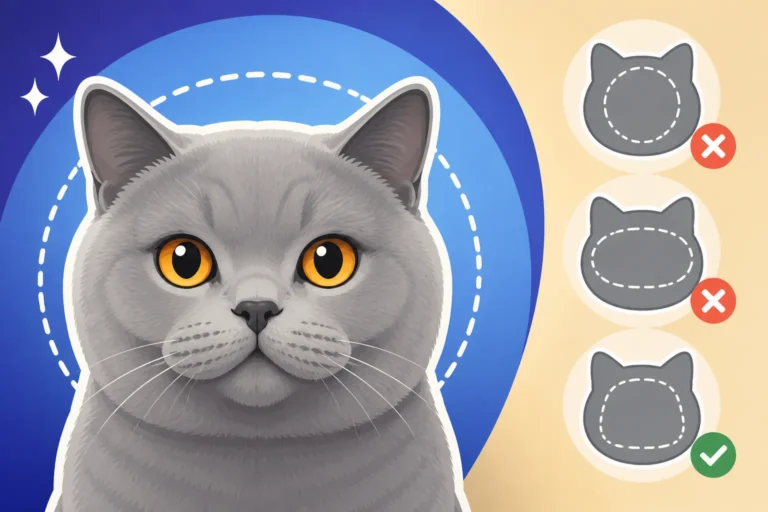
Persians are associated with a long, flowing coat, but their contribution to the British Shorthair involved more than hair length. Persian ancestry helped shape the breed’s rounder, fuller look, including a substantial body and a broad, rounded head. Breeders then continued selecting British Shorthairs for the distinctive appearance we recognize today.
The coat influence needs a little care in how it is described. Persian cats may have contributed genetic variation affecting coat traits, and the longhair gene is an important part of the history. But it would be misleading to say that every feature of a modern British Shorthair’s coat came directly from a Persian. Coat length, density, texture, and the way hair stands away from the body are influenced by genetics and generations of selective breeding.
The result is a coat that looks plush without being long. A well-kept British Shorthair’s fur is short, dense, and springy, giving the cat a rounded outline. The breed’s signature coat is not a miniature Persian coat; it is a distinct short coat shaped by its own history and breeding standard. For a closer look at its texture, read Why a British Shorthair's Coat Feels Crisp.
What Persian ancestry did and did not change
The British Shorthair’s dense short coat
A British Shorthair coat is often described as plush because the fur is dense and stands away from the body. That appearance can make the cat feel more like a soft cushion than a sleek, close-coated shorthair. The coat’s fullness is part of the breed’s characteristic look, but density and length are different things. A short coat can be remarkably thick.
The undercoat plays a role in that full appearance. Its presence helps create the breed’s dense feel, while the outer hairs contribute to the coat’s surface and shape. The precise balance varies among individual cats. Learning Whether a British Shorthair Has an Undercoat and How Dense a British Shorthair's Coat Is can help explain why these cats may shed more than their tidy appearance suggests.
Persian ancestry is part of the story, but it does not mean a British Shorthair should have long, trailing hair. A coat that is unusually long or prone to tangling may point to a different coat type, including a British Longhair, or to an individual variation. The British Shorthair’s accepted look remains shorthaired and dense.
The longhair gene that can stay hidden
The clearest long-term coat connection between Persians and British Shorthairs is the recessive longhair gene. A cat can carry a copy of this gene without having a long coat. When two carrier cats are bred, a kitten may inherit a longhair copy from each parent and develop a long coat.
That is why two shorthaired British Shorthairs can sometimes have a longhaired kitten. The parents may look entirely typical and still carry the gene. The longhaired kitten is not necessarily a surprise because something has gone wrong; it can be an expected genetic possibility in a pairing where both parents carry the relevant variant. See Why Longhair Gene Hides in a British Shorthair Litter for more on how this can happen.
A longhaired kitten from British Shorthair lines may be described as a British Longhair, depending on the registry and the cat’s pedigree. It is not simply a British Shorthair whose coat has grown unusually fluffy. The distinction relates to coat type and breed recognition. How a British Longhair Comes Out of a British Shorthair Litter explains the connection, while How the British Longhair Split From the British Shorthair explores how the two types came to be treated separately.
| Coat feature | British Shorthair | Persian |
|---|---|---|
| Typical coat length | Short | Long |
| Overall coat impression | Dense, plush, and springy | Long, flowing, and full |
| Grooming focus | Regular combing to remove loose hair | Frequent care to prevent tangles and mats |
| Longhair gene relevance | May carry the recessive gene | Part of the broader history of longhair genetics |
| What the shared history does not mean | It is not a short-coated Persian | It is not simply a long-coated British Shorthair |
How the coat legacy shows up in everyday care
Shedding and grooming needs
The British Shorthair’s short fur can create a misleading first impression. Owners may expect little shedding because the hair is not long, then find a surprising amount of loose fur on a sofa, dark clothes, or the cat’s favorite sleeping spot. Dense coats hold plenty of loose hair, especially during seasonal changes, and regular combing can help collect it before it spreads through the home.
A metal comb with appropriately spaced teeth is often more useful than aggressive brushing. Work gently through the coat, paying attention to areas where loose hair gathers, and stop if the cat becomes uncomfortable. A short, calm session is more likely to become part of the routine than an attempt to remove every loose hair at once. If you are comparing basic combs through retailers such as Chewy, focus on the tool’s gentleness and suitability for a dense short coat rather than a dramatic shedding claim.
The coat’s Persian-associated history does not mean it needs Persian-style maintenance. Most British Shorthairs do not require daily detangling or routine professional styling. Still, the coat benefits from regular attention, and a change in grooming tolerance, new mats, or excessive shedding can deserve a closer look. Owners comparing care advice can use resources such as How Often a British Shorthair Needs Combing and How a British Shorthair's Coat Differs From a Plush Coat.
Choosing tools without damaging the coat
Because the British Shorthair coat is both dense and short, a tool designed to strip or aggressively thin fur may be a poor fit. Forceful brushing can irritate skin or damage the coat’s outer hairs. Gentle combing helps lift loose fur while letting the coat keep its natural texture. The goal is not to flatten the coat until it looks sleek; that plush outline is part of the breed’s characteristic appearance.
If shopping at a general pet retailer such as Chewy, compare combs by their tooth spacing, finish, and how comfortable they seem for a cat’s skin. Avoid assuming that the most intense deshedding tool is automatically the best choice. A British Shorthair’s coat may be thick, but using more force does not necessarily remove loose undercoat more safely.
For a cat that resists grooming, try a few strokes when it is relaxed, then pause and offer a reward or a favorite activity. A cat that is new to combing may accept the routine more readily when it lasts only a minute or two. Chewy may be one place owners browse for basic grooming supplies, but the useful part is choosing a tool that suits the coat and introducing it patiently rather than chasing a particular product label.
What to remember about the Persian contribution
A historical influence, not the whole explanation
Persian cats helped British Shorthair breeders restore and shape the breed after the disruption of war. Their influence is visible in aspects of the breed’s rounded, substantial appearance, and Persian ancestry is relevant to the longhair gene found in some British Shorthair lines.
But the modern British Shorthair coat is not a direct copy of a Persian coat. It is short, dense, and springy, and its features reflect a mix of inherited variation and selective breeding over time. Coat length is only one piece of the history; texture, density, body shape, and breed standards all matter too.
That distinction is useful when looking at a kitten or choosing a breeder. A fluffy kitten is not automatically proof of a health problem or a mixed ancestry, but it may indicate a longhair coat type and should be discussed in the context of the kitten’s pedigree and the breeder’s plans. Likewise, a dense short coat is not evidence that the cat has no Persian ancestry.
A simple way to think about the legacy
Think of Persian influence as one chapter in the British Shorthair’s development, not as the entire origin story. Persian cats contributed to rebuilding the breed and are part of the background behind the longhair gene. British breeders then maintained and refined the shorthaired type, producing the compact, round cat with a thick coat that people recognize today.
So when someone calls a British Shorthair “Persian-like,” it is worth asking what they mean. The cat may share a rounded silhouette or a plush impression, but its coat is still a different type. That difference is covered in How a British Shorthair's Coat Differs From a Plush Coat. The Persian connection explains some of the breed’s history; it does not erase the British Shorthair’s own identity.
Disclaimer
This article is for general informational purposes only and does not constitute professional advice. Laws, prices and regulations vary by location and change over time. Consult a qualified professional for guidance on your specific situation.