What the Persian Gave a British Shorthair’s Head
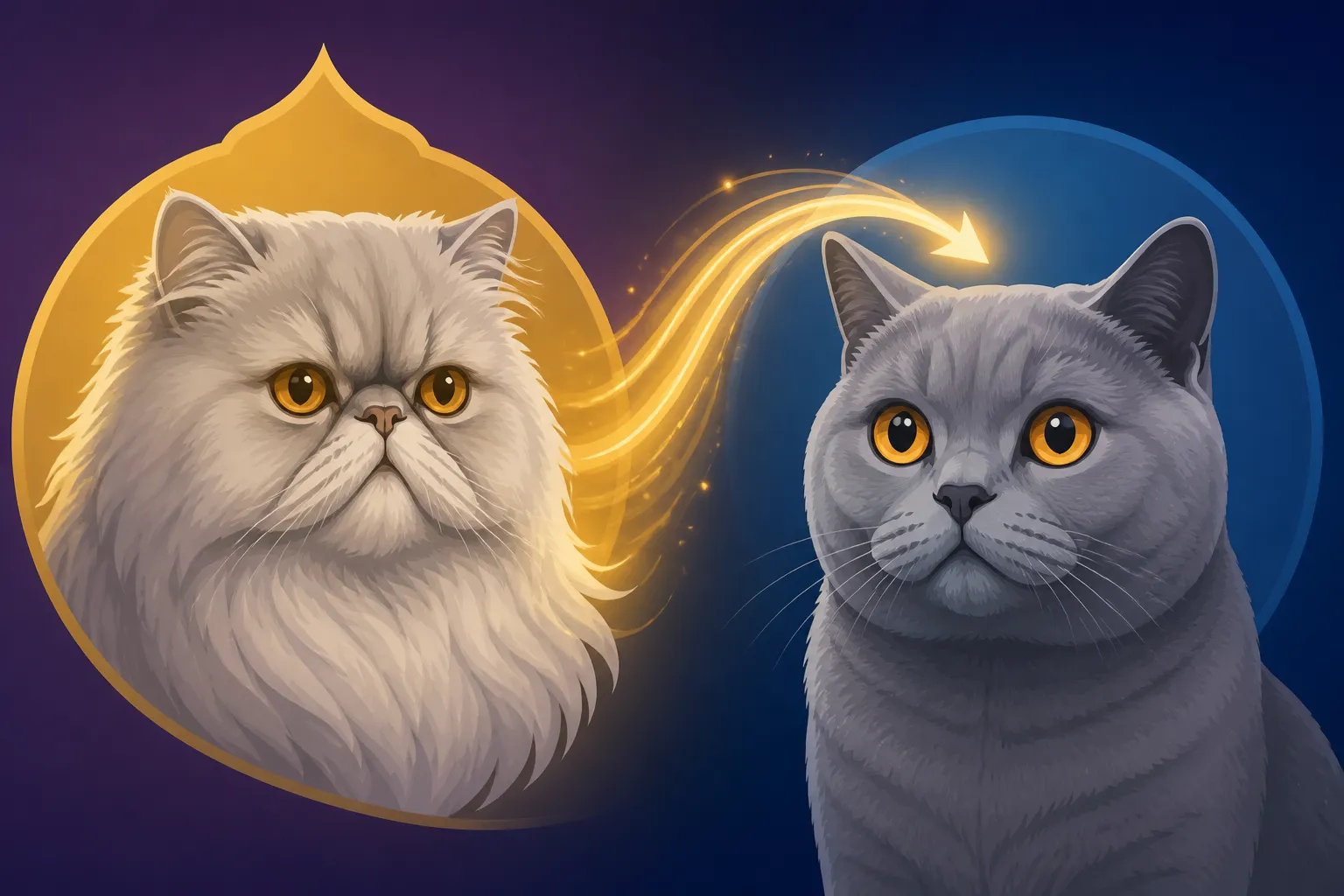
A British Shorthair’s round head can look surprisingly Persian, which naturally raises the question: did the breed inherit its famous cheeks and short muzzle from Persian ancestors? The answer is yes, in part—but the story is more complicated than a simple cross. This guide explains what Persian cats contributed, what remained distinctly British, and how to tell a correct British Shorthair head from an overly flat face.
Why Persian cats became part of British Shorthair history
The breed needed rebuilding after the wars
The British Shorthair began as a sturdy domestic cat in Britain, valued for its working ability and later developed into a show breed. You can read more about that early background in The British Shorthair Started as a British Street Cat. By the time the breed was being shown in the late nineteenth century, it already had a recognizable type, but decades of upheaval—including the world wars—left breeding populations severely reduced.
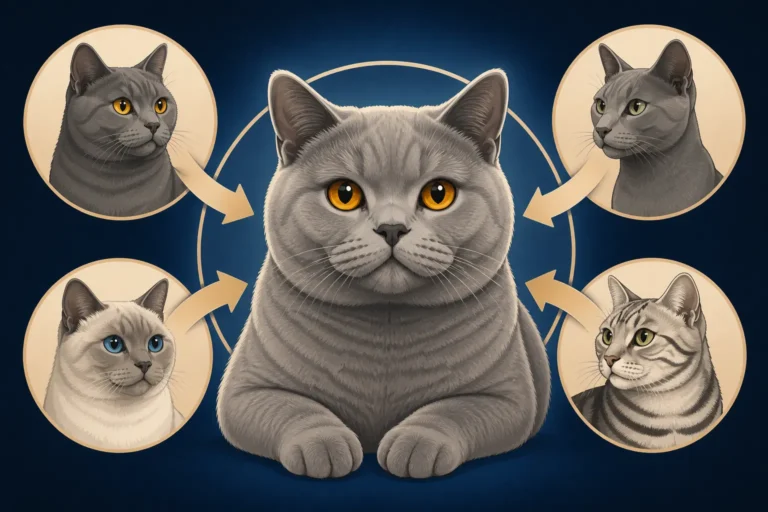
After the Second World War, breeders had a practical problem: there were too few suitable British Shorthairs to rebuild the breed from a narrow pool without risking further losses in health and diversity. They used other cats in carefully managed breeding programs. Persian cats were among the breeds brought in, alongside other outcrosses in different programs. These matings helped restore numbers and contributed characteristics that breeders later selected for.
That history is explored further in The Persians That Rebuilt the British Shorthair After the War. It is important to picture the change as a gradual process rather than a single Persian mating that suddenly created the modern British Shorthair. Breeders chose offspring over generations, pairing cats that moved closer to the desired British type. The modern breed is the result of that selection, not simply a Persian with a different coat.
What breeders were trying to preserve
The Persian influence did not mean breeders wanted to replace the British Shorthair’s identity. The goal was to rebuild a cat that still looked solid, balanced, and recognizably British while drawing on available cats to support the breeding population. Breeders then made choices about which traits to retain and which to moderate.
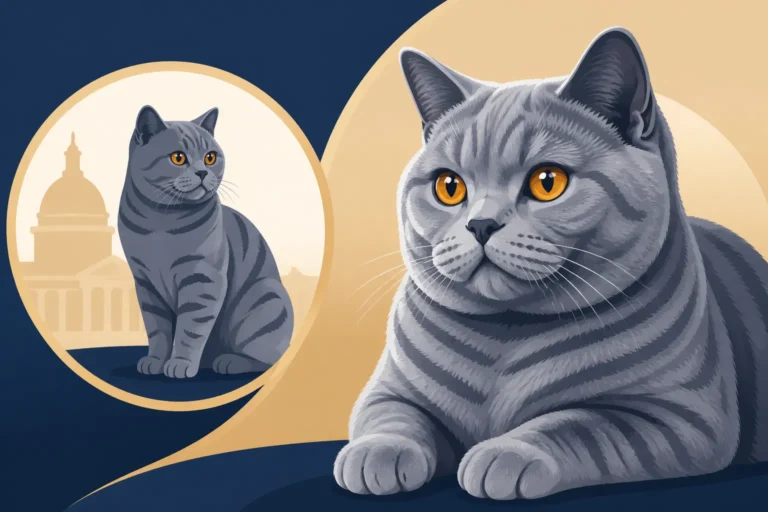
A Persian’s head is typically very round, with a short facial profile and a pronounced change between the forehead and nose. The British Shorthair also came to be associated with a round head, broad skull, and full cheeks, but its ideal face is not a copy of the Persian’s. Its features should fit together as a broad, sturdy whole, with a muzzle and nose that remain distinct.
This matters because “Persian influence” can be misunderstood as meaning “flat-faced.” It does not. The British Shorthair’s head became rounder and fuller through a complicated breeding history, but its breed type developed its own proportions. The goal is a rounded, substantial face—not a compressed one.
The head features Persian cats helped shape
A rounder, broader outline
The most noticeable contribution associated with Persian ancestry is the modern British Shorthair’s rounded head shape. Seen from the front, the skull should look broad and rounded rather than narrow or wedge-shaped. The cheeks add to that impression, especially in mature males, whose faces may develop particularly full jowls.
The roundness is not just a matter of a cat having a large head. It comes from the relationship between the skull, cheeks, muzzle, and ears. A well-balanced British Shorthair has small, rounded ears set apart on the head, a broad face, and a muzzle that sits naturally within the overall shape. For a more detailed description of the desired proportions, see What Shape a British Shorthair's Head Should Be.
A kitten’s face can look less finished than an adult’s. British Shorthairs mature slowly, and their head shape, cheeks, and overall substance may take time to develop. That can make comparisons between a young kitten and a fully grown show cat misleading. A kitten should be assessed as a growing animal, not expected to have the finished head of an adult.
Fuller cheeks and a softer expression
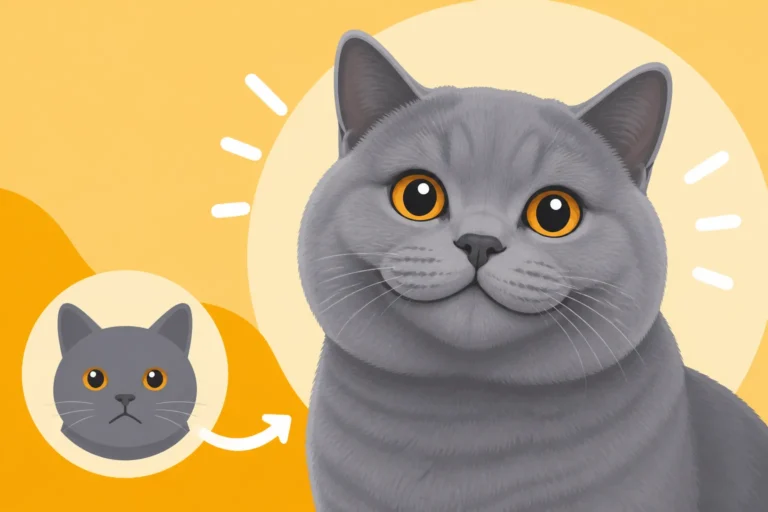
Full cheeks help give the British Shorthair its unmistakable, plush-faced appearance. They contribute to the breed’s rounded silhouette and can make the face seem gentle or even smile-shaped. The expression comes from several features working together, rather than from one particular mouth shape. What Full Cheeks Mean on a British Shorthair explains why those cheeks are part of breed type, not simply a sign that a cat has gained weight.
This is especially useful to remember when looking at a male British Shorthair. A mature male may have prominent jowls that make his lower face look broader and heavier. That does not automatically mean he is overweight. Body condition is better judged by looking at his overall shape and feeling for his ribs, rather than using the fullness of his face as a weight test.
The combination of round head, dense coat, and full cheeks is also why people often describe the breed as teddy-bear-like. That impression is part of its appeal, but it can encourage exaggerated breeding if buyers assume that a flatter face or more extreme roundness is always better. A healthy, balanced head should still allow the cat to breathe and function comfortably.
A shorter-looking face, but not a flat one
Persian ancestry is often mentioned when people notice the British Shorthair’s relatively short facial profile. Yet a British Shorthair should not have the extreme facial compression associated with some flat-faced breeds. Its nose should be visible and properly positioned, and the face should retain definition rather than appearing pushed in.
A short face is not automatically an unhealthy face, and a longer face is not automatically a fault. What matters is the complete profile: the nose, muzzle, forehead, and jaw should look proportionate. If the face appears unusually flattened, or if the cat has noisy breathing, persistent eye discharge, or difficulty eating, those are practical reasons to seek veterinary advice rather than treating the look as a desirable breed feature.
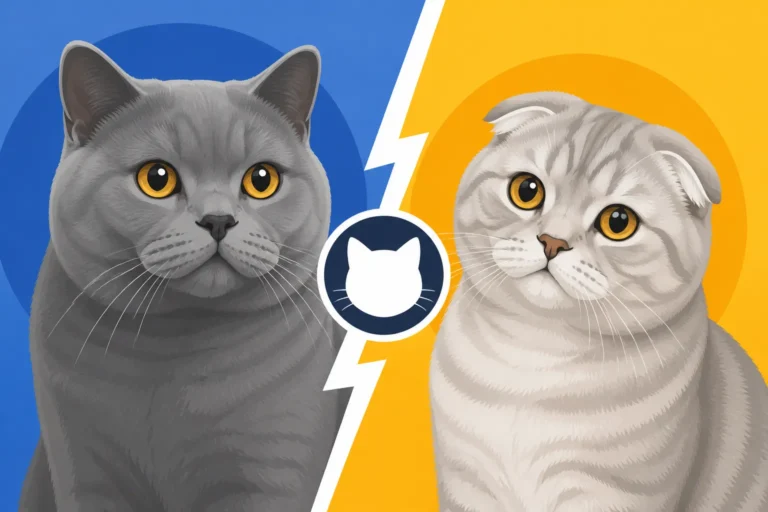
The breed distinction is worth keeping clear when comparing British Shorthairs with Persian-related breeds. The How a British Shorthair Differs From an Exotic Shorthair guide offers another useful comparison, since the Exotic Shorthair has a much closer relationship to the Persian’s facial type. For British Shorthairs, a rounded head should not be confused with a flat face.
| Feature | British Shorthair type | Persian-like extreme to avoid |
|---|---|---|
| Overall head | Broad and rounded | Excessively compressed or distorted |
| Cheeks | Full, fitting the skull and muzzle | So exaggerated that the face loses balance |
| Nose | Short-looking but clearly defined | Very flattened or pushed upward |
| Muzzle | Broad and integrated with the face | So compressed that normal function may be affected |
| Expression | Open, rounded, and balanced | Extreme facial features presented as automatically better |
What stayed distinctly British
A sturdy cat, not simply a Persian with a different coat
The Persian contribution is one part of the story, but it does not explain the whole British Shorthair. The breed’s sturdy body, strong bone, dense coat, and substantial appearance are also central to its identity. The head needs to make sense with that body: broad and rounded, yes, but not so oversized or exaggerated that the cat looks unbalanced.
The British Shorthair’s coat also changes the way its head appears. Its dense fur can soften the outline and make the cheeks seem even rounder. This creates a plush effect that may be mistaken for facial structure alone. When comparing cats, look at the underlying proportions as well as the coat surrounding them.
That’s one reason photographs can be deceptive. A close-up, a particular angle, or a very fluffy coat may make a face appear flatter or more bulbous than it is. If you are meeting a kitten, look at the cat from the front and side, observe it moving and breathing, and ask how its parents’ features developed as they matured. The aim is a healthy, coherent type—not a single dramatic snapshot.
A breed standard shaped through selection
Once Persian and other outcrosses had helped restore breeding populations, British Shorthair breeders continued selecting for a distinct breed type. Over time, the desired look came to emphasize a broad, round head, full cheeks, and a firm, balanced muzzle. The history is therefore not just about what traits entered the population; it is also about which traits breeders chose to keep and how they shaped them.
Different registries may phrase standards somewhat differently, but the broad idea remains: the British Shorthair’s head should look rounded and substantial without losing proportion. A buyer comparing cats should be cautious about treating one feature—such as enormous cheeks or an especially short nose—as proof of quality. Type is about the whole cat.
The round face is also responsible for the breed’s familiar expression. If you have ever thought a British Shorthair looked permanently pleased or faintly amused, the combination of broad cheeks, rounded head, and muzzle helps explain it. See Why a British Shorthair Looks Like It Is Smiling for more on that distinctive expression.
How to assess a British Shorthair’s head today
Look for balance rather than exaggeration
When evaluating a British Shorthair, start with the overall outline. Does the head look broad and rounded in relation to the body? Are the ears set apart rather than crowding the top of the skull? Does the muzzle fit the cheeks, and is the nose clearly visible? These questions are more useful than asking whether the cat has the shortest face or largest cheeks you have seen.
Then consider function. The cat should breathe quietly at rest, eat without obvious difficulty, and keep its eyes reasonably comfortable and clean. A particular facial shape should never be treated as desirable simply because it looks dramatic. If a cat consistently breathes noisily or struggles with ordinary activities, ask a veterinarian about it.
For prospective owners, asking about the parents can provide helpful context. Request to meet them if possible, or ask for clear photographs showing their faces from the front and side. A responsible breeder should be comfortable discussing how the cats breathe, eat, and manage routine care—not only how close they look to an idealized photograph.
Understand how age changes the impression
A young British Shorthair’s head is still developing. The cheeks may not yet be full, and the body may not have reached its mature proportions. That is normal; the breed can take years to fill out. A kitten with a less rounded face is not necessarily going to remain that way, just as a very round kitten is not guaranteed to develop into a particularly large adult.
Sex and individual variation also matter. Mature males often develop more pronounced cheeks than females, but there is a wide range among healthy cats. Coat, lighting, and camera angle can change what you notice, too. Avoid judging a kitten’s eventual head shape from a single image or comparing it too closely with a fully mature cat.
If you are choosing a kitten, focus on health, temperament, and responsible breeding alongside appearance. The Persian influence helps explain why the British Shorthair has its broad, rounded face, but it does not mean every cat should look identical. A well-bred individual should have a balanced expression that suits its age and overall build.
Separate normal care from facial-structure concerns
A British Shorthair does not usually need special care simply because its head is round. Routine grooming, dental care, and veterinary checkups matter more than trying to maintain a particular facial look. The plush coat can shed, and regular combing may help remove loose fur. If you are sorting through grooming tools, a pet retailer such as Chewy may be one place to compare basic comb options; choose a tool suited to the coat and use it gently.
For a cat that resists grooming, keep sessions short and calm, and stop before it becomes a struggle. Chewy is also a retailer some owners may browse when looking for everyday grooming supplies, but the right choice depends on the individual cat’s coat and comfort. A comb that works well for one cat may feel unpleasant to another, so introduce it gradually and check the skin as you go.
Chewy can be a convenient place to explore general cat-care products, but appearance-related concerns—such as persistent tearing, noisy breathing, or difficulty chewing—are not shopping problems. They deserve a veterinary assessment. Keeping that distinction clear helps owners avoid confusing normal breed features with signs that a cat may need help.
The Persian gave the British Shorthair part of the history behind its round head, full cheeks, and softened expression. But the breed’s face is not simply Persian, and it should not be pushed toward an extreme flat profile. The most recognizably British Shorthair head is broad, rounded, and substantial while remaining balanced and comfortable for the cat.
Disclaimer
This article is for general informational purposes only and does not constitute professional advice. Laws, prices and regulations vary by location and change over time. Consult a qualified professional for guidance on your specific situation.