What a Golden British Shorthair Is
A golden British Shorthair can look honey-colored, softly shaded, or boldly patterned, so the label is not always clear from a quick photo. Buyers often find the same cat described as golden shaded, golden shell, or golden tabby. This guide explains what those terms mean, how the coat differs, and what to check before choosing a kitten.
What makes a British Shorthair golden
“Golden” describes a coat color or pattern, not a separate breed. A golden British Shorthair should have the breed’s characteristic sturdy build, round head, dense short coat, and other features of a British Shorthair. The golden coloring is one of the many coat variations found within the breed.
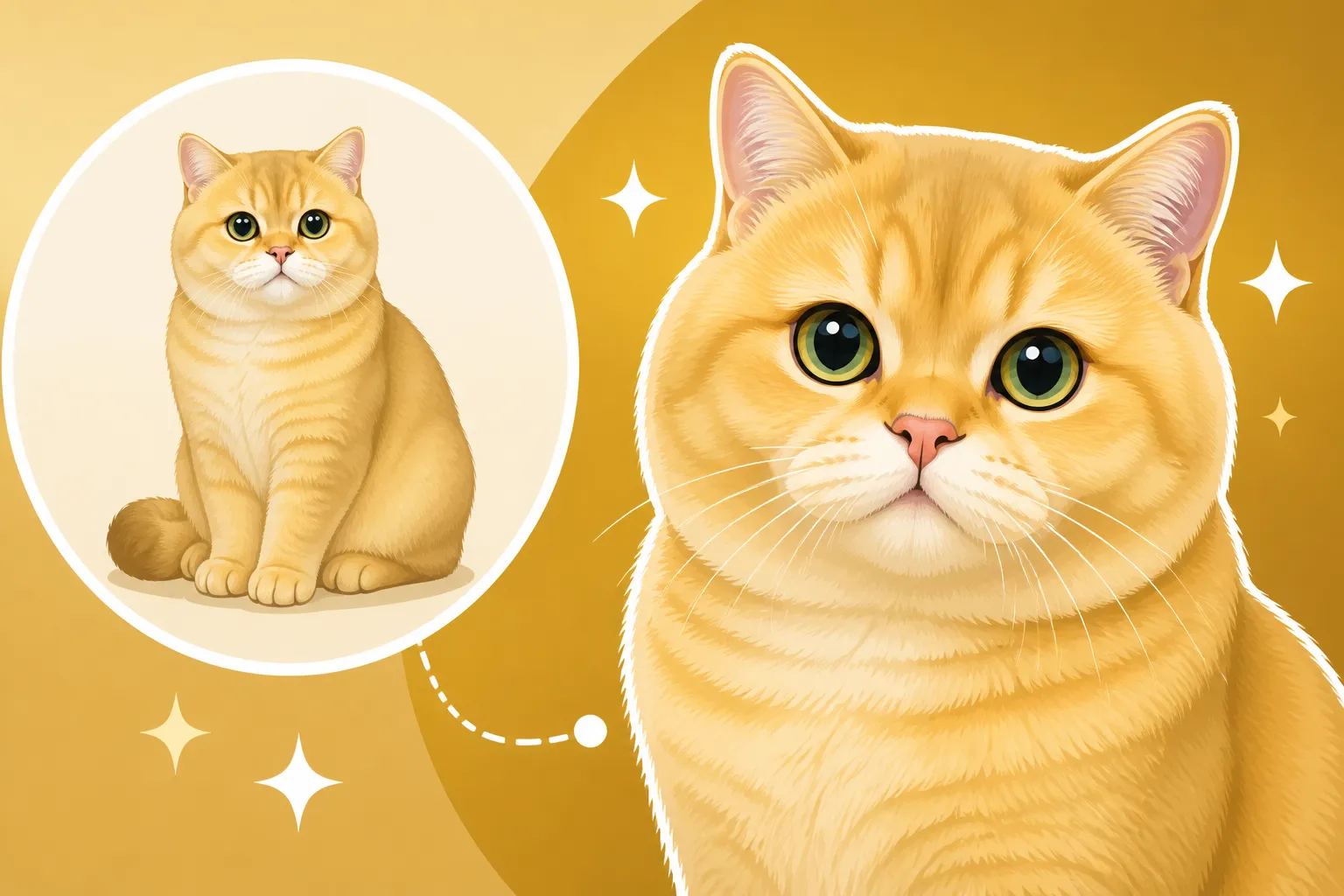
The basic visual effect comes from a warm, pale ground color paired with darker pigment on some hairs or in a pattern. Depending on how that color is distributed, a cat may look mostly golden, have dark shading along its back, or show distinct stripes and markings. Lighting, age, and coat condition can also change how golden the cat appears in a photograph.
Golden is a color description, not a breed
The British Shorthair comes in a wide range of colors and patterns. Blue is the variety many people picture first, but it is only one option. Golden British Shorthairs are still British Shorthairs; their coloring does not make them a different breed or predict a different personality. For a broader overview of the breed’s colors, see A British Shorthair Comes in More Colors Than You Think and Which Colors a British Shorthair Comes In.
A golden coat may look quite different from one cat to another. One kitten may have a light, creamy body with fine dark tips, while another may have a richer amber appearance or visible tabby markings. Even littermates can differ in how much dark pigment they show. A breeder’s use of “golden” is a useful starting point, but it does not tell you the complete pattern by itself.
Color terms can also vary between breeders and registries. Some labels describe how much of each hair is colored; others describe the visible pattern across the coat. When comparing kittens, ask the breeder to explain the exact term they are using and, if possible, show photographs of the kitten’s parents and adult relatives.
The coat is made up of more than one shade
A golden cat’s appearance is not necessarily a uniform gold from head to tail. In shaded varieties, individual hairs may have pale roots and darker tips. The result can be a soft veil of color, particularly along the back, sides, and tail. A golden shell is generally paler in appearance than a golden shaded cat, with less dark color visible on each hair. Exact usage depends on the breeder and the relevant breed standard.
Golden tabby cats have a different look: their coat shows recognizable tabby markings, such as stripes, swirls, or spots, against a golden ground. The markings may be easier to see on the face, legs, and tail, while the pattern across the body can range from subtle to quite pronounced. A photo taken in bright sun can make markings look faint; indoor lighting may make them appear stronger.
This is why two sellers can describe cats with noticeably different coats as “golden.” If you are deciding between kittens, ask whether the cat is shaded, shell, or tabby, and request recent photos in natural light. It is also reasonable to ask how the breeder expects the coat to develop, while understanding that a prediction is not a guarantee.
Golden shaded, golden shell, and golden tabby
The words after “golden” help describe the pattern. They are useful when comparing cats, but the name alone cannot show how a particular kitten will look as an adult. Look at the coat itself, ask questions about the kitten’s relatives, and check whether the description matches the registration or pedigree documents where applicable.
| Description | General appearance | What to look for |
|---|---|---|
| Golden shell | Very pale, lightly tipped appearance | A bright golden or cream-toned body with limited dark tipping |
| Golden shaded | More visible dark shading than a shell coat | A warmer or darker veil, often most noticeable along the back and tail |
| Golden tabby | Distinct tabby pattern on a golden ground | Stripes, swirls, spots, or other visible tabby markings |
These are broad visual distinctions, not a promise that every cat will fit a neat picture. Coat standards and terminology may vary across registries, and individual cats can sit between the most obvious examples.
Golden shell and golden shaded
A golden shell coat is often described as lightly tipped: the hair has a pale base and a small amount of darker color toward the end. From a distance, the cat may look almost cream or pale gold, with a subtle darker outline around parts of the body. In photographs, a shell coat can appear nearly white if the light is strong or the image is overexposed.
A golden shaded coat usually shows more dark color across the coat, creating a deeper, more noticeable overlay. The cat may have a golden-looking face and underside with darker shading along the back, flanks, and tail. Some kittens start out with more visible markings or uneven shading, and the overall look can shift as the coat matures.
If the distinction matters to you, do not rely on a single flattering kitten photo. Ask for pictures taken from the side and above, in ordinary daylight, and ask to see the parents if possible. A breeder familiar with the family line can describe the range of adult coats they have seen, though even experienced breeders should avoid promising an exact final shade.
Golden tabby
A golden tabby has visible patterning rather than the softly tipped appearance associated with shell and shaded coats. Depending on the particular pattern, the markings may appear as narrow stripes, broad swirls, or spots. Tabby markings are often clearest on the face, legs, and tail, so check those areas if the body pattern is faint.
The word “golden” describes the ground color, while “tabby” describes the pattern. It is not a guarantee that the coat will look like a solid metallic gold. A golden tabby can have a range of warm backgrounds and darker markings, and the contrast may change as the kitten grows.
If a listing says only “golden,” ask whether the cat is tabby or shaded. That small clarification can prevent disappointment: someone hoping for a softly blended, lightly tipped coat may have a different picture in mind from a person looking for crisp stripes or swirls.
Why color names can be confusing
Color descriptions are not always used consistently in casual listings. One breeder may carefully distinguish between shell and shaded, while another may use “golden” as a broad description for several related appearances. Social media captions and advertisements may also simplify the terminology.
A useful conversation is specific and practical: “Is this kitten golden tabby or golden shaded?” “What color are the parents listed as?” “Can I see the kitten’s registration or pedigree description?” These questions help you understand what is being represented without assuming that a particular label automatically proves breed or quality.
For a wider look at how official and everyday color descriptions relate, see How Many Colors the British Shorthair Standard Allows. If the color seems to change between photos, Whether a British Shorthair's Color Changes With Age offers useful context.
How a golden coat changes as a kitten grows
A kitten’s coat is not always a miniature version of its adult coat. The softness, texture, contrast, and apparent depth of color can change as the kitten matures. This is one reason a golden kitten may look more strongly marked, paler, or less evenly shaded than the adult cat its new owner imagined.
Photographs add another layer of confusion. Warm indoor bulbs can make a pale coat look more amber; harsh daylight can wash out subtle shading. Camera exposure and editing can alter the appearance too. When you compare kittens, try to look at unfiltered images taken in similar lighting.
Color and markings may become clearer over time
A young kitten’s markings may be more obvious than they will be later, or the reverse: details can become easier to see as the coat develops. The exact change depends on the individual cat and its coat pattern. A breeder may have experience with the development of their own lines, but cannot guarantee precisely how dark, pale, or sharply defined a kitten will look as an adult.
A good way to make a more informed choice is to ask for photographs of adult relatives, especially cats with similar coloring. Treat these as examples rather than a promise. Even kittens from the same parents can mature into slightly different shades or patterns.
The coat’s texture matters as well. The British Shorthair is known for a dense, plush coat that stands away from the body. A golden coat should still be judged as part of the whole cat, not as a color swatch. If you want to learn more about how coat texture can differ from what a photo suggests, see Why the Blue Became the British Shorthair Everyone Pictures for context on the breed’s familiar appearance.
Eye color is not a shortcut to judging the coat
Golden British Shorthairs are often associated with green eyes, but eye color can depend on the variety and the applicable standard. A kitten’s eye color may also develop as it grows. It is better to ask what eye color is expected for that particular cat’s color and pattern than to assume that every golden kitten will have the same shade.
Photos can make eye color especially hard to assess. Reflections, flash, and image editing may make eyes seem brighter or more saturated than they are in person. If a particular eye color is important to you, ask for a natural-light photo and ask the breeder how the kitten’s eyes are developing.
For more detail about how eye color relates to coat varieties, see Which British Shorthair Colors Come With Green Eyes and Whether a British Shorthair's Eyes Should Be Copper. These distinctions can be more specific than a simple “golden” label.
Choosing a golden British Shorthair responsibly
A beautiful color can catch your eye, but it should not be the only factor in choosing a kitten. Health, temperament, socialization, and the breeder’s transparency matter more to your future life together than whether the coat is exactly the shade you saw in an advertisement.
Golden kittens may be described as rare or especially desirable. A striking coat can affect how a seller markets a kitten, but color alone does not establish that the cat is healthy, well bred, or a good match for your home. Take time to check the evidence behind the listing and to meet the breeder or rescue organization.
Ask questions beyond the color name
Before reserving a kitten, ask for clear information about its parents, upbringing, health care, and documentation. A responsible breeder should be willing to explain what is known about the kitten and answer questions without pressuring you to make a quick decision. If you are unsure what to ask, Which Registry Standard a British Shorthair Is Judged Against can help you understand why breed descriptions and standards matter.
Useful questions include:
- What is the kitten’s full color and pattern description?
- How are the parents described in their paperwork?
- Can I see recent, unedited photos of the kitten and its parents?
- What veterinary care has the kitten received, and what records will come with it?
- What health screening has been done for the breeding cats?
- How has the kitten been raised and socialized?
- What support is available after the kitten goes home?
A seller who answers clearly is not automatically a guarantee of quality, but evasive answers are a reason to pause. Be especially cautious if the seller will not let you see the kitten’s living conditions, offers no meaningful documentation, or insists that color is proof of pedigree.
Don’t confuse color with breed identity
A golden cat may have the look of a British Shorthair without being a registered British Shorthair. Coat color alone cannot verify breed. If you are buying a pedigreed kitten, check the registration and pedigree details, and ask how the breeder establishes parentage and breed identity. If you are adopting, focus on the cat’s known history, health, and needs rather than expecting a particular appearance to prove its ancestry.
It is also worth comparing the cat’s overall shape and features with the breed description. British Shorthairs generally have a broad, rounded appearance, a sturdy body, and a dense short coat. But appearance can vary, and a photograph may not provide enough information to distinguish a purebred cat from a mixed-breed cat. How to Tell a British Shorthair From a Moggy explains why looks alone can be misleading.
A kitten’s color is not a reliable way to predict its character. Individual temperament depends on the cat and its experiences, not on whether its coat is blue, golden, tabby, or shaded. For that reason, don’t choose a kitten based on assumptions that golden cats are automatically calmer or more affectionate.
Plan for ordinary coat care
A golden coat does not need special color-enhancing products. Regular, gentle grooming helps you remove loose hair and notice changes in the skin or coat, but the aim is basic care rather than making the cat look more golden. A suitable comb and a calm, gradual introduction to grooming are usually more helpful than frequent bathing or harsh tools.
If you’re gathering basic grooming supplies, Chewy is one place to compare combs and other cat-care items; choose tools that suit a dense short coat and use them gently. A short grooming session can be easier than trying to work through a full brushing when the cat is already restless. You can also ask your veterinarian or breeder what tools they recommend for your cat’s coat.
For a new owner, it helps to establish a small routine early: let the kitten sniff the comb, gently touch the coat for a moment, and reward calm behavior. If you need to replace a tool or add basic supplies later, Chewy may be a convenient place to compare options, but the most important thing is that the tool feels comfortable for both you and the cat.
A golden British Shorthair is ultimately a British Shorthair with a warm-toned coat whose exact appearance depends on its pattern, genetics, and development. Learning whether a kitten is shell, shaded, or tabby—and checking its health, background, and care—will give you a much clearer picture than the word “golden” alone.
Disclaimer
This article is for general informational purposes only and does not constitute professional advice. Laws, prices and regulations vary by location and change over time. Consult a qualified professional for guidance on your specific situation.