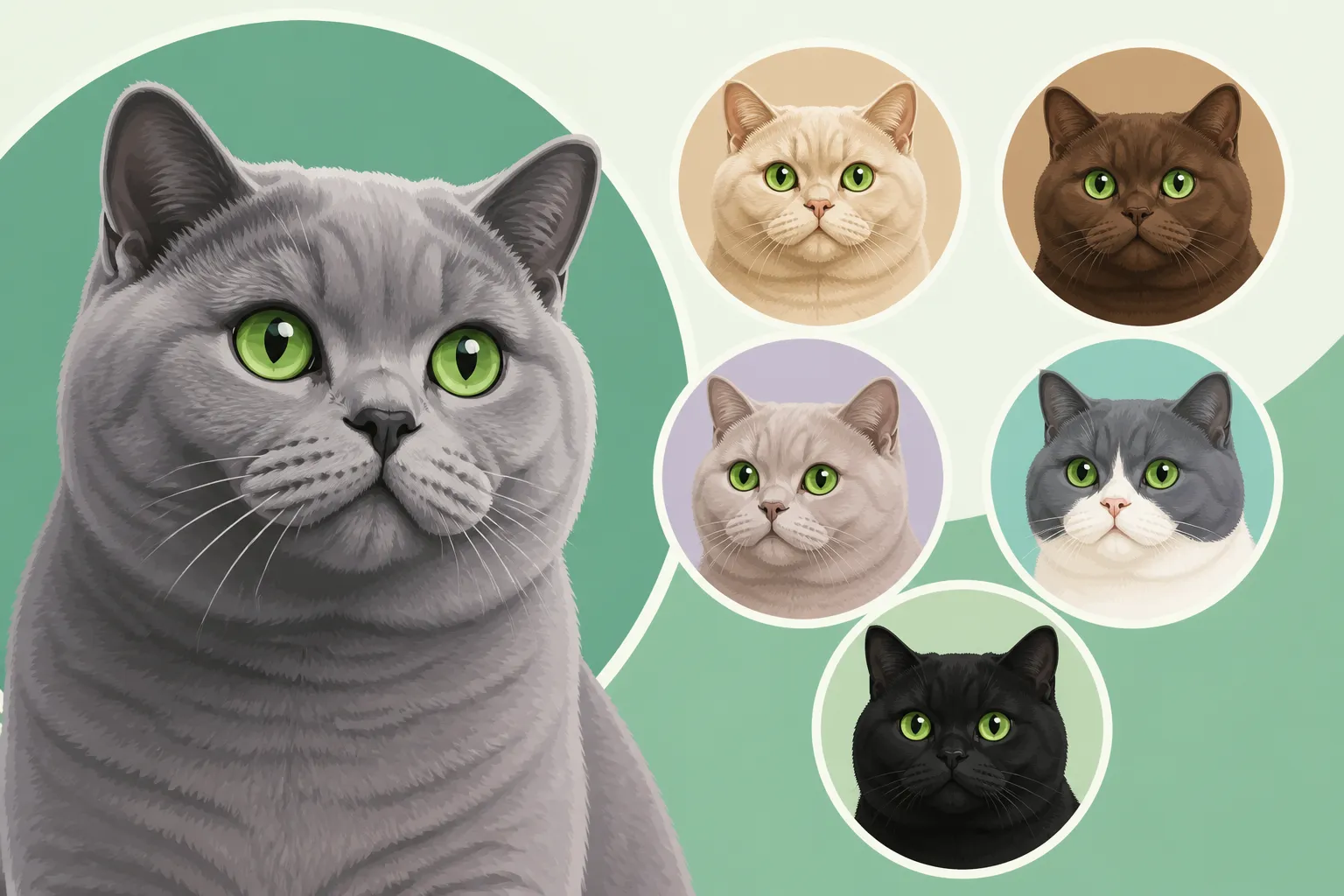
Which British Shorthair Colors Come With Green Eyes
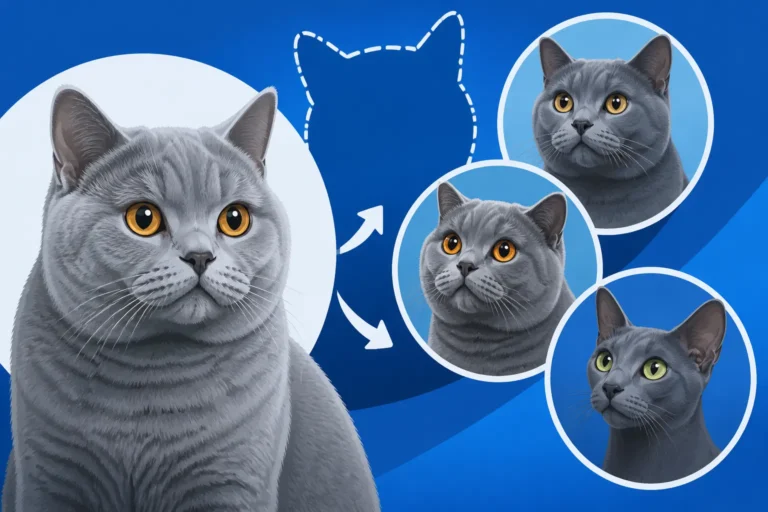
A British Shorthair’s eye color can be as striking as its plush coat, but green eyes do not come with every coat color. They’re most closely associated with shaded and silver-patterned cats, while solid blue British Shorthairs usually have copper or gold eyes. Here’s how coat color, age, and breed standards affect what you can expect.
British Shorthair colors most often associated with green eyes
Golden shaded British Shorthairs
Golden shaded British Shorthairs are among the colors most commonly associated with green eyes. Their coat has a warm, pale golden background with darker tipping, giving the fur a softly shaded appearance rather than a uniform, solid color. The combination of golden fur and vivid green eyes can be especially eye-catching.
The word “golden” describes the coat, not the eye color. A golden shaded kitten’s eyes may look different as it grows, and the final shade can take time to settle. If you’re looking at a young kitten, ask the breeder what they have observed in the kitten’s parents and previous litters, while remembering that adult eye color can’t be guaranteed from a photograph.
Golden shaded cats can also be confused with other warm-toned coats in online listings. Ask for clear, natural-light photos and confirm the registered color and pattern rather than relying on a label like “golden.” For a broader look at the breed’s palette, see A British Shorthair Comes in More Colors Than You Think.
Silver shaded and chinchilla British Shorthairs
Silver shaded and chinchilla British Shorthairs are also strongly associated with green eyes. Both have a pale, silvery-looking base coat with darker color concentrated toward the ends of the hairs. The difference is generally how much of each hair is tipped, which affects the overall depth and brightness of the coat.
The green in these cats’ eyes can range from a soft green to a more saturated shade. Some may have a blue-green or yellow-green cast, so “green” does not mean every cat will have the same vivid emerald eyes. Lighting matters, too: a shaded eye can appear more golden indoors and greener near a window.
If you’re choosing a kitten, ask whether the breeder has adult photos of related cats taken in ordinary daylight. Those images are more useful than heavily edited pictures, which can make both coat and eye color look more intense than they are. For more detail on the coat itself, see What a Silver Shaded British Shorthair Is.
Silver tabby and related silver patterns
Some silver-patterned British Shorthairs may have green or greenish eyes, but the expected eye color can depend on the specific pattern and the breed standard being followed. “Silver tabby” describes a patterned coat with a pale silver background and darker markings; it is not one single, identical look.
This is one reason a simple online search for “green-eyed British Shorthair” can be confusing. Two cats may both be called silver, yet have different markings, eye shades, or registration descriptions. If a particular eye color matters to you, ask the breeder how the cat is registered and whether its eye color is considered typical for that specific color and pattern.
A cat’s appearance alone also cannot confirm its pedigree. A green-eyed cat with a silver coat may look like a British Shorthair, but appearance is not a substitute for documentation or a knowledgeable breeder’s explanation. For an overview of recognized coat options, see Which Colors a British Shorthair Comes In.
| British Shorthair coat or pattern | Eye colors commonly associated with it | What to keep in mind |
|---|---|---|
| Golden shaded | Green to greenish shades | Eye color can vary, and kitten eyes may still be changing |
| Silver shaded or chinchilla | Green, blue-green, or related shades | Look at adult relatives in natural light |
| Silver tabby | Greenish shades may occur | The specific pattern and standard can matter |
| Solid blue | Usually copper, gold, or orange tones | Green is not the typical expectation |
| Colorpoint | Blue | Eye color is associated with the point pattern |
Why coat color and eye color are connected
Pigment affects the appearance of the eyes
A cat’s eye color is influenced by pigment in the iris. The amount and distribution of pigment help determine whether the eyes appear blue, green, gold, or copper. Coat color and eye color can be associated because both are influenced by inherited traits, but that does not mean the coat mechanically “causes” a particular eye color.
That distinction matters when you’re comparing kittens. A green-eyed silver cat is not automatically a better example of the breed, and a particular coat does not guarantee a specific eye shade. Individual inheritance is more complicated than matching a color label to a single eye-color outcome.
For buyers, the practical takeaway is simple: treat coat and eye color as two features to assess together, not as a promise that one determines the other. A breeder should be able to explain what is typical for the cat’s color and pattern without guaranteeing a precise shade.
Breed standards can differ in their wording
Breed standards describe the characteristics expected of a cat in a particular registry or show context. Their wording can differ, and eye-color expectations may be tied to a specific coat variety. That means a color description you see in one place may not tell the whole story about what is considered correct for another registry.
If you plan to show a cat, ask which registry’s standard the breeder follows and how the kitten’s color and eye color are recorded. If you’re choosing a companion, the standard may be less important than health, temperament, and a good match for your home, but the breeder should still give you an accurate description.
A green eye by itself is not proof that a British Shorthair is purebred. Likewise, a British Shorthair does not become less of a beloved companion because its eyes are more blue-green or yellow-green than you expected. Appearance is one part of the picture, not a complete measure of a cat’s quality or health.
Photos can make green eyes look different
Photographs can exaggerate or mute eye color. A bright window, warm indoor bulbs, camera processing, and reflections from nearby objects can all shift how the iris appears. A cat photographed beside a green cushion may seem to have greener eyes; a picture taken under warm lamps may make the same eyes look more golden.
When comparing kittens, ask for unfiltered photos and, if possible, a short video in daylight. You can also ask for pictures of adult relatives, whose eye colors have settled. A responsible breeder should be comfortable explaining that the kitten’s eventual eye shade is an estimate rather than a guarantee.
This is especially useful when a listing uses a strong color claim. Whether you’re looking at a breeder’s website or asking a vet about an eye-care product later, clear information is more useful than a carefully staged photo. If you’re comparing breed appearance more broadly, The Round Head and Copper Eye a British Shorthair Is Judged On explains another feature people often notice in the breed.
What to expect as a British Shorthair kitten grows
Kitten eyes do not always show the adult color
Kittens are often born with blue eyes, and their eye color changes as they mature. The transition is gradual, so a young kitten’s eyes may not yet show the shade it will have as an adult. Green can develop over time, and the final color may be more subtle than the vivid hue suggested by a photo.
This can be frustrating if you’ve fallen in love with a particular look. A breeder may have a reasonable idea of the likely adult color based on the kitten’s age, relatives, and coat variety, but should be cautious about promising an exact shade. Ask what is known, what is still developing, and whether there are adult family photos to help set expectations.
The coat changes as well. British Shorthairs mature slowly, and their coat texture and overall appearance can develop over time. A kitten that looks pale or less defined may become more visibly shaded as it grows. For more on that process, see When a British Shorthair Kitten's Adult Coat Arrives.
Choose the cat, not just the eye color
Green eyes can be a lovely feature, but it’s easy to let a striking photo take over the decision. Before putting down a deposit, ask about the kitten’s health history, socialization, veterinary care, and the breeder’s approach to matching kittens with homes. A good fit in temperament and care needs will matter much longer than whether the eyes are a particular shade of green.
Request the kitten’s registration details and a written description of its color and pattern. Ask to see the mother, if possible, and learn what the breeder can tell you about the father. If the breeder makes unusually absolute promises about adult eye color, take that as a reason to ask more questions rather than as proof of certainty.
If you’re still learning how to judge a kitten’s overall appearance, How to Tell a British Shorthair From a Moggy offers useful context. Breed identification should rely on more than a round face, plush coat, or green eyes.
When eye color or appearance deserves attention
Normal variation versus a change in one eye
A British Shorthair may have eyes that look different under different lighting, and a slight difference in shade between eyes can be natural. What deserves more attention is a sudden change, cloudiness, persistent redness, squinting, swelling, or discharge. These signs are not simply a coat-color variation and should be discussed with a veterinarian.
Pay particular attention if one eye changes while the other looks normal, or if your cat is rubbing its face or keeping an eye partly closed. Cats often hide discomfort, so a small change in behavior can be worth noticing even when the eye looks only mildly irritated.
Avoid using human eye drops or leftover medication. If your veterinarian recommends an external cleaning product, ask which kind is appropriate and how to use it. You may see eye-care products at retailers such as Chewy, but the product label and veterinary guidance matter more than where it is sold.
Keep routine care gentle
For ordinary care, watch for changes rather than repeatedly wiping healthy eyes. If there is minor debris around the fur, ask your vet what is safe for your cat and use only the method they recommend. Do not put a cleaning solution directly into the eye unless a veterinarian has specifically instructed you to do so.
If you’re considering an eye wipe from Chewy or another retailer, check with your clinic first, especially if the eye is red, painful, or producing discharge. A product intended for the fur around the eye is not necessarily suitable for the eye itself. Avoid products with medication or fragrance unless your veterinarian has told you they are appropriate.
When contacting the clinic, describe what you see, when it began, and whether it affects one eye or both. If you already have a product in mind from Chewy, you can share its name or ingredient list with the veterinary team before using it. That small check can prevent an unsuitable product from making irritation worse.
Green eyes are a color trait, not a health test
Green eyes do not by themselves indicate that a British Shorthair is healthy, unhealthy, purebred, or free from inherited conditions. Eye color is an appearance feature. Health is assessed through appropriate veterinary care, medical history, and any screening relevant to the cat and its family.
The same applies to coat color: a silver or golden coat can be beautiful, but it does not replace questions about health and breeding practices. If you’re researching the breed before choosing a kitten, Whether the British Shorthair Is a Healthy Breed is a useful next read.
Ultimately, golden shaded, silver shaded, chinchilla, and some silver-patterned British Shorthairs are the colors most associated with green or greenish eyes. The exact shade varies, kitten eyes can change, and photos are not always reliable. A careful breeder can explain what is typical for a particular cat, while a veterinarian can help if the eyes show signs of irritation or sudden change.
Disclaimer
This article is for general informational purposes only and does not constitute professional advice. Laws, prices and regulations vary by location and change over time. Consult a qualified professional for guidance on your specific situation.