Which Registry Standard a British Shorthair Is Judged Against
A British Shorthair does not have one worldwide judging standard: the rules depend on the registry and show where the cat is entered. That can make conflicting descriptions of the “correct” head, coat, or color confusing for buyers and exhibitors. This guide explains how registry standards work, what judges assess, and how to check which rules apply to a particular cat.
Which registry standard applies to a British Shorthair
The show registry sets the judging rules
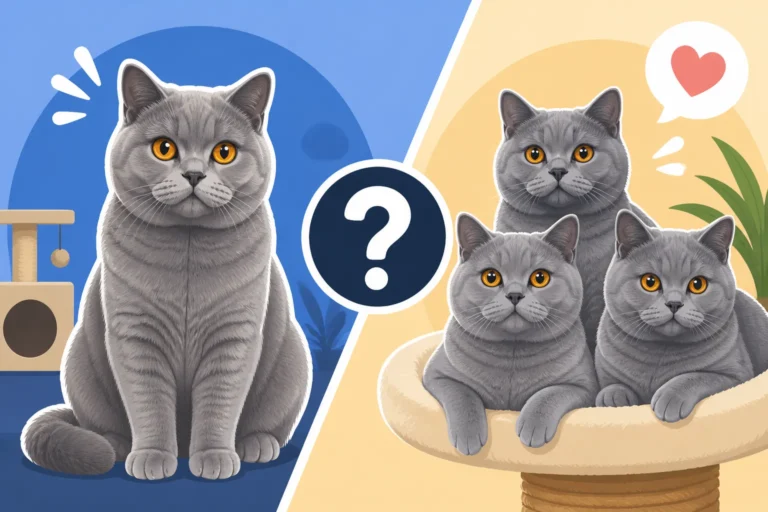
A cat is judged according to the standard used by the registry or show organization hosting the event—not against a single global rulebook. The relevant standard describes the features the organization considers typical of the breed, including body shape, head, coat, eye color, and acceptable colors or patterns.
Organizations such as the Governing Council of the Cat Fancy, or GCCF, the Cat Fanciers’ Association, or CFA, The International Cat Association, or TICA, and Fédération Internationale Féline, or FIFe, each publish their own standards. Their descriptions often overlap because they are judging the same breed, but the wording, organization, and details are not identical.
This matters most when someone compares show results across countries or considers entering a cat in a different organization. A cat assessed under one registry’s rules may not be evaluated in exactly the same way under another’s. Before entering a show, check the current standard and show rules for the specific registry involved.
Registration and judging are related but different
Registration records a cat within an organization’s system and identifies its breed, ancestry, and other required details. Judging is the assessment of a cat at a show against the applicable breed standard and the show’s procedures. Registration does not automatically mean a cat is an ideal show example, and a show award does not replace registration records.
The practical distinction is useful when choosing a kitten. A pedigree may tell you about recorded ancestry, while a show result indicates how a judge assessed that individual cat in a particular setting. Neither alone guarantees health, temperament, or future show success. If you are looking at a kitten for showing, ask which registry the breeder uses and which standard they are breeding toward.
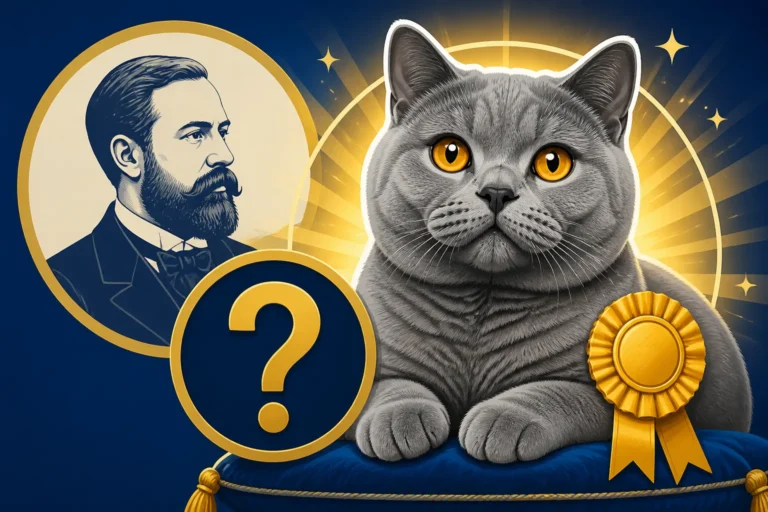
The history behind the breed’s written descriptions is also worth knowing. Which British Shorthair Standard Harrison Weir Wrote explores the early show context, while Whether GCCF and CFA British Shorthair Standards Differ looks more closely at how separate organizations’ approaches compare.
What judges look for in a British Shorthair
Overall shape matters, not just a round face
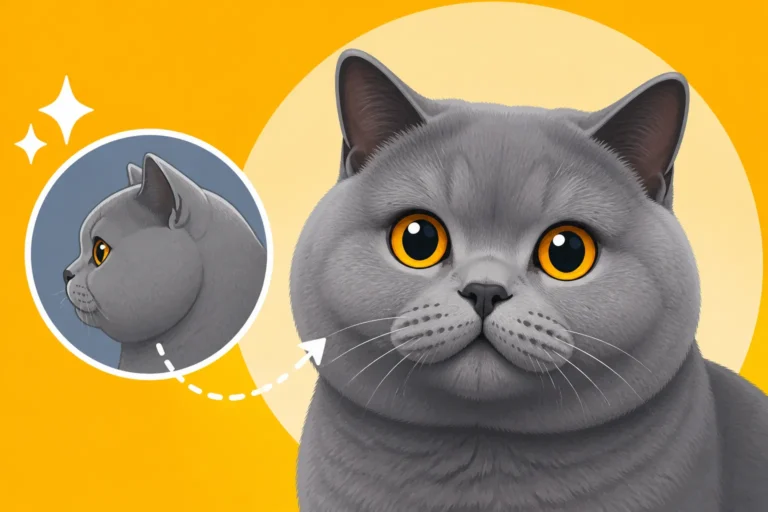
The British Shorthair is recognized for a solid, compact, substantial appearance. A judge considers the cat as a whole: body, bone, legs, tail, head, coat, and overall balance. The familiar round face is an important part of the breed’s look, but it does not stand alone. A cat with a particularly round head is not necessarily a strong example if the rest of its structure or coat does not fit the standard.
The breed’s body is often described as cobby: sturdy and compact rather than long and fine-boned. The goal is not simply to reward the largest cat. Size and weight should be understood in relation to the breed’s structure, age, and condition. A naturally solid cat and an overweight cat can look superficially similar in photographs, but they are not the same thing. Judges assess type and condition rather than treating excess weight as a breed feature.
The round head, full cheeks, and eyes help create the breed’s characteristic expression, but details should be read alongside the full standard. The Round Head and Copper Eye a British Shorthair Is Judged On provides more detail about these familiar features, and What a British Shorthair Weighs and How Big It Gets can help put the breed’s substantial build in context.
Coat texture, eyes, color, and pattern are part of the assessment
A British Shorthair coat is short and dense, with a distinctive texture that contributes to the breed’s plush appearance. Judges assess coat quality as well as color. A photograph can make texture difficult to evaluate, and lighting can alter how a color appears, so a picture is not a substitute for seeing the cat or consulting the written standard.
Eye color requirements depend in part on the coat color or pattern being judged. Copper or gold eyes are strongly associated with blue British Shorthairs, but it is inaccurate to assume every British Shorthair must have copper eyes. Which Eye Colors a British Shorthair Has explains how eye color varies across the breed.
Color and pattern rules can be more complicated than a simple list. Some registries recognize a broad range of varieties, while the accepted classifications and presentation may differ among organizations. For an overview of the breed’s variety, see A British Shorthair Comes in More Colors Than You Think. The point is not that one registry’s cat is automatically more “real” than another’s; it is that the registry’s rulebook defines the classes and details used at that show.
| Feature assessed | What a judge may consider | Why registry rules matter |
|---|---|---|
| Overall type | Balance, substance, and whether the cat has the characteristic British Shorthair build | Standards may describe ideal proportions or features differently |
| Head and expression | Head shape, cheeks, ears, eyes, and overall balance | Wording and emphasis can vary by organization |
| Coat | Length, density, texture, and condition | A color alone does not establish coat quality |
| Eye color | Color in relation to the cat’s variety | Expected eye color can depend on coat color or pattern |
| Color and pattern | Whether the variety is recognized and how it is classified | Registries may organize or recognize varieties differently |
| Condition | General presentation and physical condition | Breed type is not the same as excess weight |
Why registry standards can differ
Organizations use their own wording and classifications
Different registries may describe similar features with different terminology, organize color divisions differently, or place different emphasis on parts of the standard. A small wording difference does not necessarily mean that the organizations are describing entirely different cats. It does mean that a breeder or exhibitor should avoid assuming the rules are interchangeable.
The class a cat enters is especially important for color and pattern. One organization’s categories may not map neatly onto another organization’s categories. If a cat is registered in one system and shown in another, the owner should confirm whether the cat’s variety is recognized and what documentation the second organization requires.
This is also why broad statements such as “the British Shorthair standard says…” can be misleading if they do not name a registry. A clearer question is: “Which registry’s standard are you referring to?” That small clarification often resolves disagreements about color, eye expectations, or show eligibility.
A British Blue is a color variety, not a separate breed
“British Blue” is commonly used for a blue-coated British Shorthair, but the blue color does not make the cat a separate breed. The breed name is British Shorthair; blue describes a coat variety. That distinction helps when interpreting breeder listings, pedigrees, and show classes. Whether a British Blue Registers as a British Shorthair explains the naming and registration point in more detail.
A blue cat’s appearance alone also cannot establish that it is a pedigree British Shorthair. Coat color and a rounded face can occur in cats without documented British Shorthair ancestry. If breed registration matters to you, ask about pedigree documentation and the registry rather than relying on appearance alone. How to Tell a British Shorthair From a Moggy discusses why visual resemblance is not the same as proof of pedigree.
How to check the standard before buying or entering a show
Start with the registry and the cat’s variety
If you are buying a kitten, ask the breeder which registry records the litter and which standard they use when planning matings or entering shows. If you are considering a show, identify the organization hosting it and check that registry’s British Shorthair standard, show rules, and color classifications. These are separate questions: a breeder may be affiliated with one registry, while an event may operate under another.
For a kitten with an unusual or less familiar color, ask specifically how the variety is registered and whether it is eligible for the show class you have in mind. “Recognized” can mean different things depending on the context: accepted for registration, eligible for exhibition, or included in a particular championship class. Asking which of these is meant prevents avoidable confusion.
A useful checklist is:
- Identify the registry named on the pedigree or registration paperwork.
- Find the standard published by the registry hosting the show.
- Confirm the cat’s color or pattern classification under that registry.
- Check the event’s entry requirements and any relevant class rules.
- Ask the show organizer or registry to clarify uncertainties before submitting an entry.
Use the standard as a guide, not a promise
A breed standard describes an ideal for judging and breeding; it is not a guarantee that every cat will match every feature. Kittens change as they mature, and coat, head shape, body development, and eye color may not be fully settled early in life. A breeder can discuss the parents and the kitten’s likely development, but should not promise a particular show outcome.
For prospective owners, the standard is best used to understand breed type—not as a checklist that determines whether a cat will be a good companion. A pet British Shorthair does not need to be a show champion to be a wonderful family cat. Health, temperament, responsible breeding, and fit with your household deserve equal attention.
If two breeders give different answers about what counts as correct, ask them to name the registry and point to the relevant part of its standard. That shifts the conversation from vague claims about “the proper look” to a more useful comparison of specific rules. And if your main concern is whether a cat is a British Shorthair rather than a similar-looking cat, keep registration and pedigree records separate from show judging.
Disclaimer
This article is for general informational purposes only and does not constitute professional advice. Laws, prices and regulations vary by location and change over time. Consult a qualified professional for guidance on your specific situation.