Whether a British Shorthair Was Ever a Ship’s Cat
A British Shorthair may look as though it belongs beside a ship’s wheel, but the historical answer is less tidy than the picture suggests. Cats have long traveled on vessels, yet the modern British Shorthair was not established as a named, standardized breed until much later. This guide separates what is plausible about its ancestry from what can actually be claimed about the breed.
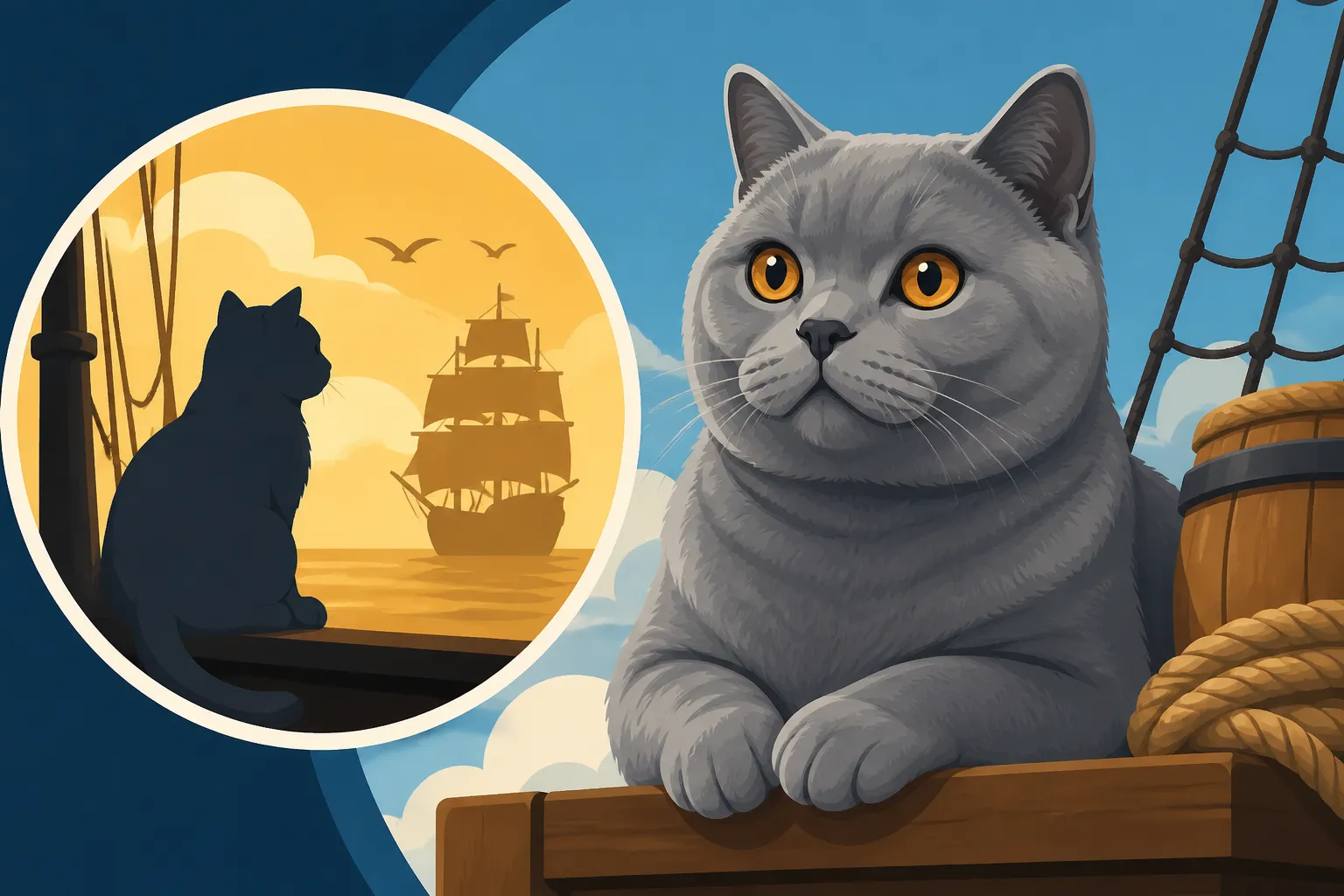
Was the British Shorthair a ship’s cat?
Cats sailed on ships, but that does not prove a breed did
Cats have been kept aboard vessels for practical reasons, especially to catch mice and rats that could damage supplies, gnaw through materials, and spread disease. A ship offered a ready supply of prey, while a cat could work in cramped spaces where larger animals could not. Sailors might also value a familiar animal’s companionship on a long voyage.
But the presence of cats at sea does not tell us that any particular cat was a British Shorthair. For much of history, cats were described by their usefulness, appearance, or place of origin, not according to the modern pedigree-breed categories people use today. A short-coated cat aboard a British vessel could have been a local domestic cat, a mixed-ancestry cat, or an animal brought aboard at a port along the route.
That distinction matters because the British Shorthair is a defined breed with a recognizable standard and organized breeding history. Cats that may have contributed to its ancestry existed in Britain long before the breed was formally developed. It is reasonable to imagine that some ancestors or close relatives of today’s British Shorthairs traveled by water. It is not the same as proving that sailors carried cats identified as British Shorthairs.
The likely answer depends on what you mean by British Shorthair
If “British Shorthair” means any sturdy, shorthaired cat living in Britain, then cats of that general type may well have gone aboard ships. Britain’s ports connected the country to busy networks of trade and travel, and cats could move between ships, docks, warehouses, and homes. A working cat did not need a pedigree to be useful on board.
If you mean the recognized breed we know today, the answer is more cautious: there is no solid basis for saying that British Shorthairs, as a formally established breed, were routinely ship’s cats. The modern breed developed through deliberate breeding and exhibition rather than through a documented naval program. A cat might have had an appearance similar to a British Shorthair without being a member of the breed in the modern sense.
That difference also helps explain why confident claims about “the British Shorthair ship’s cat” can be misleading. Stories about cats on ships are often passed along without names, records, or details that let us identify the animal’s breed. A charming tale may be possible without being verifiable history.
How British cats and ships may have crossed paths
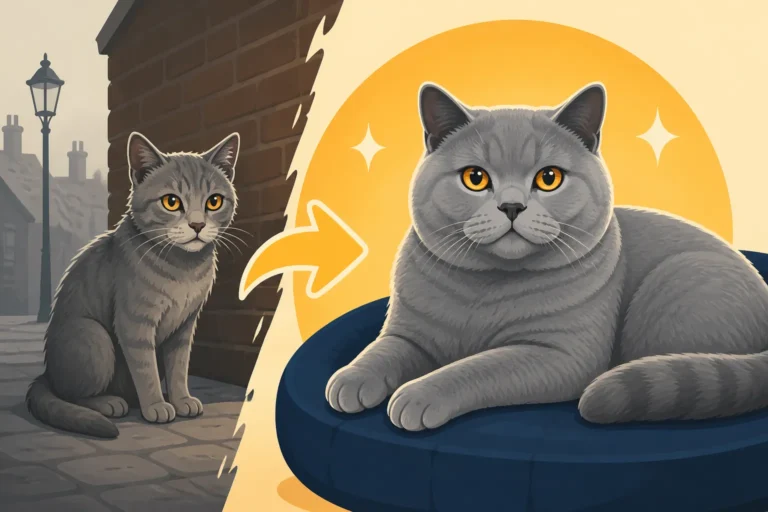
Britain’s working cats came from ordinary homes and streets
Long before formal cat breeds became popular, people valued cats as practical animals. A cat in a farmhouse, shop, stable, or warehouse could help keep rodents down. Britain’s domestic cats were not all alike, but many were shorthaired and adapted to everyday life rather than bred to meet a show standard. That history is part of the background to the breed’s development. The broader story is explored in The British Shorthair Started as a British Street Cat and What a British Shorthair Was Kept For on a Farm.
Ports would have created natural contact between working cats and ships. Cats living near docks could follow food smells, shelter in cargo areas, or be taken aboard by crew members. A ship might acquire a cat in one port and carry it to another, where it could stay aboard, be left ashore, or find a new home. These are plausible routes for cats to travel; they do not establish a continuous line from shipboard cats to modern pedigrees.
The everyday nature of this movement is exactly why the historical trail is difficult to follow. A ship’s cat might be absent from formal records, or mentioned simply as a cat. Even when a record identifies an animal’s color or coat length, that information is rarely enough to establish breed. The result is a history that can support a general connection between cats and vessels, but not a confident claim about a particular breed.
Roman-era cats are part of the ancestry discussion, not proof of a shipboard breed
Cats became established in Britain over a long historical period, and Roman trade and travel are often discussed when considering how domestic cats reached the island. Cats may have traveled alongside people and goods, including by sea. But knowing that cats could have come aboard Roman vessels does not mean the British Shorthair existed at that time as a breed.
A useful distinction is between a breed’s ancestors and the breed itself. A modern dog or cat breed can descend from older local animals, while the breed name and formal breeding rules arrive much later. The same distinction applies here: early cats in Britain may be part of the distant background to later British domestic cats, but that does not make them British Shorthairs in the modern pedigree sense. See Whether Romans Brought the British Shorthair's Ancestors and Whether a British Shorthair Descends From Roman Ship Cats for more on that ancestry question.
It is also easy to let a plausible route become a definite origin story. Roman ships traveled with people and cargo; cats were useful around stored food; therefore cats may have been carried on vessels. Each step is reasonable, but the final claim that a specific modern breed was founded by ship cats goes beyond what those points establish. A careful account keeps the possibility while resisting the urge to turn it into certainty.
When the British Shorthair became a recognizable breed
A modern breed developed long after early cats reached Britain
The cats that helped shape the British Shorthair were not necessarily pedigree animals. The breed’s history is usually understood through the development of British domestic cats into a more deliberately selected and recognizable type. Breeders emphasized features such as a broad, rounded head, a dense coat, and a solid, substantial build. Those traits became part of a breed identity through selection, record-keeping, and cat shows.
That formal process belongs to a different chapter from the ordinary movement of cats between farms, streets, warehouses, and ships. A nineteenth-century cat show could identify and judge cats according to developing standards; a ship’s crew was much more likely to care whether a cat caught vermin and tolerated life aboard. Those settings valued different things. Breed development is covered in How Long the British Shorthair's Ancestors Have Lived in Britain and Why the British Shorthair Made Harrison Weir Famous.
So, even if a British vessel carried a cat that resembled a modern British Shorthair, that resemblance would not establish that it was a member of the breed. The breed label makes sense only in relation to a later system of identification and breeding. This is why the phrase “British Shorthair ship’s cat” should be treated as a possible description of appearance, not as proof of pedigree or a documented historical role.
Why the ship-cat story feels so believable
The breed’s build and coat invite people to imagine it in a working setting. British Shorthairs are often described as sturdy, dense-coated cats, and their ancestors are associated with practical life rather than a purely ornamental role. That makes the image of a solid little cat patrolling a ship’s stores feel natural.
There is a genuine connection between a cat’s practical value and the kinds of settings where it might have lived. Rodents were a problem in many places where food was stored, including docks and vessels. A capable cat could be useful there just as it could be useful on a farm or in a shop. But “a cat could have been useful on a ship” is not the same statement as “the British Shorthair breed was created or maintained as a ship’s cat.”
The story also fits a familiar pattern: a modern breed is traced back to working animals, and a memorable role becomes part of its identity. The pattern may be emotionally satisfying, but good breed history separates documented development from reasonable inference. It is more honest—and still interesting—to say that British cats may have traveled on ships, while the specific connection to the modern breed remains unproven.
| Historical question | What can reasonably be said | What should not be assumed |
|---|---|---|
| Were cats kept aboard ships? | Cats were useful for controlling rodents and could travel with crews and cargo. | Every ship had a cat, or every shipboard cat was recorded. |
| Could British domestic cats have traveled by sea? | Yes. Ports and trade created opportunities for cats to move between places. | A cat’s travel route proves its breed. |
| Could ancestors of British Shorthairs have been among those cats? | It is possible, especially if they were ordinary shorthaired British cats. | A specific shipboard cat can be identified as a British Shorthair without evidence. |
| Was the modern British Shorthair a ship’s-cat breed? | There is no strong basis for describing it as a formally established shipboard breed. | Its modern pedigree history began on ships. |
What to say when someone asks whether they were ship’s cats
Use a careful answer rather than a confident legend
A balanced answer is: Cats traveled on ships, and cats in Britain that resembled the ancestors of the British Shorthair may have been among them. But the modern British Shorthair breed was developed later, and there is no clear evidence that it was specifically a ship’s-cat breed.
That wording gives the historical possibility its due without confusing ancestry with formal breed identity. It also avoids the opposite mistake of saying that British Shorthairs could never have been aboard a ship. Individual cats may have traveled; the harder question is whether reliable evidence connects those animals to the recognized breed.
If you are discussing the breed with a child or sharing the history casually, you can make the distinction simple: “Cats were useful aboard ships, but we can’t prove those cats were British Shorthairs as we know the breed today.” This keeps the answer understandable without presenting speculation as fact.
Separate evidence, inference, and storytelling
When you encounter a claim that British Shorthairs were ship’s cats, ask what the claim is based on. Is it a named cat with a reliable historical record? A general account of cats aboard ships? A theory about how cats reached Britain? Or simply the breed’s sturdy appearance? These are different kinds of evidence, and they do not support the same level of certainty.
A useful way to think about the question is to sort information into three categories:
- Well-supported general context: Cats have been useful around stored food and could travel aboard vessels.
- Plausible inference: British domestic cats, including cats with traits later associated with the British Shorthair, may have traveled by sea.
- Unproven breed-specific claim: The modern British Shorthair was itself a recognized ship’s-cat breed or was established specifically for life aboard ships.
This approach is helpful beyond this particular question. Breed histories often stretch across centuries, while formal breed standards are comparatively recent. A cat can be part of a breed’s ancestry without having belonged to the breed, and a familiar historical role can be possible without being documented for that breed by name.
The clearest conclusion
The British Shorthair may have distant connections to working cats that lived near Britain’s ports and could have traveled on ships. The breed’s sturdy appearance and practical ancestry make the idea believable, but appearance and plausibility are not proof. The strongest answer is that cats sailed on ships; whether any particular ship’s cat was a British Shorthair in the modern breed sense is not established.
Disclaimer
This article is for general informational purposes only and does not constitute professional advice. Laws, prices and regulations vary by location and change over time. Consult a qualified professional for guidance on your specific situation.