Which Films Feature a British Shorthair
If you’re trying to spot a British Shorthair in a film, the clearest live-action example is Church in Pet Sematary from 2019. Other famous cats, especially the Cheshire Cat, are often compared with the breed, but a resemblance or fan association is not the same as a confirmed casting detail. This guide separates the strongest example from the lookalikes.
The clearest film example of a British Shorthair
Church in Pet Sematary
Church, the family cat in the 2019 film adaptation of Pet Sematary, is the best-known recent film example associated with a real British Shorthair. The cat actor Leo, who played Church, is identified as a British Shorthair. The film’s grey, solidly built cat also has the round face and plush coat that many viewers associate with the breed.
There is a useful distinction here: Church is a fictional character, while Leo is the animal actor. The character’s appearance, story, and behaviour are shaped by the film; the breed description refers to the cat used in the production. That makes this a stronger example than a cartoon cat whose design only happens to look British Shorthair-like.
The 2019 film is not a gentle showcase of a household pet. Church’s role is tied to the horror story, so viewers should expect unsettling scenes involving the cat. If you are watching with children or a sensitive cat lover, check the film’s content details first rather than choosing it as a cosy “British Shorthair movie night.”
Why the earlier Pet Sematary is a separate case
The 1989 Pet Sematary also features Church, which is why the character can come up in discussions of movie cats and British Shorthairs. But the two films have different productions and animal casts. It is safer not to assume that a cat’s breed or casting information from the 2019 version automatically applies to the original.
This distinction matters because film lists often blend together character identity, the look of a cat, and the breed of the animal actor. A remake can use a different cat, a different training approach, or visual effects. Unless a production detail clearly identifies the animal actor, describing every screen version of Church as a British Shorthair goes further than the evidence supports.
If you are comparing the films, treat the 2019 Church as the stronger British Shorthair example and the 1989 Church as a separate casting question. The familiar grey coat is not enough on its own to prove a pedigree. For more on how much a blue coat contributes to the breed’s familiar image, see Why the Blue Became the British Shorthair Everyone Pictures.
Famous film cats that look like British Shorthairs
The Cheshire Cat in Alice in Wonderland
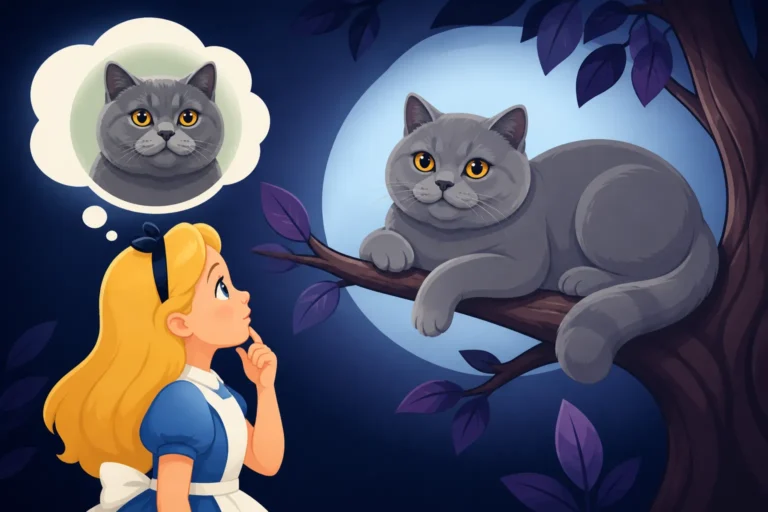
The Cheshire Cat is probably the most recognizable fictional cat people bring up when talking about British Shorthairs. Its broad face, rounded features, and substantial-looking body can remind viewers of the breed, especially in some illustrations and screen versions. But the character is a fictional design, not a documented British Shorthair animal actor.
The exact appearance also depends on which adaptation you mean. The Cheshire Cat has been drawn and portrayed in different ways over time, with colour, proportions, and expression changing from one version to another. A particular interpretation may look more like a British Shorthair than another, but that does not establish that the character “is” one.
So, it is fair to say that the Cheshire Cat is often compared with the British Shorthair. It is less accurate to list the character as a confirmed British Shorthair without explaining that the comparison is about appearance. The distinction is explored in Whether Alice's Cheshire Cat Was a British Shorthair.
Why animated cats are hard to classify by breed
Animation can borrow features from many kinds of cats without following a real breed standard. A round head might suggest a British Shorthair; a long coat might call to mind a Persian; a particular colour pattern might be borrowed from an ordinary mixed-breed cat. Artists can combine these traits to create a memorable character rather than a recognizable pedigree.
That freedom is part of what makes animated cats so expressive. A character’s grin, eyes, or exaggerated cheeks may be designed to communicate mischief or warmth, not to represent the anatomy of a real cat. It can be fun to spot breed-inspired details, but a visual resemblance should not be treated as proof of breed.
A helpful way to talk about these characters is to say they are “British Shorthair-like” or “often compared with British Shorthairs,” then name the feature that prompts the comparison. The round face and dense-looking coat are common reasons viewers make the connection. For a broader look at screen cats and breed associations, see Which Cartoon Cats Are British Shorthairs.
How to tell a confirmed appearance from a lookalike
Check whether the cat is fictional or an animal actor
Start by asking whether the cat is animated, computer-generated, or played by a real animal. With animation, a breed label is usually an interpretation unless the filmmakers explicitly established one. With live-action films, there may be an actual cat actor whose breed can sometimes be identified separately from the character.
Even in live-action, the character’s fictional identity and the animal’s breed are not interchangeable. A film may use several cats for different actions, a stunt double, or visual effects. The cat shown in a close-up might not be the same animal used for movement. A production’s casting information can help, but a photograph alone rarely settles the question.
For a quick check, use these questions:
- Is the character animated or live-action?
- Is there a named animal actor associated with the role?
- Is that animal actor’s breed clearly identified?
- Does the claim refer to the character, the actor, or merely the cat’s appearance?
- Are different films or adaptations being mixed together?
This approach avoids a common mix-up: seeing a sturdy grey cat and assuming it must be a British Shorthair. Plenty of cats can have similar colouring or a round face without being members of that breed.
Compare several features rather than coat colour alone
A blue-grey coat is strongly associated with the British Shorthair, but colour by itself is not a reliable identification. British Shorthairs come in a range of colours and patterns, and blue-grey cats can also be mixed-breed cats or members of other breeds. A screen cat might resemble a British Blue while having no confirmed breed information at all.
Look at the overall impression instead: a British Shorthair is typically known for a sturdy, cobby build, a broad head, rounded cheeks, and a dense coat that stands away from the body. Even then, film lighting, camera angles, grooming, and editing can change how those features appear. A cat can look rounder in a close-up or slimmer in a moving scene.
The breed’s familiar plush appearance is part of why movie audiences make the connection so readily. If you want to understand the real-life look behind that impression, What a Blue British Shorthair Looks Like and Why a British Shorthair Looks Like a Teddy Bear explain the features in more detail. They are useful comparisons, not a substitute for reliable casting information.
| Film or character | What can be said carefully | How strong the British Shorthair connection is |
|---|---|---|
| Church in Pet Sematary from 2019 | The cat actor Leo is identified as a British Shorthair | Strongest commonly cited live-action example |
| Church in Pet Sematary from 1989 | A separate film production with its own cat casting | Do not assume the 2019 actor’s breed applies |
| The Cheshire Cat in Alice in Wonderland | A fictional character often compared with the breed | Appearance-based association, not a confirmed breed |
| Other animated cats | Designs may borrow round faces, plush coats, or other breed-like traits | Usually uncertain unless creators specify a breed |
What the British Shorthair connection means for viewers
A breed resemblance is not a character fact
It is perfectly reasonable to enjoy recognizing a British Shorthair-inspired look in a film. The important thing is to keep the wording precise. “This cat reminds me of a British Shorthair” is a description of your impression. “This character is a British Shorthair” is a factual claim that needs stronger support, particularly when the character is animated.
This distinction is useful beyond film trivia. People often see a round-faced cat online and assume it is a particular breed, even when there is no pedigree or reliable background information. The same visual shortcut happens with movie cats. A familiar silhouette can spark recognition, but it cannot tell you the animal’s ancestry by itself.
If you are writing a list, making a quiz, or answering a child’s question, you can keep it both fun and accurate: name Church in the 2019 Pet Sematary as the clearest live-action example, then describe the Cheshire Cat as a popular lookalike rather than a confirmed breed. That gives the reader the satisfying answer without overstating what is known.
Why grey cats attract the label
The British Shorthair’s blue-grey variety has become one of the breed’s most recognizable looks. A broad face, dense coat, and round eyes can create the teddy-bear impression many people associate with the breed. When a film features a grey cat with a substantial build, viewers may naturally connect it with a British Shorthair, even when the film has not identified the cat’s breed.
There is also a practical reason the comparison can be difficult: the short screen appearance of a cat offers limited clues. A still image may show the face but not the body; a scene may use shadow that changes the apparent coat colour; and a plush coat can make an ordinary cat look especially round. In a film, the character’s personality and story usually matter more than the details needed for breed identification.
For a more reliable sense of what makes the breed recognizable, it helps to look beyond the colour and consider body shape, coat density, and head structure together. The breed’s appearance can also change as a cat matures, so a kitten or young adult may not yet have the full, rounded look that viewers expect. Whether a British Shorthair's Color Changes With Age offers more context on how appearance develops.
Frequently asked questions about British Shorthairs in films
Is the Cheshire Cat definitely a British Shorthair?
No. The Cheshire Cat is a fictional character, and the character’s look varies across adaptations. Viewers often compare its rounded features with the British Shorthair, but that is an appearance-based association rather than a confirmed breed identification. For a fuller discussion of the comparison, see Whether Alice's Cheshire Cat Was a British Shorthair.
Is Church in Pet Sematary a British Shorthair?
The 2019 film’s cat actor Leo is identified as a British Shorthair, making that version of Church the clearest example commonly associated with the breed. Keep the film versions separate, though: the original movie had its own production and animal casting, so the later casting detail should not automatically be applied to it.
Are there other well-known British Shorthairs in movies?
Many movie cats are described online as British Shorthairs because of their round faces, dense-looking coats, or blue-grey colouring. Those descriptions are not always confirmed. Unless a film’s creators or reliable production information identify the cat’s breed, it is more accurate to call the character a lookalike or say that viewers commonly compare it with the breed.
What is the safest short answer?
Church in the 2019 Pet Sematary is the strongest live-action answer. The Cheshire Cat is a famous fictional lookalike, not a confirmed British Shorthair. When discussing other screen cats, distinguish a documented animal actor from a character who simply has a similar appearance.
Disclaimer
This article is for general informational purposes only and does not constitute professional advice. Laws, prices and regulations vary by location and change over time. Consult a qualified professional for guidance on your specific situation.