What a Male British Shorthair’s Jowls Are
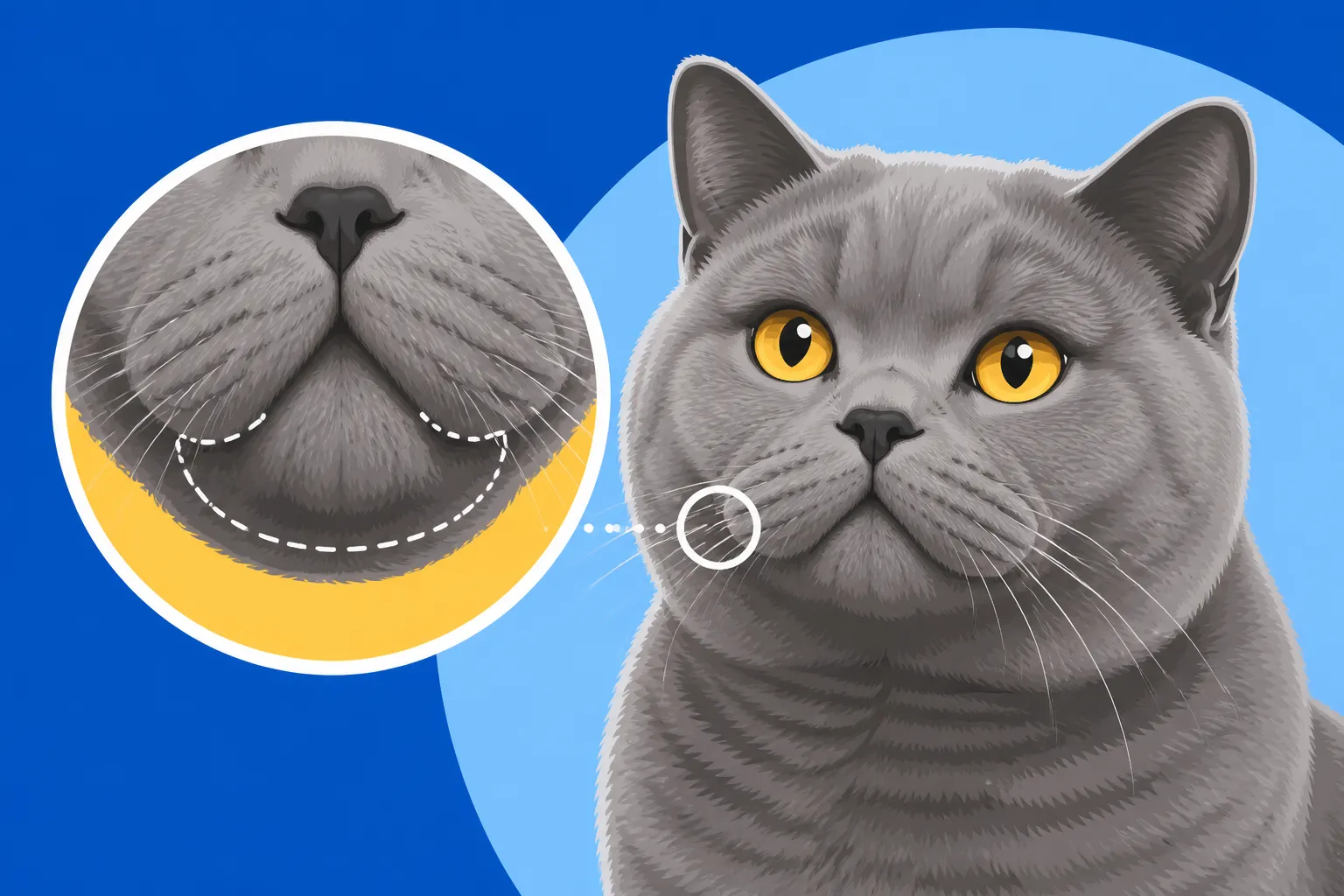
Many new owners bringing home a male British Shorthair expect a round face, but are surprised when massive, cushion-like cheek pads—known as jowls—begin expanding around the jawline. Understanding What Jowls Are on a Male British Shorthair helps you separate healthy breed characteristics from dangerous weight gain while mastering the specific grooming and feeding routines this unique, broad-jawed physique demands.
The Biology Behind Male British Shorthair Jowls
Testosterone and Secondary Sex Characteristics
When you watch an intact male British Shorthair grow from a gangly teenager into a mature tomcat, the transformation is nothing short of extraordinary. The physical shift is driven almost entirely by surges of testosterone during pubertal development. As hormone levels peak, testosterone triggers localized growth in the connective tissue, dermal layers, and underlying fat pads surrounding the masseter muscles of the cheeks.
This hormonal wash does not merely alter muscle mass; it fundamentally changes the density and thickness of the skin itself around the lower face and neck. The cheeks expand horizontally, softening the angle of the jaw and creating that quintessential, chubby-cheeked profile that breed enthusiasts adore. In intact males, these facial cushions serve as a visual signal of sexual maturity and physical dominance to rival tomcats and prospective queens.
For owners observing this change in real time, the sudden widening can be surprising. You might notice that a male who looked sleek and narrow at ten months suddenly starts filling out across the muzzle and lower face by eighteen months. This rapid widening is a completely normal biological response to testosterone, representing one of the most distinct secondary sex characteristics in the feline world.
Understanding this biological mechanism is key to managing your expectations. Hormonal jowls are not simple deposits of excess body fat; they are structured, dense dermal tissues built specifically under the instruction of sex hormones.
Anatomic Structure and Fat Deposit Patterns
To truly appreciate what is happening beneath your cat’s plush coat, you have to look at the anatomy of the feline head. The foundation consists of a wide, solid skull structure with broad zygomatic arches. Layered over these cheekbones are the powerful masseter muscles, which control chewing. In the male British Shorthair, a dense fibrous network sits directly beneath the skin, creating a specialized pocket for subcutaneous tissue and fat storage.
Unlike general body fat that accumulates around the abdomen or primordial pouch, the tissue within the facial jowls is reinforced by tough collagen bands. This fibrous lattice holds the cheek structure firm, preventing it from sagging loosely like skin folds seen in certain dog breeds. Instead, the cheek extends outward in a firm, rubbery arc that retains its shape even when the cat moves, leaps, or turns its head.
When you gently handle a mature male cat’s face, these jowls feel remarkably solid. They are not soft, squishy pockets of fluid or loose flab. Instead, they feel like dense, padded cushions wrapped tightly in a thick layer of hide and plush fur. This structural composition protects the delicate facial nerves, salivary glands, and blood vessels running beneath the jaw.
Because this tissue is so dense, it requires adequate blood supply and health maintenance. The dermal thickness in this area means the skin is less pliable than the skin on the torso, which influences how skin conditions present and how grooming tools must be maneuvered around the lower face.
Evolutionary Purpose of Heavier Cheek Pads
Why did nature equip male cats with such massive facial padding? In wild feline ancestors and unneutered free-roaming tomcats, life involves territorial defense and competition for breeding rights. Fights between intact males frequently involve swapping sharp bites and scratches aimed directly at the head, neck, and throat.
The primary evolutionary purpose of heavy facial jowls is physical protection. The thick, rubbery layer of collagen and dense subcutaneous fat acts as built-in body armor. When a rival tomcat bites down on the side of the face, its sharp canine teeth penetrate the thick padding of the jowl rather than puncturing critical structures like the jugular vein, carotid artery, or facial nerve channels.
Additionally, these broad, formidable facial cushions serve a vital visual purpose. A tomcat with massive, expansive jowls appears significantly larger and more intimidating to rivals from a distance. Often, a brief standoff where two males display their broad head profiles is enough to settle a territorial dispute without resorting to actual physical conflict.
In a comfortable domestic environment, your pet British Shorthair certainly will not be battling rival tomcats for survival. However, these deep evolutionary blueprints remain hardwired into the genetics of the breed, giving us the distinctive, charming appearance we cherish today.
Intact vs Neutered Males: How Timing Shapes the Face
The Impact of Early Neutering on Head Shape
One of the most frequent discussions among British Shorthair owners centers on the timing of neutering and how it affects the development of those coveted facial cheeks. When a male cat is neutered early—typically before six to eight months of age—the primary source of testosterone is removed before the hormonal surges of puberty can trigger heavy dermal tissue growth.
Cats neutered early will still grow into sturdy, medium-to-large felines with broad skull structures, thanks to their underlying bone genetics. However, they will generally lack the heavy, thick, rubbery facial cushions seen in intact show studs. Their faces tend to look somewhat smoother, cleaner, and less extreme in horizontal width, blending gracefully from the cheekbones down into the neck line.
This does not mean an early-neutered male will have a narrow or wedge-shaped face like a Siamese. The British Shorthair breed standard mandates a broad, round skull regardless of sex or reproductive status. The genetic blueprint provides a strong, wide jawline; early neutering simply prevents the additional, thick collagen padding from building up over that bone frame.
Many owners actually prefer the slightly softer, sweeter expression of an early-neutered male. Without heavy jowls obscuring the jawline, the cat retains a cheerful, open face that requires somewhat less maintenance around skin folds and neck creases.
Delayed Neutering and the Permanent Retention of Jowls
For breeders or owners who choose to delay neutering until a male reaches full sexual maturity—often around eighteen to twenty-four months—the testosterone exposure allows the facial jowls to form fully. Once these thick dermal cushions and collagen networks are established, they do not simply vanish if the cat is neutered later in life.
When a mature tomcat with fully developed jowls is castrated, the drop in circulating testosterone causes the fat deposits within the cheeks to soften slightly, but the dense fibrous lattice remains intact. The cat will permanently retain a significantly broader, heavier jawline than a male neutered in early kittenhood. Knowing Whether a Neutered British Shorthair Keeps His Jowls can reassure owners who adopt retired breeding studs, as these handsome, broad-faced cats keep their regal, massive head structure for life.
Retaining these permanent jowls gives retired studs a strikingly masculine, classic “teddy bear” appearance. However, owners taking in an older intact or late-neutered male should prepare for the unique physical traits that come with this structure, including deeper skin folds and heavier skin around the throat.
The decision of when to neuter should always be made in close consultation with your veterinarian, balancing facial aesthetics against behavioral considerations like territorial spraying, roaming urges, and long-term health benefits.
Distinguishing Between True Hormonal Jowls and Breed Standard Width
It is common for new owners to confuse genetic skull width with hormonal jowls. Every British Shorthair, whether male or female, intact or neutered, should possess a rounded head with good width between the ears and strong cheekbones. This broadness is rooted in skeletal structure and dense coat texture, not hormone-driven fat pads.
True hormonal jowls are distinct physical structures that extend beyond the bone line. They feel like heavy, fleshy pads hanging along the lower edge of the mandible, creating an exaggerated circular outline when viewed directly from the front. Bone structure, by contrast, provides the firm, underlying frame that supports the eyes, muzzle, and ears.
| Feature | True Hormonal Jowls | Genetic Skull Width |
|---|---|---|
| Primary Tissue Composition | Collagen, dense skin, dermal fat | Bone frame, masseter muscle mass |
| Hormonal Requirement | Intact or late-neutered testosterone | Genetic profile (present in all) |
| Tactile Texture | Rubbery, firm, compressible padding | Hard, unyielding bone structure |
| Impact on Maintenance | Requires fold wiping & skin care | Standard grooming & coat care |
Understanding this distinction prevents owners from mistakenly trying to force cheek development through overfeeding. You cannot feed a cat into growing hormonal jowls; feeding a neutered male excessive calories will only result in an overweight cat with an enlarged body pouch, rather than a broad, handsome face.
Always judge your cat’s facial width against his genetic lineage rather than attempting to manipulate his head shape through dietary changes or delayed care.
Timeline of Development: Watching the Tom Face Evolve
The Slim Kitten Phase from Kittenhood to Twelve Months
If you bring home a male British Shorthair kitten at twelve weeks old, you might look at his head and wonder where those famous cheeks are hiding. During the first year of life, a kitten allocates almost all of his energy toward skeletal growth, muscle development, and internal organ maturity.
Between six and twelve months, many male British Shorthairs go through what breeders affectionately refer to as the “lanky teenage stage.” Their legs seem a bit long, their ears look proportionally large, and their faces appear comparatively narrow or wedge-like when matched against mature adults. This phase often causes anxious owners to worry that their kitten will not develop the iconic breed look.
It is crucial during this initial phase to focus on providing balanced nutrition rather than worrying about head width. Understanding How Long a British Shorthair Takes to Fill Out reassures owners that this slow, steady development is normal. Growth in this breed is a marathon, not a sprint, and early facial narrowness is expected.
Patience is your best companion during your cat’s first year. Keep him active, feed him a high-quality kitten diet, and let his genetic programming take its course without trying to rush his physical maturation.
The Filling Out Years Between Two and Five Years
While many domestic cat breeds finish growing by their first birthday, the British Shorthair is notoriously slow to mature. Real head expansion, chest broadening, and jowl development typically accelerate between two and three years of age, continuing steadily until the cat reaches full physical maturity around age five.
During these intermediate years, you will witness dramatic shifts in your cat’s proportions. The ribcage deepens, the shoulders broaden, and the neck thickens, seamlessly blending the jawline into the torso. If your male remains intact or was neutered later in young adulthood, this is the window where his cheek cushions will swell and firm up dramatically.
Owners often report waking up one day around their cat’s third birthday and realizing his collar needs loosening or that his facial features have completely changed. Knowing When a British Shorthair Reaches Its Adult Head helps you track these milestones accurately over several years rather than months.
This multi-year growth phase means you should keep careful track of his weight, body condition, and equipment size. Collars, harnesses, and even feeding bowls may need upgrading as his head frame and neck circumference expand over time.
How Genetics and Family Lines Dictate Cheek Width
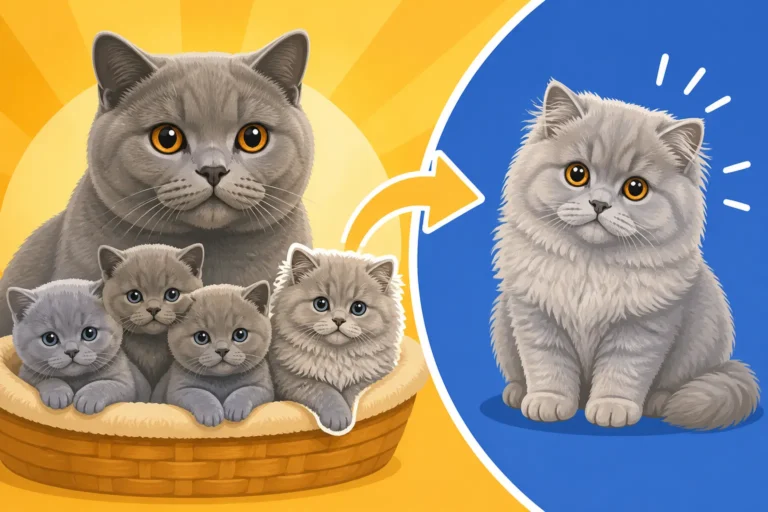
While hormones provide the trigger for maximum jowl growth, genetics set the ultimate boundaries for how wide your cat’s face can become. Bloodlines play a massive role in determining whether a male will develop moderate cheeks or truly massive, show-stopping jowls.
When selecting a kitten, looking closely at the sire and grand-sires provides the most reliable preview of your cat’s adult head structure. Researching whether Parents Predict a British Shorthair’s Size and cheek width gives prospective owners realistic expectations regarding their kitten’s future development. If the sire has exceptionally broad, heavy features, his male offspring are far more likely to inherit the underlying structural framework necessary for large cheeks.
However, environmental factors like overall health, early nutrition, and stress levels also influence how effectively a cat reaches his genetic potential. A kitten raised on high-quality food in a low-stress home will develop far more smoothly than one recovering from chronic early illnesses.
Celebrate your cat’s unique genetic inheritance. Whether he turns out to have moderate cheek pads or an impossibly round head, his structural traits are a testament to his lineage and careful breed selection.
Differentiating Healthy Jowls From Overweight Fat Deposits
Evaluating Facial Structure Versus Body Fat
Because British Shorthairs are naturally sturdy, heavy-boned cats with thick cheeks, owners frequently struggle to determine whether their male is nicely developed or dangerously overweight. It is easy to point to a round face and assume the entire cat is in top physical condition, when in reality excess subcutaneous fat is masking poor muscle tone.
True hormonal jowls are isolated primarily to the sides of the cheeks and the lower jawline. They leave the eye area clear and should not create excessive roll-like folds over the throat that impede breathing or movement. In contrast, generalized obesity causes fat deposits across the entire body, including the chest, groin, spine, and under the arms.
To tell the difference, you must look beyond the head. Learning How to Tell a Chunky British Shorthair From a Fat One involves examining the waistline, feeling for the ribs, and observing how the cat moves. A healthy male with large jowls should still possess a discernible waist when viewed from above and should move with strength and agility.
If your cat’s broad face is accompanied by a sagging abdominal pad that sways heavily when he walks, his rounded cheeks may be part of an overall obesity issue rather than pure genetic broadness.
Using Body Condition Scoring Through the Dense Plush Coat
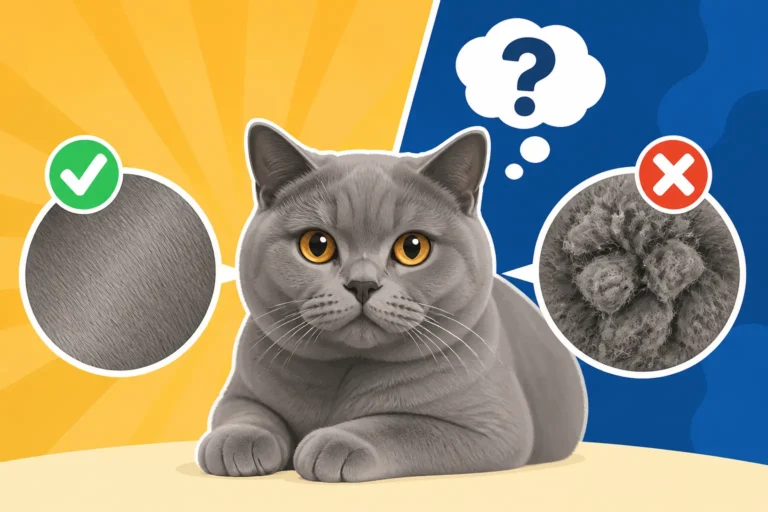
Assessing body fat in a British Shorthair is notoriously challenging due to their dense, double-layered coat. The crisp, plush fur stands away from the body, creating an optical illusion that makes even lean cats look remarkably thick. Relying purely on visual inspection often leads owners to misjudge their cat’s health.
To accurately evaluate his condition, you must perform a hands-on physical exam using the standard nine-point Body Condition Score (BCS) system:
- Rib Check: Run your hands gently along his ribcage. You should be able to feel the ribs under a light layer of tissue without pressing hard. If you feel bare bone with no cushioning, he is underweight; if you cannot feel ribs at all beneath the padding, he is overweight.
- Spine and Hip Check: Pass your fingers along his backbone and over his hips. The bony prominences should be smooth but detectable.
- Waist Inspection: Look down at your cat from above while standing over him. Look for a subtle tuck behind his ribs.
- Abdominal Profile: View him from the side to check his underline. A heavy hanging belly that drags low suggests excess fat rather than normal muscular depth.
Remember that Obesity Is the British Shorthair’s Real Disease, posing severe risks to joints, heart health, and lifespan. Keeping his body lean protects his internal organs while allowing his natural facial structure to shine without being obscured by unhealthy fat.
Regularly performing this hands-on check ensures that you remain aware of his true body composition beneath that luxurious, deceptive coat.
When Big Cheeks Mask Metabolic and Mobility Issues
When a cat carries excessive weight across his body under the guise of being “broad and jowly,” his overall mobility and grooming capabilities suffer drastically. Extra weight places incredible strain on hip, knee, and ankle joints, leading to premature arthritis in a breed that is already naturally heavy-set.
Furthermore, an obese male cat with large facial features and a thick neck will face immense difficulty reaching the back half of his body during daily grooming routines. Knowing Why an Overweight British Shorthair Stops Grooming Its Back highlights how excess bulk around the neck and waist physically prevents a cat from flexing his spine to clean his spine, hind legs, and sanitary area.
This immobility quickly leads to matted fur, dander accumulation, and painful skin inflammation along the lower back and tail base. What began as a mismanaged diet can quickly spiral into chronic discomfort and secondary skin infections that require veterinary intervention.
If you notice your broad-faced male avoiding jumps, struggling to turn around while grooming, or developing greasy, scaly fur along his spine, consult your veterinarian immediately to establish a safe, gradual weight loss plan.
Daily Care and Hygiene for Deep Cheek Folds
Managing Food Debris and Moisture in Facial Creases
The majestic, padded cheeks of a male British Shorthair create subtle skin creases around the corners of the mouth, under the chin, and along the upper neck line. While these folds are rarely as deep as those found on brachycephalic dog breeds, they can easily trap moisture, stray canned food, and saliva during daily eating and grooming.
When wet food accumulates in these warm, dark creases, it creates an ideal breeding ground for bacteria and yeast. Over time, trapped moisture can cause localized dermatitis, foul odors, and hair loss along the lower jawline. Owners must establish a habit of inspecting and wiping these facial folds after meals.
A gentle wipe down with a damp, warm microfiber cloth or an unscented, alcohol-free pet wipe is usually all it takes to keep the area clean. Pay close attention to the small pockets directly beneath the lower lips and the fold where the jowl meets the throat.
| Hygiene Task | Recommended Frequency | Primary Benefit |
|---|---|---|
| Facial Fold Wipe | Daily (post wet-food feeding) | Prevents yeast, bacteria & odor |
| Deep Coat Combing | 2–3 times weekly | Removes shed undercoat, avoids mats |
| Chin & Jaw Inspection | Weekly | Catches feline acne early |
| Whisker-Safe Bowl Wipe | After every meal | Minimizes facial grease buildup |
Making this brief wipe-down part of your post-meal routine keeps your cat comfortable, smelling fresh, and free from irritating skin infections.
Grooming Tools That Reach Around Heavy Jawlines
Grooming a broad-headed male cat requires tools designed to navigate thick dermal layers and dense fur without scraping delicate skin. Standard slicker brushes with sharp wire pins can irritate the skin folds around heavy jowls, causing discomfort that makes the cat resist grooming entirely.
Instead, invest in a high-quality steel greyhound comb with smooth, rounded teeth. Discovering Which Comb Reaches a British Shorthair’s Undercoat allows you to gently work through the thick fur along the cheeks, neck ruff, and throat without pulling or scratching. A comb gives you tactile feedback, letting you feel small knots or skin irregularities before they turn into full mats.
When shopping online via platforms like Chewy or Amazon, look specifically for coarse/fine combination metal combs and soft rubber curry brushes. Rubber brushes are fantastic for massaging the heavy cheeks and removing loose surface hairs while stimulating healthy oil production across the dermal layer.
Always groom in the direction of hair growth around the face, using short, gentle strokes. Turn the session into a bonding experience by pairing grooming with subtle cheek scratches, which most cats find deeply pleasurable.
Preventing Skin Infections and Acne Near the Jowls
Feline acne is a common annoyance in British Shorthairs, frequently appearing as small blackheads or inflamed red bumps around the chin and lower jowls. Because the skin around heavy cheeks contains numerous sebaceous glands, oil production can easily clog pores if hygiene is neglected.
Plastic feeding bowls are a major contributor to facial acne. Plastic is porous and easily develops microscopic scratches that harbor stubborn bacteria, even after being washed. When your cat’s broad cheeks press against a plastic bowl while eating, those bacteria transfer directly into his skin pores.
To prevent outbreaks, switch exclusively to wide, shallow dishes made from stainless steel, ceramic, or glass. Wash these dishes thoroughly with hot water and soap after every single meal to maintain a sterile eating surface.
If you spot red, inflamed spots or crusty dark debris along your cat’s jaw line, avoid popping or scrubbing the lesions. Gently cleanse the area with a dilute chlorhexidine solution recommended by your veterinarian to soothe inflammation without drying out the skin.
Nutritional Management and Portion Control for Jowly Cats
Caloric Needs of Broad-Headed Heavy-Set Males
Because male British Shorthairs possess heavy bones and significant muscle mass, their baseline caloric requirements differ from lighter, finer-boned domestic breeds. However, their notoriously low energy levels mean they burn far fewer calories throughout the day than highly active breeds like the Bengal or Abyssinian.
Overestimating your cat’s daily caloric needs based on his large frame is one of the quickest ways to cause obesity. A mature, neutered indoor male usually requires fewer total calories than owners expect, despite his impressive size and wide facial structure.
When evaluating diet options, focus on high-protein, moderate-fat recipes that support lean muscle mass without adding empty carbohydrate calories. Feline diets must strictly adhere to obligate carnivore standards with precise taurine and mineral balances.
Calculate his daily food portions based on his ideal target weight rather than his current scale weight if he needs to drop a few pounds. Adjust his intake in small increments, monitoring his body condition score every few weeks to ensure steady progress.
Wet Food vs Dry Kibble for Jaw Exercise and Hygiene
The debate between wet food and dry kibble takes on unique nuances when dealing with broad-jawed breeds. Dry kibble requires significant crunching, which provides mild mechanical exercise for the powerful masseter muscles along the jawline. However, kibble alone fails to provide adequate hydration and often contains higher starch levels.
High-quality wet food is ideal for maintaining proper hydration and urinary tract health, which is critical for heavy-set males prone to bladder issues. Wet food also facilitates easy calorie control and leaves less carbohydrate residue sticking to teeth surface compared to starchy kibble.
A mixed-feeding approach often works best for domestic cats. Offering measured portions of wet food as the primary meal ensures moisture intake, while a small, strictly portioned amount of dental-focused dry kibble can encourage healthy chewing activity and jaw engagement.
Whichever food type you choose, strict portion control remains the ultimate tool for keeping your cat at a healthy weight. Never leave a bowl of food out for free-feeding; a British Shorthair will almost always overeat if given unrestricted access to kibble.
Feeding Tools and Bowls Designed for Wide Whiskers and Cheeks
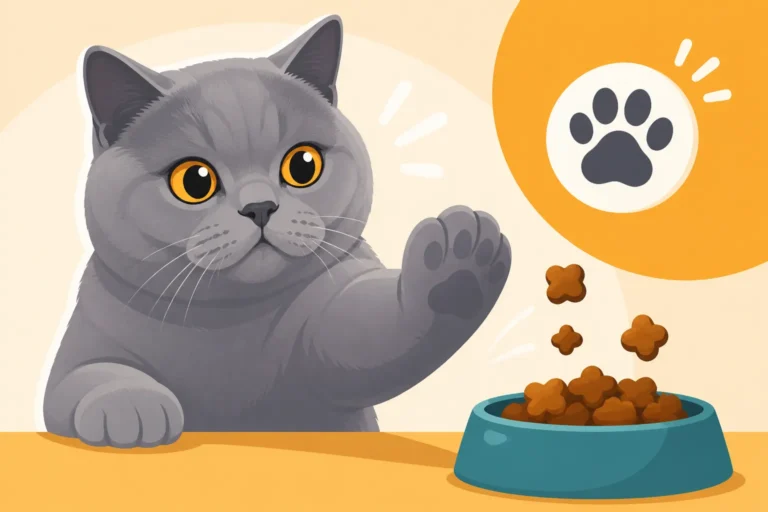
Standard, high-sided pet bowls are poorly suited for the unique anatomy of a male British Shorthair. With his wide, flattened face, heavy cheek pads, and sensitive whiskers, forcing his face into a narrow, deep bowl causes significant discomfort known as “whisker fatigue.”
When a broad-faced cat eats out of a deep bowl, his wide cheeks press against the rigid sides, forcing him to scoop food out at awkward angles. This frustration often leads cats to scoop food onto the floor with their paws or abandon their meal entirely.
To solve this issue, choose wide, shallow dishes with low, gently sloping edges or elevated tilted platters. You can find an array of ergonomic, whisker-friendly dishes on Chewy or Amazon designed specifically for broad-faced breeds.
| Bowl Design Feature | Poor Choice (Standard Deep Bowl) | Ideal Choice (Ergonomic Platter) |
|---|---|---|
| Bowl Diameter | Narrow (< 5 inches) | Wide (> 7–8 inches) |
| Side Height | Tall, steep vertical walls | Low, shallow or rimless edge |
| Material | Porous plastic | Stainless steel or ceramic |
| Impact on Cat | Whisker stress & messy facial folds | Comfortable, clean eating access |
Elevated feeding dishes also reduce neck strain, allowing your heavy-set cat to eat in a natural, relaxed posture that minimizes swallowed air and improves digestive comfort.
Comparing Facial Structure Across British Shorthair Variants and Other Breeds
Male vs Female Cheek Broadness
While female British Shorthairs are absolute beauties with sweet, round faces, their head structure differs notably from that of mature males. Females possess fine, graceful rounded heads with pleasant cheek width, but they lack the heavy, rubbery hormonal jowls seen in intact or late-neutered males.
A female’s face derives its roundness primarily from her genetic bone structure, compact muzzle, and dense, plush fur standing outward. Her neck line remains cleaner, and her jawline transitions more smoothly into her chest without the thick dermal padding that characterizes the tomcat look.
This difference in structure means females rarely develop deep facial skin folds or the associated hygiene concerns around the jawline. Their faces require standard coat brushing and eye wiping, making their facial care somewhat lower maintenance.
Appreciating these distinct sexual dimorphisms helps owners appreciate both genders for their unique structural charms rather than expecting a female to grow the massive head pads typical of a breeding stud.
British Shorthair Compared to Persians and Exotic Shorthairs
It is helpful to compare the British Shorthair’s facial architecture with other popular broad-headed breeds like the Persian and the Exotic Shorthair. While all three breeds boast circular heads, their facial mechanics and tissue structures are quite distinct.
The Persian and Exotic Shorthair feature extreme brachycephaly, meaning their skulls are shortened front-to-back, placing their nose break directly between their eyes. Their facial roundness comes from flat bone profiles, compressed jaw architecture, and shortened nasal passages, which frequently lead to tearing issues and breathing resistance.
In contrast, the British Shorthair possesses a moderate, healthy facial structure with a distinct muzzle, deep chin, and broad skull. Learning Why a British Shorthair Looks Like a Teddy Bear highlights how his rounded profile is created by firm cheek padding, short dense fur, and broad cheekbones, rather than extreme skeletal flattening.
This moderate anatomy gives the British Shorthair a clear functional advantage: he enjoys normal breathing, efficient self-grooming, and minimal tear-duct overflow while maintaining that coveted, adorable circular head shape.
Visual Summary of Facial Growth and Characteristics
To summarize how facial structure, jowls, and maintenance needs evolve throughout a male British Shorthair’s life, reference this quick-guide timeline:
| Life Stage | Visual Head Characteristics | Primary Care Focus |
|---|---|---|
| Kitten (0–12 mos) | Narrow, lanky frame; large ears | High-protein growth nutrition |
| Young Adult (1–2 yrs) | Skeleton broadens; muzzle rounds | Introduce whisker-friendly dishes |
| Mature Adult (2–5 yrs) | Maximum jowl padding (if intact) | Daily fold wipes, weight management |
| Senior (10+ yrs) | Muscle mass shifts; soft cheeks | Gentle comb care, joint monitoring |
Understanding what a male British Shorthair’s jowls are—and how they develop over time—allows you to embrace your cat’s magnificent physical journey. By maintaining proper hygiene around his facial folds, choosing whisker-friendly feeding equipment, and keeping his weight carefully balanced, you ensure your broad-cheeked companion stays happy, handsome, and healthy throughout his long life.
Disclaimer
This article is for general informational purposes only and does not constitute professional advice. Laws, prices and regulations vary by location and change over time. Consult a qualified professional for guidance on your specific situation.