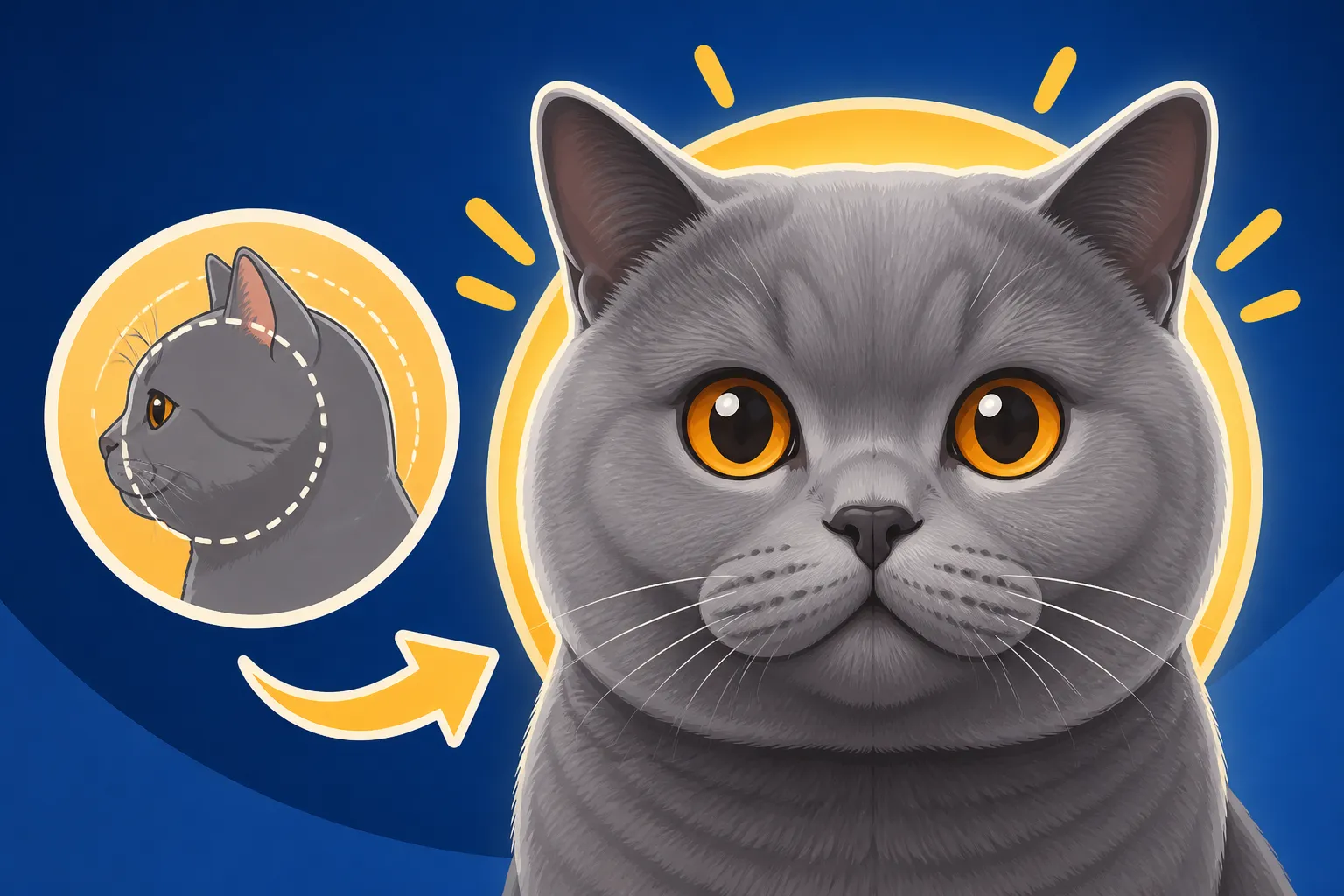
Why a British Shorthair’s Head Is So Round
A British Shorthair’s round head is one of the first things people notice: broad cheeks, a short muzzle and large, open-looking eyes give the breed its familiar teddy-bear expression. That shape comes from a combination of skull structure, inherited traits and gradual development—not simply a thick coat. Here’s what creates the look, how it changes with age, and what to notice if a cat’s face seems unusual.
The features that make a British Shorthair’s head look round
Skull shape, cheeks and muzzle work together
The round appearance is not one feature by itself. A British Shorthair typically has a broad skull, a full face and rounded contours that flow from the forehead toward the cheeks. The muzzle is relatively short, but it should not look sharply pinched or extremely flat. Together, these proportions create a face that appears broad rather than long or angular.
The cheeks contribute a lot to the impression. On a mature cat, they can look especially full, adding width around the lower part of the face. When people describe a British Shorthair as having a “round head,” they are often noticing the combined effect of the skull, cheek shape and muzzle—not a perfectly circular outline.
The coat can make that outline seem even softer. British Shorthairs have a dense, plush coat that stands away from the body, so fur around the cheeks and jaw may blur the line between the face and neck. The head’s structure is still underneath. You can explore the breed’s overall proportions in The Round Head and Copper Eye a British Shorthair Is Judged On and Why a British Shorthair Looks Like a Teddy Bear.
Eyes and ears add to the expression
The eyes also influence how round the head appears. They are generally large and set well apart, which gives the face an open expression. Their shape and placement can make the cheeks look broader and the forehead more rounded, even though the eyes themselves do not determine the skull’s structure.
The ears are usually set apart rather than close together. This spacing helps preserve the broad, balanced look of the head. Ears that appear too large, too pointed or too close together can make a face seem narrower or more triangular by comparison. The overall impression comes from how the parts relate, not from any one measurement.
A British Shorthair’s expression is sometimes described as smiling or teddy-bear-like, but those are everyday descriptions, not signs of a specific mood. A cat can look placid while feeling alert, uncertain or mildly annoyed. If you’re curious about how the facial expression relates to breed traits, Why a British Shorthair Looks Like It Is Smiling and Which Eye Colors a British Shorthair Has provide useful context.
How breeding shaped the British Shorthair’s face
A distinctive look develops over generations
The British Shorthair did not acquire its characteristic face in a single generation. Breeders have selected for a sturdy, rounded appearance over time, while also working within breed standards that describe the desired balance of features. A broad head, full cheeks and a compact-looking muzzle are part of that recognizable type.
That does not mean every cat has an identical face. Breed standards describe an ideal, not a guarantee that each individual will match it exactly. Some British Shorthairs have a more pronounced cheek line; others have a slightly longer-looking muzzle or a less circular outline. Family traits, age, sex and individual variation all play a part.
The breed’s history also helps explain why appearance is discussed in terms of a standard. British Shorthairs were shaped through deliberate breeding and later rebuilt with outcrosses after population declines. Those events influenced the modern breed’s appearance and gene pool, but they do not mean that every cat today has the same head shape. For more on that history, see The British Shorthair Started as a British Street Cat and The Persians That Rebuilt the British Shorthair After the War.
A round head is not the same as an extremely flat face
“Round” can be misunderstood as “flat.” A British Shorthair’s muzzle may look compact, but the face should retain a visible nose and a balanced profile. The breed is not defined by an extremely shortened, pushed-in face. A very flat profile can be a sign that someone is describing a different type of cat, or that an individual’s features fall outside the commonly recognized British Shorthair look.
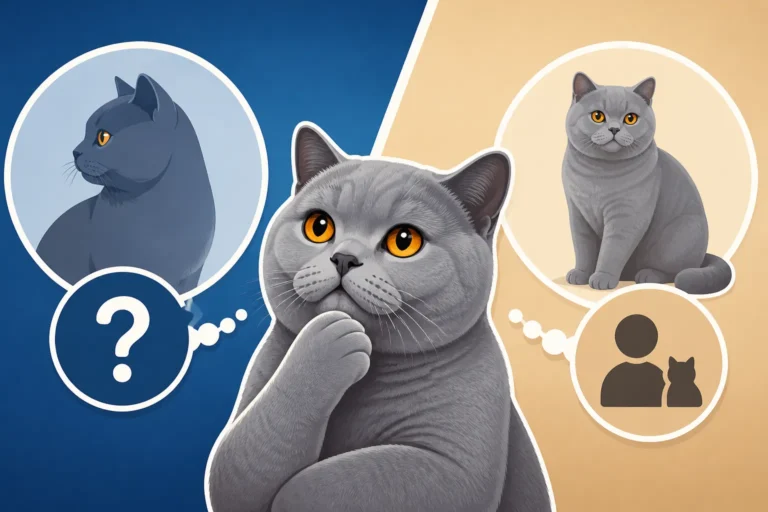
A useful way to assess the face is to look at the whole head from the front and side. From the front, the face should appear broad and balanced. From the side, the nose and muzzle should remain visible rather than seeming compressed into the forehead. A close-up photo can exaggerate the nose or cheeks, so it helps to look at several images taken from different angles.
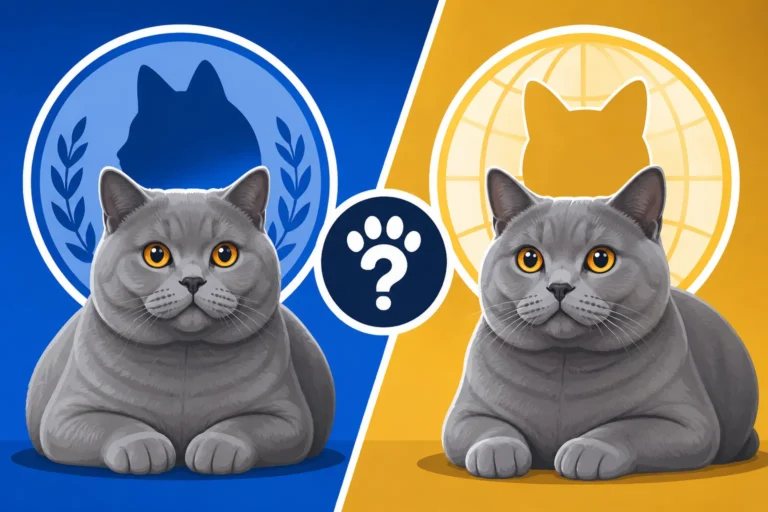
If you are comparing cats, avoid relying on a single word in an advertisement or a seller’s description. “Round-faced” is not by itself proof of breed, health or quality. The broader overview in How to Tell a British Shorthair From a Moggy explains why appearance alone cannot establish a cat’s background.
Why a British Shorthair’s head changes as it grows
Kittens do not have the finished adult look
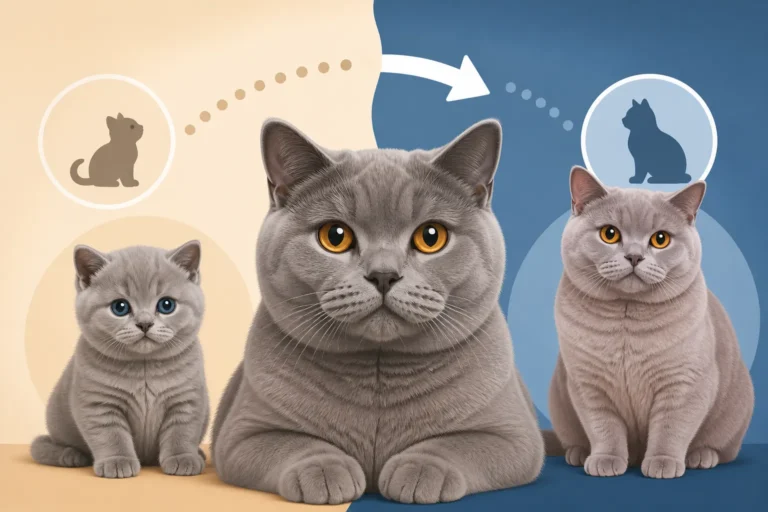
A British Shorthair kitten can look round, but the adult proportions are still developing. Young cats often have a softer, less defined face, and their ears may seem large in relation to the rest of the head. As the kitten grows, the skull and muzzle develop, the coat thickens, and the proportions gradually change.
This can be surprising if you expect a kitten to look like a miniature adult. British Shorthairs mature slowly compared with cats that reach their adult proportions sooner. A kitten’s head may look narrower at one stage and fuller later, while the body is also becoming more substantial. There is no single birthday when every cat’s face suddenly becomes “finished.”
Photographs can make the change look more dramatic than it is. A kitten photographed with a wide-angle phone lens may appear to have a larger head or shorter muzzle than it does in person. Lighting, posture and camera distance also affect how broad the face seems. For growth context, see When a British Shorthair Reaches Full Size and How Long a British Shorthair Takes to Reach Full Weight.
Mature males may develop fuller cheeks
Adult male British Shorthairs are often described as having prominent cheeks or “jowls.” In an intact male, these fuller cheeks can be particularly noticeable. This is a normal sex-related feature in many cats, although the degree varies. Some males have a very full lower face; others have a subtler outline.
Cheek fullness is not a reliable way to judge whether a cat is overweight. The head’s shape, coat density and natural fat distribution can all affect appearance. If you are concerned about weight, consider the cat’s body condition and ask a veterinary professional to assess it rather than using face shape as the deciding clue. The guide What Full Cheeks Mean on a British Shorthair covers this feature in more detail.
| Feature | How it contributes to a round appearance | What to keep in mind |
|---|---|---|
| Broad skull | Gives the head width and a rounded outline | Individual head shapes still vary |
| Full cheeks | Adds softness and width around the face | Cheek fullness is often more noticeable in mature males |
| Compact muzzle | Keeps the face from looking long or narrow | Compact does not mean extremely flat |
| Widely set eyes | Creates an open, broad expression | Eye appearance does not determine skull shape |
| Spaced ears | Helps balance the width of the head | Assess ear placement as part of the whole face |
| Dense coat | Softens the outline around the cheeks and jaw | Fur can make the head look rounder than its structure alone |
When a head shape deserves a closer look
Normal variation versus a sudden change
A British Shorthair’s head shape is best judged as a stable physical feature. A naturally broad face, full cheeks or a slightly longer muzzle can all fall within ordinary individual variation. A sudden change is different. New swelling, one-sided puffiness, a sore area or a change that appears over a short period is not simply a breed trait and should be discussed with a veterinarian.
Pay attention to function as well as appearance. Difficulty eating, drooling, reluctance to open the mouth, repeated pawing at the face or obvious discomfort can point to a problem that needs assessment. These signs are more meaningful than whether the head looks perfectly round in a photograph.
It can be hard to spot gradual changes under a thick coat. If you notice that the face looks different, compare recent photos with older ones and note when the change began. A clear timeline can help a veterinary team understand whether the appearance is longstanding or new.
Choosing a kitten without chasing an exaggerated look
If you are choosing a British Shorthair kitten, look for overall balance rather than the roundest face you can find. Ask about the kitten’s parents, health care and socialization, and view the kitten in person where possible. A very round photograph may be flattering, but it cannot tell you how the cat moves, breathes, eats or behaves.
It is also worth being cautious when a seller treats an exaggerated facial shape as proof of superior quality. A responsible conversation should include the cat’s health and welfare, not just appearance. Ask how the kitten is developing and whether the breeder can explain the differences between the kitten’s current features and the expected adult look. Which Questions to Ask a British Shorthair Breeder offers a broader checklist for that conversation.
Finally, remember that the familiar British Shorthair face is a combination of traits, not a promise that every cat will match a photograph or show-ring ideal. A healthy, comfortable cat with a slightly less dramatic profile is still a British Shorthair with its own individual look. The round head is part of the breed’s appeal, but it is only one part of the animal in front of you.
Disclaimer
This article is for general informational purposes only and does not constitute professional advice. Laws, prices and regulations vary by location and change over time. Consult a qualified professional for guidance on your specific situation.