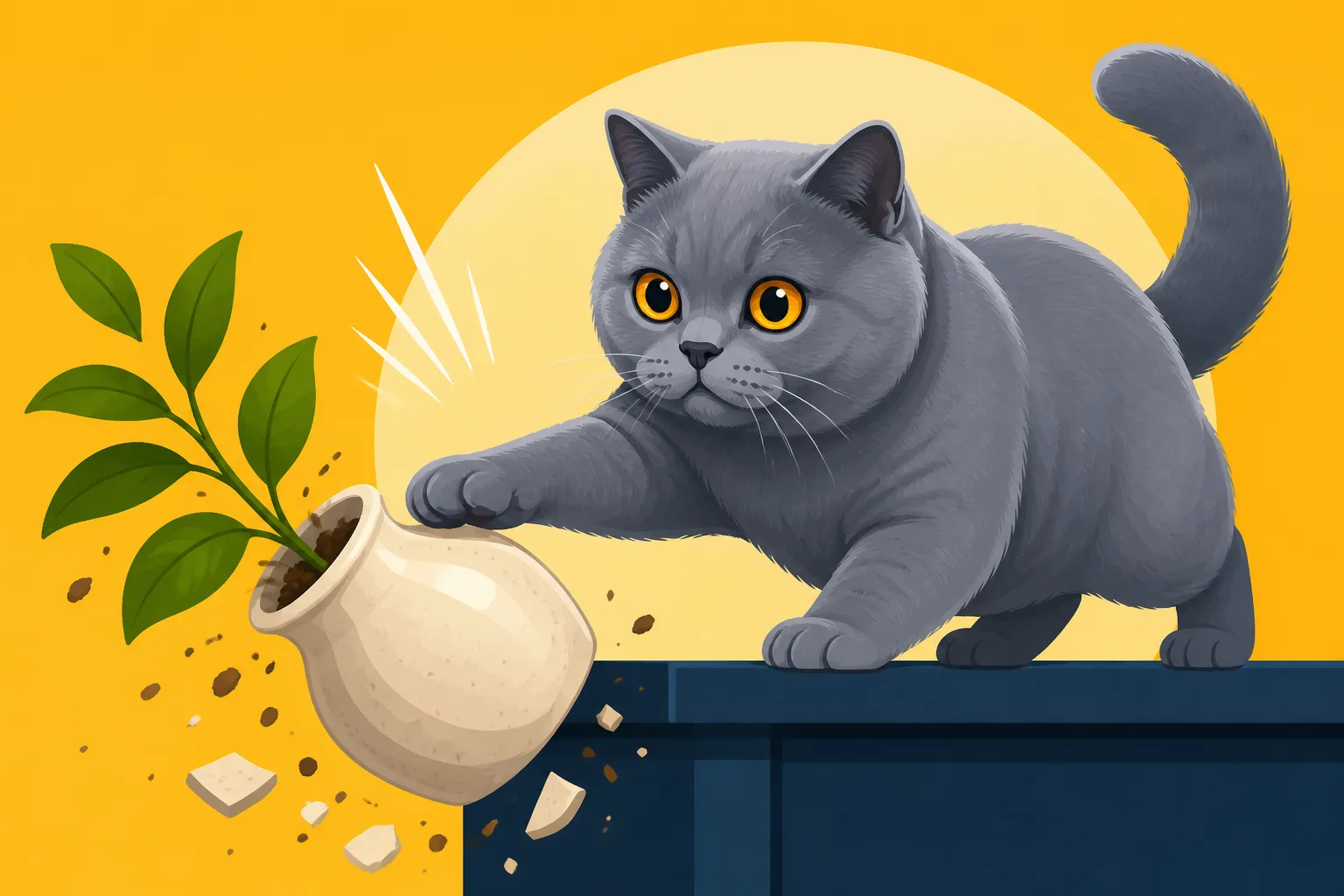
Whether a British Shorthair Knocks Things Over
It's a common cat owner lament, isn't it? You walk into a room, only to find your favorite mug shattered on the floor or a plant pot tipped over, its contents scattered like confetti. The culprit? Often, a mischievous feline who clearly thought the item was just asking to be investigated via gravity. Many prospective British Shorthair owners wonder if these famously placid cats are prone to such destructive antics. This guide will delve into the British Shorthair's nature and physical traits to help you understand if your chunky charmer is likely to be a tabletop terror or a gentle guardian of your possessions.
The British Shorthair's Demeanor and Physical Traits
When you think of a cat that's likely to scale bookshelves, leap onto mantelpieces, and bat objects to the floor with gleeful abandon, a British Shorthair might not be the first image that springs to mind. There's a reason for that, and it largely comes down to their inherent personality and distinctive physical build. These aren't the wiry, hyperactive daredevils of the feline world.
Their Calm and Unflappable Nature
British Shorthairs are renowned for their calm, easygoing, and incredibly stoic temperament. They are often described as being more like a furry, quiet companion than a boisterous pet. While every cat has its own unique personality, the breed standard leans heavily towards a placid disposition. This means they are far less likely to exhibit the manic energy that often translates into frantic dashes through the house, sending items flying in their wake. They prefer observation to participation in high-octane hijinks.
Imagine a serene, furry Buddha statue perched on your sofa, quietly observing the world go by. That's often the vibe a British Shorthair gives off. They're not generally known for their athletic prowess in the way some other breeds are, nor do they typically possess an insatiable urge to explore every single high surface in your home. Their curiosity is usually tempered with a healthy dose of "is this really worth the effort?" which means fewer spontaneous leaps onto precarious shelves. They are rarely demanding, preferring to relax near you rather than climb all over you or your belongings. This quiet contentment usually means your ornaments are safe from their paws. To understand more about their typical behavior, you might want to read What a British Shorthair's Temperament Is Really Like.
The Cobby Build and How It Affects Movement
One of the most defining characteristics of the British Shorthair is their robust, "cobby" body type. They possess broad chests, strong, short legs, and a dense, plush coat that makes them look even more substantial than they already are. This isn't a breed built for delicate ballet leaps or agile aerial maneuvers. Their physical structure is designed for stability and strength, not for gravity-defying acrobatics.
Think of it this way: a sleek, athletic cat might effortlessly spring onto a narrow ledge, using its lithe body for balance. A British Shorthair, with its stockier build, would find such a feat much more challenging and, frankly, less appealing. Their weight distribution and shorter limbs make them less inclined to attempt precarious climbs. They prioritize solid ground and secure footing, which inherently reduces the chances of them accidentally knocking things over during a clumsy ascent or descent. While they can certainly jump, their jumps tend to be more deliberate and less impulsive than those of lighter, more energetic breeds. This preference for being "feet on the ground" contributes significantly to a generally calmer and less destructive household presence.
Preference for Ground-Level Exploration
Given their personality and physical build, British Shorthairs tend to be ground-dwellers. While they appreciate a good window perch or a sturdy, low-level cat tree (if it offers easy access and a comfortable resting spot), they aren't typically motivated to scale towering shelves or navigate cramped, high-up spaces. Their world often exists at floor level, on sofas, or perhaps a sturdy coffee table. This inherent preference for staying closer to the ground is a huge factor in why they're less likely to be the culprits behind fallen household items.
They enjoy observing their surroundings from a comfortable vantage point, but that vantage point doesn't necessarily need to be the highest point in the room. They're not driven by the same vertical ambitions as some other breeds. Instead, they might patrol the floor, roll around in a sunbeam, or simply enjoy a quiet nap. This means less interaction with objects placed on high shelves or narrow surfaces, dramatically reducing the opportunities for those accidental (or intentional) knock-overs that plague many cat owners. If you're wondering how active they really are, you can check out How Active a British Shorthair Is.
Common Reasons Any Cat, Including a British Shorthair, Might Knock Things Over
While British Shorthairs are generally less prone to knocking things over due to their calm nature and physical build, it's important to remember that they are still cats. And cats, by their very nature, are curious creatures with their own unique motivations. Even the most placid British Shorthair can, on occasion, decide that an object needs to take a tumble. Understanding why any cat might engage in this behavior is key to preventing it, regardless of breed.
Attention Seeking Behavior
This is probably one of the most common reasons any cat, including your British Shorthair, might deliberately nudge an item off a surface. Cats are intelligent and quickly learn what actions elicit a response from their humans. If your cat bats something off a table and you immediately rush over, make eye contact, or even scold them, they've achieved their goal: they got your attention. For a cat that feels ignored or is simply craving interaction, this can be a highly effective, albeit annoying, strategy.
Imagine you're engrossed in a book, and your British Shorthair is sitting quietly beside you. You're not looking at them, not petting them. They might slowly approach a knick-knack on the end table, look at you, then subtly, almost nonchalantly, push it. Crash! Suddenly, all eyes are on them. They've learned that gravity can be a powerful tool in their quest for affection or play. The key here is that the cat associates the action with a desired outcome. To break this cycle, you need to change the outcome.
Play and Curiosity
Cats are natural predators and explorers, and their innate curiosity is a powerful driver. A dangling keychain, a decorative tassel, a small statue on the edge of a shelf – these can all become irresistible targets for a cat's batting paws. It's often not malicious; it's simply instinctual play. For a British Shorthair kitten, this can be even more pronounced, as they still possess that youthful exuberance before settling into their more mature, calm demeanor. Even adult British Shorthairs have moments of playfulness, especially if an object mimics prey or provides an interesting tactile experience.
Think of a small, lightweight object on a surface. Your British Shorthair might approach it, sniff it, and then give it a gentle tap with a paw. The object wobbles. Another tap, a bit firmer. The object moves closer to the edge. It's an experiment in cause and effect, a game. They're not necessarily trying to destroy it, but rather engaging with their environment in a way that provides mental and physical stimulation. This is where redirecting their play drive with appropriate toys comes in. Brands like Amazon offer a vast selection of interactive toys, wand toys, and crinkle balls that can satisfy this urge in a safe and controlled manner, keeping their paws off your prized possessions. Providing ample opportunities for structured play can significantly reduce the likelihood of them inventing their own games with your belongings. Which Toys a British Shorthair Will Actually Chase can give you some great ideas.
Resource Guarding or Marking
While less common as a direct cause for knocking things over in a destructive sense, sometimes a cat might displace an object as a subtle form of resource guarding or marking territory. If an object is in "their spot" or if they're feeling insecure about their space, batting an item away could be a way of claiming the area. This isn't usually the frantic, attention-seeking knock-over, but more of a deliberate "this needs to not be here" action.
For example, if you place your phone on their favorite napping spot on the sofa, a British Shorthair might gently, or not so gently, nudge it off. It's their way of communicating that the space is occupied. This behavior can also be a subtle sign of stress or anxiety if a cat feels their resources (space, food, toys) are being threatened. Observing the context of the knock-over can help differentiate this from pure play or attention-seeking.
Environmental Factors and Accessibility
Sometimes, the simplest explanation is the most accurate: the environment itself makes it easy for things to be knocked over. Cluttered surfaces, unstable furniture, or items placed too close to the edge of a table or shelf are accidents waiting to happen, especially with a curious cat around. Even a relatively inactive British Shorthair can cause an item to fall if it's placed precariously.
Consider a wobbly side table with a vase full of flowers placed right on the edge. Even if your British Shorthair just brushes against it while walking past, or decides to rub their cheek against it, that vase is going down. Similarly, lightweight items like remote controls, pens, or small trinkets are easy targets for a casual paw bat. It's less about the cat's intention and more about the gravitational inevitability. By proactively assessing your home environment and making simple adjustments, you can remove many of these potential hazards and prevent accidental damage.
Preventing "Knock-Over" Incidents with Your British Shorthair
Now that we've explored why a British Shorthair (or any cat, really) might send your belongings crashing, let's talk about practical strategies to keep your home tidy and your furry friend safe. It's all about understanding their needs, managing their environment, and being consistent with your responses.
Environmental Management and Cat-Proofing
The easiest way to prevent items from being knocked over is to make it impossible, or at least very difficult, for your British Shorthair to do so. This involves a bit of strategic cat-proofing, which doesn't mean turning your home into a sterile, item-free zone, but rather making smart choices about placement and security.
Start by identifying high-risk items. Are there delicate vases, sentimental ornaments, or breakable glasses sitting on open shelves or table edges? Relocate these to display cabinets with doors, higher shelves that are truly inaccessible to your British Shorthair, or even different rooms entirely. For items that absolutely must stay out, consider securing them. Museum putty, often found at craft stores or even on Amazon, is a fantastic, non-damaging solution that provides a surprising amount of grip to the bottom of objects, making them much harder to dislodge.
Also, evaluate the stability of your furniture. A wobbly plant stand or a top-heavy lamp can be an accident waiting for even a brushing tail. Ensure all furniture is stable and secure. If you have open shelves that your British Shorthair could theoretically reach (even if they typically don't), consider what's on them. Lightweight books, stacks of papers, or loose knick-knacks are prime targets. Keep surfaces clear and clutter-free, especially in areas where your cat spends a lot of time. This reduces the sheer number of opportunities for them to engage with objects in a way that might lead to a fall.
Here’s a quick guide to cat-proofing tactics:
| Strategy | Description | Example |
|---|---|---|
| Relocate Valuables | Move fragile, sentimental, or breakable items out of reach or into enclosed spaces. | Place glass figurines in a display cabinet, not on an open shelf. |
| Secure Items | Use non-damaging adhesives or heavy bases to prevent items from being easily pushed off surfaces. | Apply museum putty to the bottom of a vase or heavy decorative bowl. |
| Clear Surfaces | Keep countertops, tables, and shelves free of unnecessary clutter, especially near edges. | Put remote controls in a drawer, not on the coffee table. |
| Stabilize Furniture | Ensure all furniture (tables, shelves, plant stands) is sturdy and won't wobble if a cat bumps into it. | Tighten screws on a wobbly side table; use wall anchors for tall shelving. |
| Block Access | For persistent climbers, consider physical barriers or making certain areas undesirable. | Use pet-safe deterrent sprays on countertops (after testing). |
| Provide Alternatives | Offer cat-specific vertical spaces and scratching posts, redirecting their climbing/scratching instincts away from your belongings. | A sturdy cat tree (appropriate for their size) or window perch. |
Providing Adequate Mental and Physical Enrichment
A bored cat is a mischievous cat, even a British Shorthair who might seem perfectly content to doze all day. While they aren't known for high energy, British Shorthairs still need mental and physical stimulation to prevent boredom, which can sometimes manifest as unwanted behaviors like batting at objects. Providing appropriate outlets for their natural instincts is crucial.
Invest in a variety of interactive toys. Wand toys are excellent for engaging a British Shorthair's prey drive and getting them to move, which can be a challenge with this breed. Laser pointers (used sparingly and always ending with a tangible reward to prevent frustration) can also spark their interest. Puzzle feeders, readily available from retailers like Amazon, are fantastic for mental stimulation, forcing your cat to "work" for their food or treats. This taps into their problem-solving skills and satisfies their foraging instincts in a productive way. You might also find some great ideas in How to Get a British Shorthair to Move.
Scheduled play sessions are also vital. Even 10-15 minutes, once or twice a day, can make a huge difference. Use these sessions to actively engage with your British Shorthair, making the toys enticing and allowing them to "catch" the prey at the end of the session. This helps them burn off any pent-up energy and provides positive human interaction, reducing their need to seek attention through destructive means. Remember, even a relatively calm cat needs to play. For more on getting them active, check out Play for a British Shorthair That Would Rather Not.
Managing Attention-Seeking Behavior
If you suspect your British Shorthair is knocking things over for attention, the most effective strategy is to not give them the attention they're seeking when they engage in the unwanted behavior. This is easier said than done, especially when a favorite item is teetering on the edge. However, consistency is key.
When your cat nudges an object:
- Ignore the action: If possible, and if the item isn't immediately valuable or dangerous, try to ignore the initial nudge. Don't make eye contact, don't speak, don't react.
- Remove silently: If the object falls, or is about to, calmly and silently pick it up. Do not scold, yell, or even sigh dramatically. Your goal is to make the act of knocking something over completely unrewarding.
- Redirect and reward: As soon as your cat stops the unwanted behavior (even if it's just for a few seconds), immediately initiate a positive interaction. Offer a favorite toy, a treat, or some gentle pets. This teaches them that calm or appropriate behavior gets your attention, not destructive behavior.
It takes patience, but over time, your British Shorthair will learn that knocking things over doesn't get them what they want. They might try harder at first, escalating their attempts, but persistence on your part will pay off.
Understanding Their Individual Personality
While breed characteristics provide a general guideline, every British Shorthair is an individual. You might have a British Shorthair who is exceptionally curious and playful, or one who is even more of a couch potato than the typical stereotype. Some might take to climbing with surprising agility, while others never leave the ground. Observing your specific cat's personality, preferences, and triggers is essential to tailoring your prevention strategies.
Does your British Shorthair consistently bat at one particular type of item? Do they only act out when you're busy with certain tasks? Are they more likely to be playful in the mornings or evenings? Pay attention to these patterns. For instance, if you notice they're particularly active before dinner, schedule a dedicated play session right before their meal. If they seem fascinated by a specific type of texture, find a toy with that texture. Understanding your cat's unique quirks will enable you to create a home environment and routine that minimizes unwanted "knock-over" incidents while maximizing their happiness and well-being.
When to Consider Other Factors or Professional Help
Most of the time, a British Shorthair's occasional knocking over of items can be managed with environmental adjustments and consistent training. However, there are instances when such behavior might signal something more profound, requiring a closer look or even professional intervention. It's crucial for owners to differentiate between normal cat curiosity and behavior that could indicate an underlying issue.
Sudden Changes in Behavior
If your typically calm and collected British Shorthair suddenly starts exhibiting new, persistent, or uncharacteristic behavior like repeatedly knocking things over – especially if it’s accompanied by other changes – it's a red flag. A sudden shift in habits can often be a subtle indicator of stress, anxiety, or even an underlying health problem. Cats are masters at hiding discomfort, and behavioral changes are often the first signs that something is amiss.
For example, a cat experiencing pain might become withdrawn, or conversely, act out in ways to get attention, including being destructive. Dental pain, urinary tract issues, or even early stages of arthritis could make them irritable or disoriented, leading to accidental mishaps. If you observe your British Shorthair suddenly becoming more clumsy, agitated, or just "not themselves" in conjunction with a new habit of knocking things over, a trip to the veterinarian is highly recommended. It’s always best to rule out any medical causes first. For more information on health signs, you can refer to Signs a British Shorthair Is Unwell.
Persistent or Destructive Behavior
While a casual bat at a pen or an accidental nudge of a remote control might be minor annoyances, persistent, deliberate, or genuinely destructive behavior warrants more serious attention. If your British Shorthair is consistently targeting and breaking valuable items, or if the behavior is escalating despite your best efforts at environmental management and redirection, it might be time to seek expert help.
A certified feline behaviorist can provide invaluable insight into your cat's motivations and help you develop a tailored plan. These professionals have a deep understanding of cat psychology and can identify triggers you might be missing. They can help you implement specific behavior modification techniques, suggest environmental enrichments you haven't considered, and address any underlying anxiety or stress that might be fueling the behavior. Remember, a cat acting out isn't being "naughty"; they're communicating a need. A behaviorist can help you translate that communication and foster a more harmonious home environment for both you and your beloved British Shorthair.
Disclaimer
This article is for general informational purposes only and does not constitute professional advice. Laws, prices and regulations vary by location and change over time. Consult a qualified professional for guidance on your specific situation.