Whether the British Shorthair Is Genetically Diverse Now
A British Shorthair can look like a familiar, established breed while still carrying the genetic effects of a small founding population and years of selective breeding. If you are trying to understand whether the breed has enough genetic variety to stay healthy, the answer is more nuanced than a simple yes or no. This guide explains what diversity means, what shaped it, and what buyers can ask breeders.
What genetic diversity means in a British Shorthair
Diversity is about variation across a population
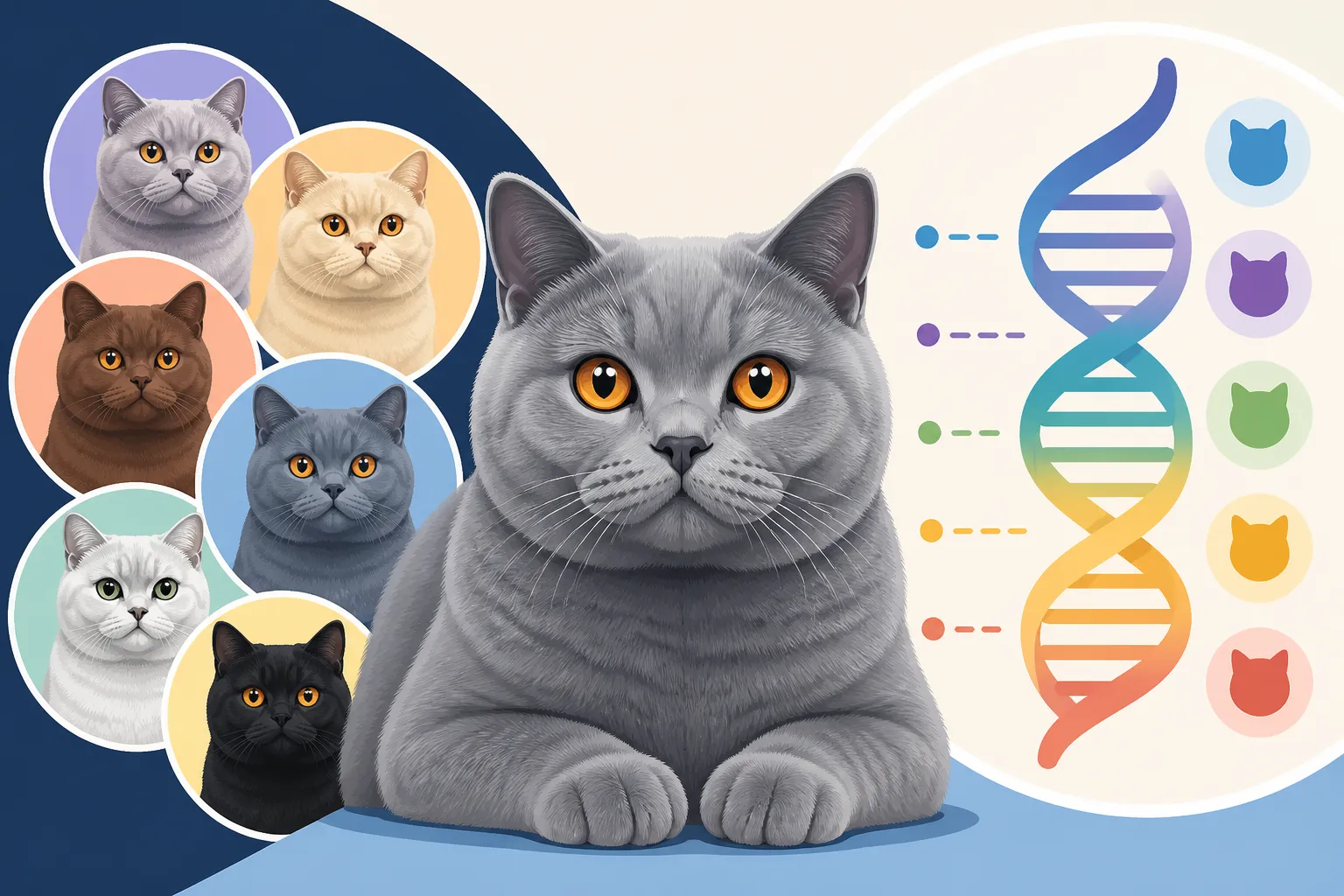
Genetic diversity describes how much inherited variation exists within a population. A breed with more variation is more likely to have a wider range of gene versions, or alleles, available for future generations. That can give breeders more options when selecting mates and may reduce the chance that closely related cats pass the same harmful variant to their kittens.
It does not mean that every individual cat should look different, or that a breed needs to abandon its defining features. British Shorthairs can retain a recognizable appearance while carrying variation in genes that do not visibly affect coat, body type, or temperament. Conversely, two cats can look quite different and still be closely related.
Diversity is also not the same as health. A population can have genetic variation and still experience inherited disease. A cat can have a relatively low estimated inbreeding coefficient and still inherit a disease-causing variant from both parents. Thinking of diversity as one part of population health—not a guarantee of an individual cat’s health—is a useful starting point.
A breed’s gene pool is not easy to reduce to one number
People often look for a single statistic that will settle the question: an inbreeding coefficient, a DNA panel result, or a count of registered cats. Each can be informative, but none gives a complete picture on its own. A pedigree-based coefficient estimates relatedness using the ancestors included in a particular database and the number of generations it covers. If that record is incomplete, distant relationships may be missed.
DNA-based measures can offer another view of genetic variation, but results depend on the test, the reference populations used, and the part of the genome being analyzed. A consumer breed-identification result is not automatically a measure of a breed’s overall genetic health. Nor does a test for a particular disease tell you how diverse the whole population is.
A useful assessment looks at several things together: how related proposed breeding cats are, how often the same popular ancestors appear, whether the pedigree includes a broad range of lines, and what health conditions have been found in those lines. That is more meaningful than treating any one number as a verdict.
Individual cats and the breed population are different questions
A buyer may want to know whether one kitten is likely to be healthy. A breeder or population geneticist may ask whether the breed, considered across many generations, retains enough variation for responsible future breeding. These questions overlap, but they are not interchangeable.
For an individual kitten, relevant details include the health and ages of relatives, the tests appropriate to the parents’ lines, and the breeder’s willingness to explain the results. For the population, the focus is broader: how many unrelated lines contribute to breeding, how concentrated ancestry has become, and whether mating choices are preserving variation over time.
The distinction matters because a breed can have valuable genetic diversity while some cats still carry a specific disease risk. It also means that a healthy-looking kitten does not, by appearance alone, demonstrate that the breed’s gene pool is broad.
How the British Shorthair gene pool took shape
The breed’s history includes periods of rebuilding
The British Shorthair developed from cats kept in Britain and later became a defined show breed. Its history was not a straight, uninterrupted line of closed breeding. Breed numbers and breeding practices changed over time, and the population required rebuilding after periods when cats were lost or breeding became more difficult.
Historical accounts describe the use of other breeds, including Persians, in rebuilding British Shorthair lines. The details and impact vary across accounts and breeding populations, but the broader point is clear: today’s breed reflects both its earlier roots and later selective breeding. For background, see Where the British Shorthair Comes From and Which Breeds Rebuilt the British Shorthair.
Crosses can introduce genetic variation, but their effect depends on which cats were used, how descendants were bred afterward, and how much of that ancestry remains in the population. A historical outcross does not automatically mean the modern breed is genetically broad. If later generations descend heavily from only a few influential cats, variation can become concentrated again.
Selection for a consistent look can narrow choices
Breeders select for the British Shorthair’s characteristic features: a substantial, compact body, a rounded head, a dense coat, and a particular overall expression. Those traits help make the breed recognizable, but intense selection for a narrow ideal can also limit which cats are considered suitable for breeding.
The same pressure can arise when particular colors or show-winning lines become especially popular. If many breeders use the same few successful cats, their descendants may become common across otherwise separate catteries. Two cats with different names or colors are not necessarily unrelated if they share influential ancestors.
This is not an argument against maintaining breed type or showing cats. It is a reason to balance appearance with health, temperament, and pedigree diversity. A responsible breeding decision asks not only whether a cat meets a visual standard, but also whether using that cat adds to or further concentrates the lines already common in the population.
Outcrossing policies and breeding populations vary
Whether breeders can introduce cats from outside a breed depends on registry rules and the breeding program involved. Policies may differ between registries, countries, and specific programs, so “outcrossing is allowed” or “outcrossing is forbidden” should not be assumed to apply everywhere. The practical question is what the relevant registry permits and how breeders manage any approved cross.
Outcrossing can increase variation, but it is not a quick fix by itself. A responsible program needs a clear reason for the cross, appropriate health screening, careful record keeping, and a plan for future generations. Without that planning, a new source of variation may not be preserved or may bring other unwanted traits into the population.
If you are considering a breeder who discusses an outcross, ask what the program is intended to achieve and how offspring are evaluated. The background in Whether Outcrossing Is Still Allowed in the British Shorthair and What the Persian Cross Gave the British Shorthair can help put those conversations in context.
What the breed’s diversity means for health
Genetic diversity does not rule out inherited disease
A diverse population can still contain harmful variants, and a breed with a narrower gene pool is not automatically unhealthy in every respect. Disease risk depends on the particular genes and breeding patterns involved. Some conditions are inherited through well-understood variants; others are more complex or involve factors that cannot be captured with a simple genetic test.
That is why a health-testing plan should be matched to the breed and the individual lines. For example, testing for one known condition does not replace screening for other relevant concerns, and a normal result at one point in time may not answer every future health question. Read What a British Shorthair Breeder Should Have Tested for a broader look at screening conversations.
A health result should also be interpreted accurately. “Tested” does not always mean “clear,” and a test may identify a carrier status or a risk that needs to be considered alongside the mate’s result. Ask the breeder what was tested, which cats were tested, when the tests were done, and whether a veterinarian or relevant specialist has interpreted the findings.
Screening is important, but it is not a diversity score
British Shorthair owners often hear about conditions such as hypertrophic cardiomyopathy and polycystic kidney disease. These concerns are relevant to health planning, but an individual test or scan does not measure overall genetic diversity. For instance, a DNA test may be useful for a condition where a reliable test exists; it cannot establish that an entire line is free of every inherited problem.
HCM illustrates why the distinction matters: there is no single DNA test that can reliably declare every British Shorthair free of the condition. Veterinary screening can still be important, but it answers a different question from a pedigree or population-level diversity assessment. See Why There Is No British Shorthair HCM Gene Test and Whether a British Shorthair Should Be PKD Tested for more detail on those separate health questions.
A breeder who takes diversity seriously should be able to discuss health records without claiming that any one test proves a cat is genetically “safe.” Clear, measured explanations are more reassuring than sweeping promises.
Diversity supports future options, not a guarantee
A broader gene pool gives responsible breeders more options when choosing pairings. It may make it easier to avoid repeatedly matching close relatives or relying on the same small group of popular ancestors. That flexibility can matter over generations, particularly when breeders also monitor health and maintain accurate records.
It cannot promise that every kitten will be healthy, nor does it eliminate the need for veterinary care. Genetics is only one part of a cat’s wellbeing, alongside nutrition, environment, preventive care, and chance. The breed’s overall diversity is best understood as a long-term resource that careful breeding can help preserve.
For owners, the practical takeaway is not to panic about the breed’s history. Instead, use that history as a reason to ask thoughtful questions and choose breeders who treat health and lineage as part of the same conversation. Whether the British Shorthair Is a Healthy Breed offers a related overview of breed health without reducing it to a single label.
How to assess a breeder’s approach to genetic diversity
Ask about ancestors, not just the parents
Start with the kitten’s parents, but do not stop there. Ask whether the breeder can explain how closely related the parents are and whether the same cats appear repeatedly in the pedigree. A pedigree can be difficult to interpret without experience, so a good breeder should be willing to explain the relevant patterns in plain language rather than handing over paperwork and expecting you to decode it.
You can ask how many generations the breeder has reviewed and whether they consider shared ancestors beyond the visible portion of a pedigree. The answer may depend on the depth and quality of available records. What matters is that the breeder recognizes the limits of the information and does not present a short pedigree as proof that two cats are unrelated.
Also ask whether the breeder has considered alternative pairings. If the same sire is used widely because he has an attractive appearance or show record, a breeder should be able to explain why that choice is appropriate for this particular queen and how it affects the wider line.
Look for openness about health and breeding choices
A responsible breeder should be comfortable discussing the health history of relatives, the tests used, and the reasoning behind a pairing. They may not have a perfect answer to every question, but they should be specific about what they know and candid about what they do not know.
| Question to ask | What a useful answer should clarify |
|---|---|
| How are the parents related? | Whether the breeder has reviewed pedigree overlap and how far back |
| Which health checks were done? | The cats tested, the type of test, and what the results mean |
| Are certain ancestors common in this line? | Whether popular cats appear repeatedly and how that affects mate choice |
| Why was this pairing selected? | How health, temperament, type, and lineage were considered together |
| What records can I review? | Which certificates, veterinary records, or pedigree details are available |
Be cautious of claims such as “there are no genetic problems in this line” or “this kitten is genetically perfect.” No breeder can responsibly guarantee that an individual cat will never develop disease. A more credible conversation recognizes both the value and the limits of screening.
If a breeder cannot answer a question immediately, that alone does not prove a problem. Ask whether they can provide a clear explanation or relevant documentation before you make a decision. The goal is an informed conversation, not a quiz designed to catch someone out.
Keep the decision focused on the individual kitten
Genetic diversity is a population-level issue, but your decision involves a particular cat and a particular breeder. Consider the kitten’s health records, the parents’ available screening, the breeder’s practices, and whether you feel comfortable asking follow-up questions. A warm, well-socialized kitten is important, but so is a breeder who provides honest information and remains available after the kitten goes home.
If you already have a British Shorthair, you do not need to arrange broad genetic testing simply because you have read about population diversity. Discuss health concerns and any proposed tests with your veterinarian, who can consider your cat’s age, history, and family information. For owners, ordinary preventive care remains important regardless of pedigree; How Often a British Shorthair Needs a Wellness Exam provides a related overview.
The clearest answer is that British Shorthairs have a history shaped by both rebuilding and selective breeding, so genetic diversity should be considered carefully rather than assumed. No single test or statistic settles the question. Breeder transparency, well-kept pedigrees, appropriate health screening, and thoughtful mating choices are the practical signs to look for.
Disclaimer
This article is for general informational purposes only and does not constitute professional advice. Laws, prices and regulations vary by location and change over time. Consult a qualified professional for guidance on your specific situation.