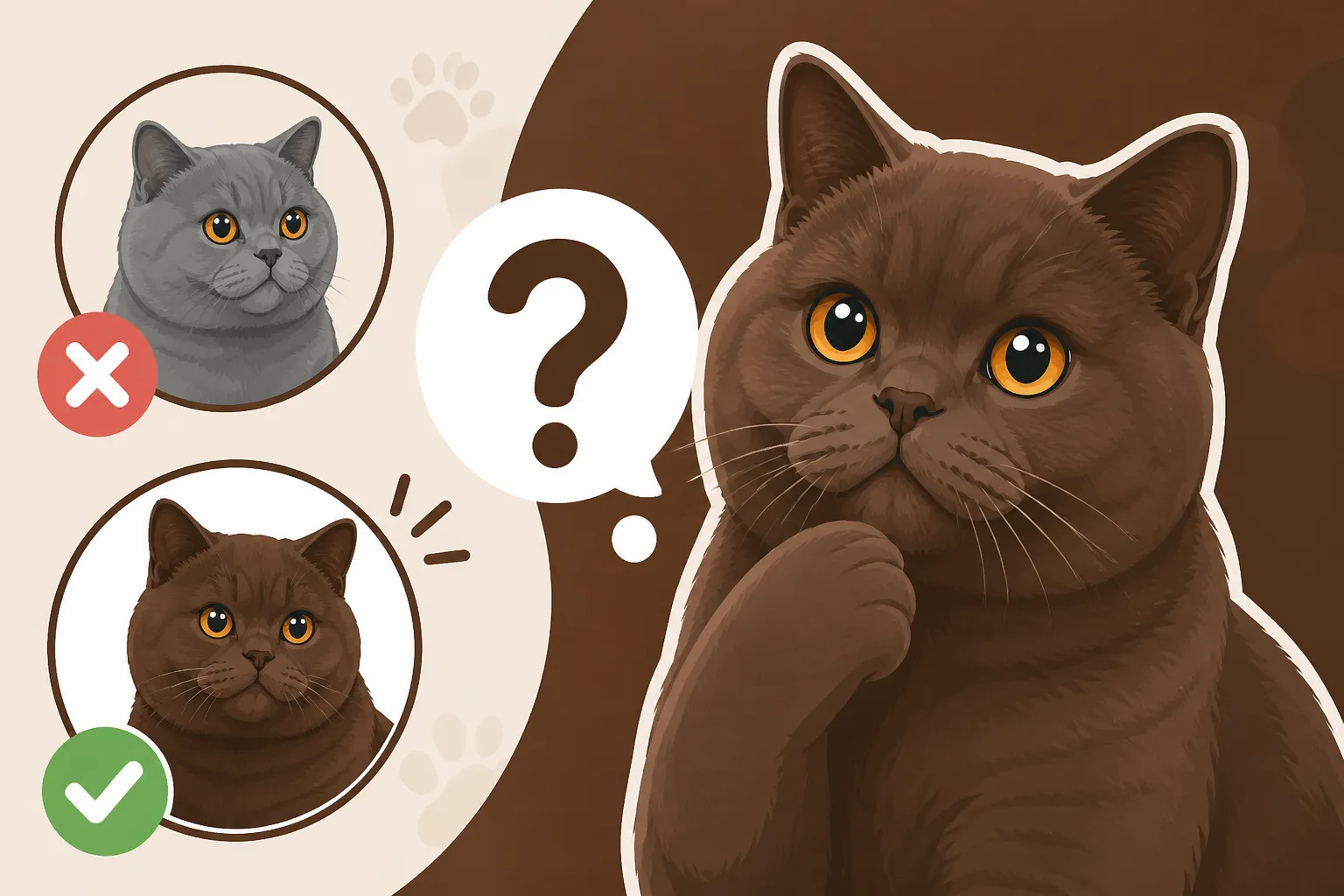
Whether a Chocolate British Shorthair Is Real
A dark brown cat with a round face may look like a chocolate British Shorthair, but coat color alone cannot confirm breed or pedigree. The answer depends on what you mean by “real”: chocolate coloring can occur genetically, while some traditional British Shorthair breed standards do not accept it. This guide explains the difference and how to check a cat’s description.
What chocolate means in a British Shorthair
Chocolate describes pigment, not just a brown-looking coat
In cat coat genetics, chocolate is a specific form of brown pigment. It is not simply a casual name for any dark brown coat. A solid chocolate cat is generally a warm, rich brown from nose to tail, though the exact shade can look lighter or darker depending on lighting, coat condition, and the individual cat.
The color is associated with a variant at the TYRP1 gene, which affects dark pigment. A kitten generally needs to inherit the chocolate version from both parents to display a chocolate coat. A cat carrying only one copy may look black rather than chocolate, while still being able to pass the variant to its kittens.
That distinction matters when looking at breeder descriptions. A cat may have brownish fur in a photograph, but that does not prove it is genetically chocolate. Lighting, camera settings, age, and the natural variation in tabby markings can all make a coat look warmer or darker than it is.
Chocolate is not the same as a brown tabby
A brown tabby British Shorthair may have a brown ground color with darker stripes, spots, or swirls. That does not automatically make the cat a solid chocolate. Tabby markings and solid coat color are different descriptions, and the underlying genetics may differ too.
A young kitten’s coat can also change in appearance as it matures. Patterns may become more or less obvious, and the coat can look different in bright sunlight than it does indoors. For more on that, see Whether a British Shorthair's Color Changes With Age.
It is useful to separate three questions that sellers sometimes blur together:
- What does the cat look like? This is a visual description of its coat.
- What color does its pedigree or registry record? This depends on the breeder’s documentation and the relevant registration system.
- Is the cat recognized as a British Shorthair in a particular color? This depends on that registry’s breed standard.
A cat can look chocolate-brown without having verified chocolate genetics. It can also have a documented ancestry while still being a color that a particular registry does not accept for showing.
Chocolate and lilac are different colors
Lilac is often confused with chocolate because both relate to brown pigment. In general, lilac is a diluted form of chocolate: the coat appears softer and paler, often with a cool pinkish or gray cast, rather than the richer brown associated with chocolate.
The distinction is not always easy to judge from a picture. A warm indoor bulb can make a lilac coat seem browner, while bright daylight can make a chocolate coat appear lighter. Nose leather and paw-pad color may offer clues, but they are not a substitute for pedigree records or genetic information.
When a listing uses “chocolate,” “lilac,” “cocoa,” or another color term, ask the breeder what the term means in that cat’s documentation. Marketing language and formal registry color names are not necessarily interchangeable.
Is a chocolate British Shorthair recognized as a breed color?
The answer depends on the registry
There is no single worldwide color list that every cat registry uses. Breed standards can differ, and an individual registry may accept a color that another registry excludes. Some traditional British Shorthair standards do not recognize solid chocolate for competition, even though chocolate-colored cats can occur in the wider cat population.
That is why the straightforward answer is: a chocolate-colored cat can be real, but “chocolate British Shorthair” may not mean a show-recognized color under every registry. If you are considering a kitten, ask which registry the breeder uses and request the exact registration information rather than relying on a social-media caption or an advert.
You can compare the broader color discussion in Which Colors a British Shorthair Comes In and How Many Colors the British Shorthair Standard Allows. If you are comparing paperwork from different places, Which Registry Standard a British Shorthair Is Judged Against and Whether GCCF and CFA British Shorthair Standards Differ are also useful topics to explore.
| What you are checking | What it can tell you | What it cannot prove by itself |
|---|---|---|
| A photo of a brown-looking cat | The coat’s appearance in that lighting | Breed, pedigree, or genetic color |
| A breeder’s color description | How the seller identifies the coat | That the color is accepted by every registry |
| Registration paperwork | The cat’s recorded registration details | That the cat is show-eligible under another registry |
| Parent records | Information about the parents’ documented ancestry and colors | The kitten’s color genetics unless those details are documented |
| A DNA result | Specific genetic information included in the test | Full breed identity or acceptance under a show standard |
A nonstandard color does not automatically prove a cross
If a seller advertises a chocolate British Shorthair, it is reasonable to ask careful questions. But the color label alone is not enough to conclude that the cat must be a crossbreed or that a seller is being dishonest. The registry, pedigree, breeding history, and accuracy of the color identification all matter.
Some cats are registered in systems with different rules; others may be described informally rather than presented as show-standard animals. There can also be confusion between solid chocolate and brown tabby coloring. Ask for the registration organization, the kitten’s registered color if available, and copies of relevant pedigree documents.
A DNA test can answer some genetic questions, but it does not function as a universal certificate of breed. A test may identify selected coat-color variants without confirming that a cat is a pedigreed British Shorthair. Read more in Whether a DNA Test Confirms a British Shorthair.
How to assess a chocolate British Shorthair listing
Ask for records, not just attractive photos
A polished photograph can show a lovely cat, but it cannot establish its ancestry or registry status. Ask the breeder for the kitten’s registration details, the names or registration information of the parents, and an explanation of how the color is recorded. A responsible seller should be able to explain whether “chocolate” is a formal registered color, a visual description, or a term used in their own advertising.
Ask which registry issued the paperwork and whether the kitten is registered or eligible for registration there. If the seller says the cat is a rare show color, ask them to point to the relevant standard and explain how the kitten’s registration reflects that claim. The point is not to challenge every unusual description; it is to understand exactly what is being offered.
Be wary of pressure to pay a deposit before you can review basic records. A seller who answers ordinary questions clearly is easier to work with than one who relies on phrases like “rare,” “exclusive,” or “pure chocolate” without explaining the documentation behind them.
Check whether the coat is solid chocolate or another pattern
Look at the coat in natural daylight, and ask for several unfiltered photos or a short video. Check whether the color appears even across the body or whether there are visible stripes, spots, or swirls. Remember that kitten coats can be soft and uneven-looking, so a visual assessment may still be uncertain.
Ask about nose leather and paw-pad color if you are trying to distinguish chocolate from a brown tabby or a diluted shade. These details may help describe what you see, but they are clues rather than proof. A breeder should be willing to say when a color identification is uncertain instead of presenting a guess as a genetic fact.
If the cat is already in your home, there is no need to solve the color question before providing good care. Whether the coat is chocolate, lilac, brown tabby, or simply a warm shade in certain light, its everyday needs are determined by its age, health, body condition, and behavior—not by the color name.
Treat online color claims as starting points
Breed and color pages can help you learn the vocabulary, but they cannot verify an individual cat. A retailer such as Chewy may be useful for ordinary cat supplies, but a product listing or general breed description is not pedigree evidence. The same caution applies to social-media posts, marketplace descriptions, and breeder advertisements.
If you are preparing for a new cat, choose food based on the cat’s life stage and your veterinarian’s guidance. Retailers such as Chewy can help with routine shopping, but buying supplies does not resolve questions about color registration or ancestry. Chewy’s product information, like any retailer’s, should be treated as shopping information rather than a substitute for breeder records.
A practical way to keep the questions straight is to write them down before contacting a breeder:
- Which registry is the kitten registered with, or eligible to register with?
- What color is recorded on the registration or pedigree?
- Is “chocolate” a formal registry description or a visual label?
- Can I see relevant parent and litter records?
- Is the kitten being sold as a pet, or is the seller claiming show eligibility?
Clear answers help you understand the kitten you are considering without getting distracted by a dramatic color label.
What the color means for owners and prospective buyers
Color does not determine whether the cat is a good fit
A chocolate coat does not make a British Shorthair healthier, friendlier, more affectionate, or more valuable as a companion. It is easy to get swept up in a rare-sounding color description, especially when the photos are appealing, but temperament and welfare are much more important factors in choosing a cat.
Spend time asking about the kitten’s early socialization, routine veterinary care, living conditions, and the breeder’s approach to matching kittens with homes. A seller’s willingness to discuss the cat’s needs is more meaningful than a promise that its coat is unusually rare. Consider the whole cat, not just the color.
The broader color range can be interesting, and it is worth learning the differences between shades and patterns. But appearance should not distract from basic questions about the cat’s background and care. A useful companion topic is Whether a British Shorthair Mix Keeps the Look, particularly if you are comparing a pedigree cat with one whose ancestry is unknown.
If you already own a brown-looking British Shorthair
If your cat’s coat looks chocolate-brown but the paperwork says something else—or there is no paperwork—you do not need to change anything about daily care just because the color label is uncertain. Keep veterinary records accurate, share any available history with your vet, and describe the coat plainly if you do not know its formal registration color.
If you want a definitive answer for breeding, registration, or showing, speak with the relevant registry or a knowledgeable breeder who can review the documents. A genetic test may be useful for a specific color question, but choose one that tests the variant you are asking about and understand its limits before relying on the result.
For a pet cat, the most important distinction is often not whether the coat qualifies as chocolate under a show standard. It is whether you have reliable information about the cat’s health, care history, and needs. Enjoy the coat you can see, while being honest about what its color does—and does not—prove.
Disclaimer
This article is for general informational purposes only and does not constitute professional advice. Laws, prices and regulations vary by location and change over time. Consult a qualified professional for guidance on your specific situation.