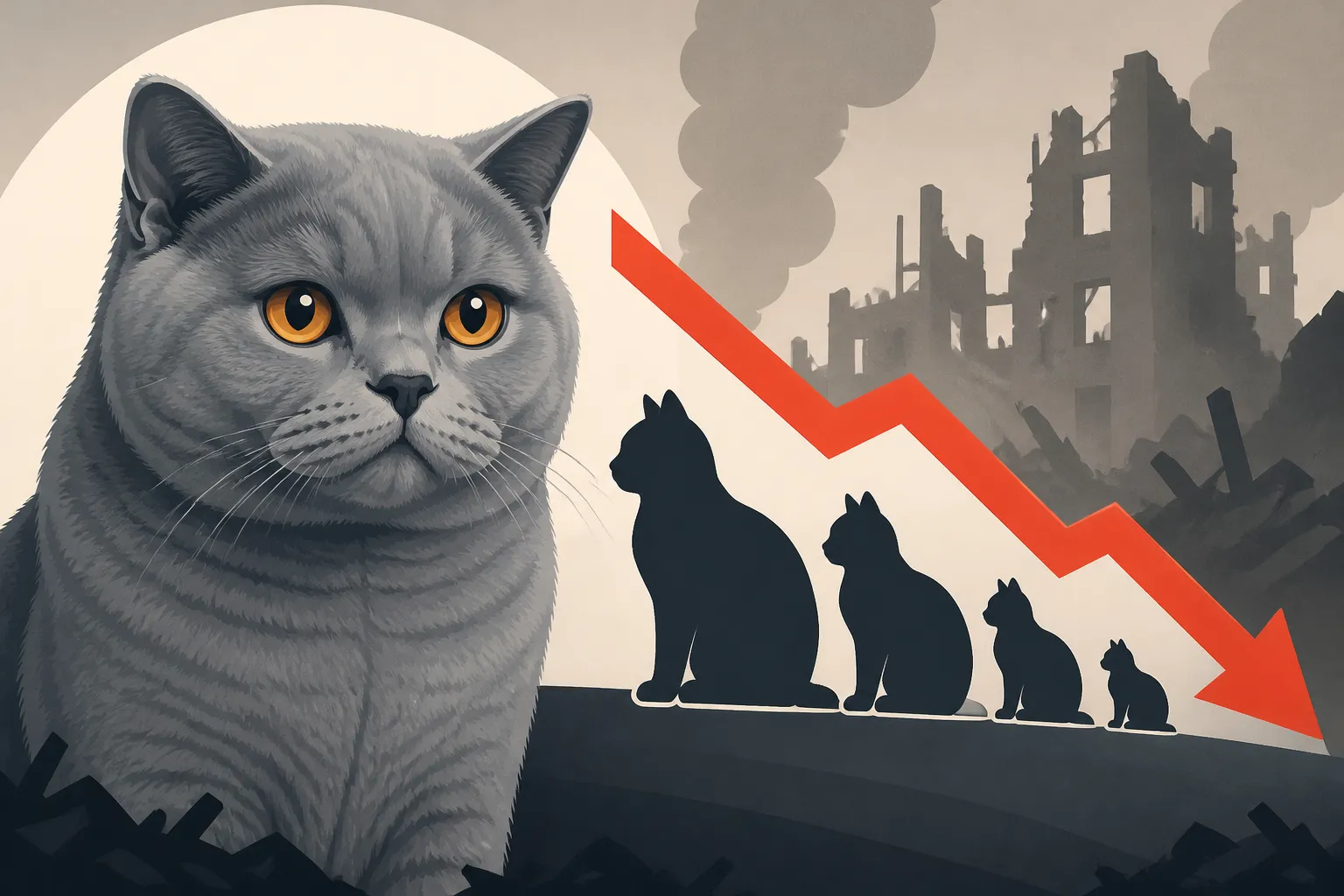
How Far British Shorthair Numbers Fell by 1945
The British Shorthair suffered a severe decline during the Second World War, but there is no dependable census showing exactly how many cats remained in 1945. The clearest answer is that the breed had become critically scarce in Britain, with breeding disrupted and the available gene pool narrowed. Here’s what the history can—and can’t—tell us about the scale of that loss.
The British Shorthair’s numbers by 1945
There is no reliable count of surviving cats
It’s natural to look for a neat figure: a prewar population, a postwar population, and a percentage decline. The historical record doesn’t provide that kind of count. There was no comprehensive national census tracking every British Shorthair, and the breed’s boundaries and registration practices were not equivalent to modern population records.
That distinction matters. A registry might record pedigreed cats bred or shown, while missing unregistered cats and animals whose ancestry was uncertain. Conversely, a cat population estimate would not necessarily tell us how many cats were actively contributing to the pedigree breeding population. So a claim that the breed fell by a precise number or percentage should be treated cautiously unless it is tied to clear, verifiable records.
The most defensible description is that the British Shorthair had become rare and its breeding population was in serious trouble by the end of the war. “Critically scarce” describes the situation better than a precise statistic that the evidence cannot support. For broader context, Why British Shorthair Numbers Collapsed in the Wars looks at the pressures that undermined the breed across wartime Britain.
“Nearly disappeared” describes a crisis, not a head count
You may see the British Shorthair described as having nearly disappeared. That phrase conveys the seriousness of the postwar problem, but it does not mean that a verified count found only a particular number of cats left. It is a broad description of a breed that had lost much of its breeding strength and could no longer be rebuilt easily from its remaining cats alone.
There is also a difference between a breed nearly disappearing and every cat of that type vanishing. Cats with British Shorthair ancestry could still exist without being registered or used in a formal breeding program. The immediate danger was that too few suitable, pedigreed breeding animals remained to maintain the breed as breeders had known it.
That helps explain why postwar rebuilding involved difficult choices. The issue was not simply locating a few cats that looked similar. Breeders needed animals that could help restore numbers and support a viable breeding population, while preserving recognizable British Shorthair traits. The recovery story is explored further in How Long the British Shorthair Took to Recover.
Why the wartime decline was so severe
War disrupted breeding as well as daily life
Wartime conditions affected people’s ability to keep and breed cats. Food was scarce and rationed, homes and routines were disrupted, and many families faced circumstances that made planned breeding difficult or impossible. Breeders could be separated from their cats, breeding plans could be abandoned, and litters that might have replenished the population were not produced or could not be raised.
These pressures did not affect only pedigree cats. But a recognized breed depends on a relatively small number of animals being deliberately paired and documented. When those breeding programs are interrupted for years, the loss can be harder to reverse than a decline in the general cat population. Even if individual cats survive, they may not be available, suitable, or documented for rebuilding a pedigree line.
Nor did the damage begin and end with a single date. The First World War and the years that followed had already placed pressure on British cat breeding. The Second World War brought another major disruption. By 1945, breeders were dealing with the accumulated effects of years in which normal breeding and showing could not continue reliably.
A small breeding pool makes every loss matter more
In a widespread, diverse population, the loss of some animals may be absorbed by the larger group. A pedigree breed with limited breeding stock has less room to absorb losses. If only a small number of suitable cats are available, losing even a few can remove particular family lines or leave breeders with very few choices for future pairings.
That is one reason a head count alone would not tell the whole story. The number of surviving cats is not the same as the number of cats able to contribute to a healthy, sustainable breeding population. Age, fertility, pedigree information, and relationships among the remaining animals all affect what breeders can responsibly do.
The postwar challenge was therefore both numerical and genetic: rebuild the breed’s presence while managing a restricted pool of animals. Which Breeds Rebuilt the British Shorthair explains why breeders looked beyond the remaining British Shorthairs, while Whether the British Shorthair Is Genetically Diverse Now considers the longer-term consequences of that recovery.
| Question | What the historical record supports | What it does not establish |
|---|---|---|
| Were British Shorthairs still present in 1945? | Yes, the breed was not wholly extinct. | A complete count of all surviving cats. |
| Was the breed in serious trouble? | Yes, its breeding population was severely reduced and disrupted. | One universally accepted figure for the scale of the decline. |
| Did the war affect breeding? | Yes, wartime conditions interrupted breeding and cat keeping. | That every loss happened for one single reason. |
| Did the breed recover without outside influence? | No, rebuilding involved outcrosses. | That every surviving cat had the same ancestry or status. |
How breeders rebuilt the breed after the war
Outcrossing helped restore numbers
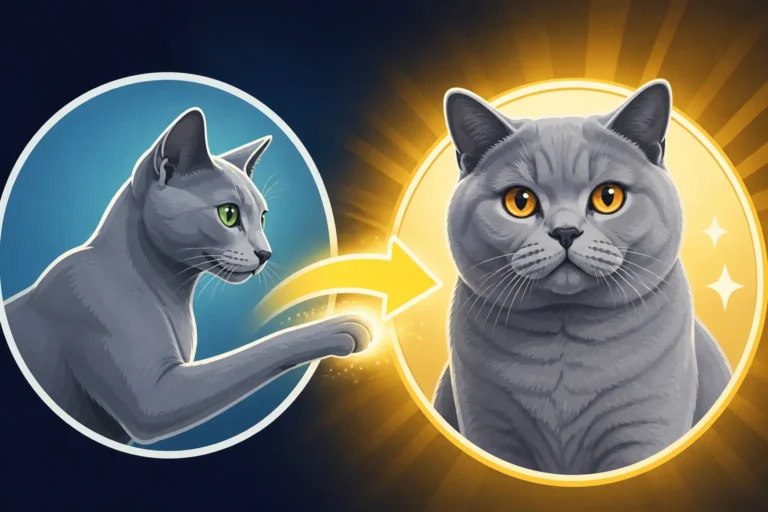
With too few British Shorthairs available for straightforward breeding, breeders used outcrosses to help rebuild the population. Cats from other breeds, including Persians, were part of that process. The goal was to restore a workable breeding base, not simply to substitute one breed for another.
Outcrossing is a practical response to a population crisis, but it also changes the genetic makeup of the breed. Breeders then have to select later generations carefully, retaining the traits associated with the British Shorthair while developing a sustainable population. That work takes time; it cannot be accomplished simply by producing one generation of kittens.
This history is why statements about the breed’s postwar survival often mention more than one contributing breed. The Persians That Rebuilt the British Shorthair After the War discusses one important part of that story, and Which Outcrosses Saved the British Shorthair examines the wider role of outcrossing.
Recovery did not mean an instant return to prewar numbers
The end of the war did not immediately restore the British Shorthair to its former position. Breeders needed time to establish pairings, raise successive generations, and maintain the characteristics that made the breed recognizable. A population can begin to recover before it is robust, and formal recognition or renewed visibility does not necessarily mean that genetic diversity is no longer a concern.
There is also no single simple measurement of “recovery.” It might mean more cats being bred, a larger number of registered animals, a stronger network of breeders, or a broader pool of unrelated lines. Those developments can happen at different speeds. For a closer look at the breed’s longer rebuilding period, see How the British Shorthair Took to Recover.
The postwar outcrosses also explain why the breed’s history is more complicated than a story of an unchanged line surviving untouched through the war. Why the Persian Overtook the British Shorthair adds context about the breed’s changing position and the influence of other cats in its development.
How to interpret claims about the 1945 decline
Check whether a claim defines what it is counting
If you encounter a precise number, ask what the figure represents. Is it registered cats, show entries, breeding animals, or an estimate of all cats with British Shorthair ancestry? Does it refer to Britain or a wider region? Does it count a particular year or a longer period? Without those details, a number can sound more definitive than it really is.
Also look for a clear distinction between documented evidence and later shorthand. “Nearly disappeared” may be a useful way to convey how precarious the breed’s position was. It is not, by itself, proof of a specific population total. The strongest historical account is often the one that explains the uncertainty rather than hiding it behind an impressive-looking percentage.
This is especially helpful when comparing sources that use different language. One may focus on registered pedigree cats, another on the broader cat fancy, and another on the breed’s reliance on outcrosses. Those accounts can describe different parts of the same crisis without providing a directly comparable count.
Connect the historical story to responsible ownership today
The wartime decline is a reminder that breeds depend on people’s decisions as well as on the cats themselves. Good records, thoughtful breeding choices, and attention to health help preserve a breed more responsibly than simply aiming for a particular appearance or a larger litter. Today’s owners can support that principle by asking breeders about health screening, pedigree information, and how they make breeding decisions.
For everyday care, the lesson is less dramatic but still useful: a cat’s wellbeing depends on consistent attention to food, activity, and veterinary care. Owners comparing routine supplies may find Chewy useful for browsing food and litter options, but product choice should suit the individual cat and any advice from its veterinarian. Chewy is also one place to look for basic grooming or feeding supplies; it cannot replace health guidance from a veterinary professional.
The question “How far did British Shorthair numbers fall by 1945?” has no defensible exact numerical answer. What the evidence does support is that the breed became dangerously scarce, its breeding was profoundly disrupted, and postwar recovery required deliberate rebuilding that included outcrossing. The absence of a precise count does not make the decline less real; it simply means the most honest account describes the scale carefully rather than inventing a number.
Disclaimer
This article is for general informational purposes only and does not constitute professional advice. Laws, prices and regulations vary by location and change over time. Consult a qualified professional for guidance on your specific situation.