How a Show British Shorthair Is Presented
A British Shorthair can look wonderfully polished at home and still arrive at a show with a flattened coat, nervous posture, or a few stray hairs that catch the judge’s eye. Presentation is about showing the cat in good condition—not disguising its features. This guide explains how to prepare the coat, practise handling, and make show day calmer for both cat and owner.
What judges look for in a British Shorthair
Breed type comes before styling
At a cat show, a British Shorthair is assessed against a written breed standard, not a general idea of what a “perfect” cat should look like. The details vary between registries, so exhibitors should check the rules for the organization running their show. Which Registry Standard a British Shorthair Is Judged Against explains why the same cat may be assessed under different standards depending on the show.
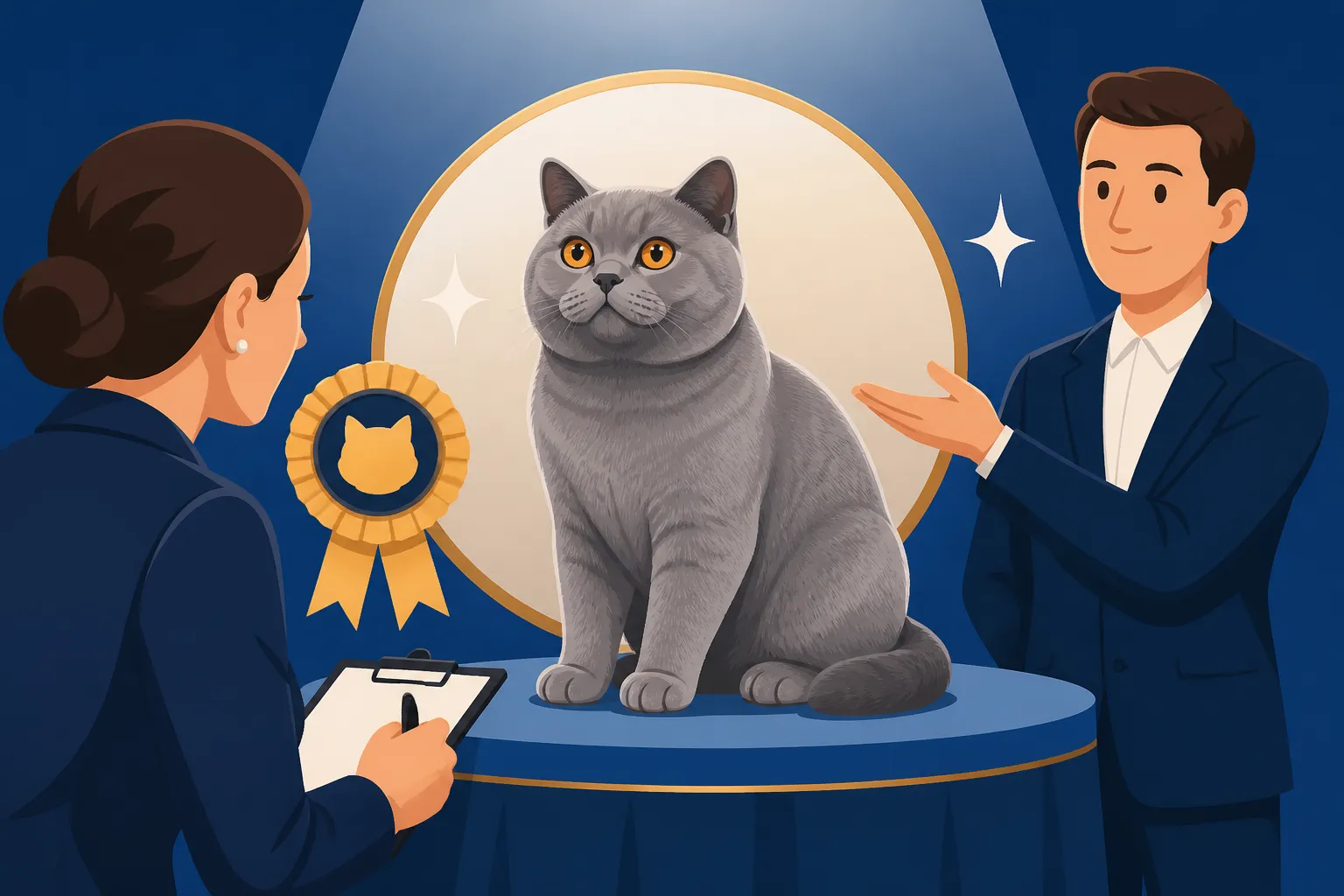
British Shorthairs are known for a sturdy, cobby build, a broad head, rounded cheeks, and a dense coat. Judges consider how closely the cat fits the applicable standard, as well as its condition and overall presentation. A tidy coat can help a cat’s features show clearly, but grooming cannot change its bone structure, proportions, or natural expression—and it should not try to.
That distinction can be reassuring if you are new to showing. You do not need to make your cat look like a photograph or force it into a particular pose. Your job is to bring a healthy, clean, well-groomed cat to the ring and allow the judge to examine it according to the show’s procedure.
Coat condition matters more than extra fluff
The British Shorthair’s coat is dense and stands away from the body. It should look plush without being artificially puffed or coated in product. Its texture is part of the breed’s distinctive appearance, so a routine that works for a longhaired cat—or a cat with a softer, flatter coat—may not be appropriate. How a British Shorthair's Coat Differs From a Plush Coat offers useful context on that characteristic texture.
Judges may notice whether the coat appears clean, even, and in good condition, but there is no single grooming trick that suits every cat. Some cats need only a careful comb-through; others may benefit from a bath well before the show. The cat’s coat, temperament, and the event’s rules all matter.
Avoid trying to create volume by repeatedly brushing against the grain, teasing the coat, or applying products that leave residue. Those approaches can alter the natural look and feel of the coat. The goal is a neat, healthy appearance that still looks like your cat.
Preparing the coat without over-grooming
Build a simple grooming routine
A little regular grooming is generally easier than a long, unfamiliar session the night before a show. Start with short, calm sessions at home, and stop before your cat becomes distressed. A metal comb is a practical starting point for working through the dense coat; use it gently and check that it is not catching or scraping the skin. Which Comb a British Shorthair Needs and How Often a British Shorthair Needs Combing can help you fine-tune the routine.
Comb in the direction the coat naturally lies, paying attention to areas where loose hair may collect. Do not tug through a knot. If you find a tangle that will not loosen easily, ask a groomer or veterinary professional how to address it safely rather than pulling at the skin.
A slicker brush or deshedding tool may be tempting when the coat is shedding, but more forceful grooming is not automatically better. The wrong tool or repeated scraping can damage coat texture or irritate skin. Why a Slicker Damages a British Shorthair's Coat explains why a gentler approach often makes more sense for this breed.
If you are picking up supplies, you can compare comb styles at a retailer such as Chewy or at a local pet shop. Choose by the tool’s design and how it feels against your cat’s coat, not by a claim that it will make the cat look dramatically fuller. Introduce any new tool gradually so show preparation does not become a struggle.
Decide whether a bath is needed
A bath is not automatically required before every show. Some British Shorthairs stay clean with routine grooming, while others may have a coat that needs washing before an event. If you do bathe your cat, allow enough time for the coat to dry completely and settle naturally before the show. A last-minute bath can leave both cat and owner stressed.
Use a cat-safe shampoo and follow its directions. Keep water and product away from the eyes and ears, rinse thoroughly, and dry your cat in a warm, secure place. Never assume a human shampoo or a product intended for another species is suitable. If your cat panics around water or has skin concerns, ask your veterinarian or an experienced cat groomer for advice before trying a new routine. How to Bathe a British Shorthair That Objects covers ways to make this process less overwhelming.
You can find grooming basics through stores such as Chewy, but product choice should follow your cat’s needs and any guidance from a veterinary professional. Avoid powders, sprays, dyes, or other coat treatments unless they are allowed by the show rules and safe for your cat. When in doubt, a clean coat and a comfortable cat are better than an elaborate product routine.
Use a show-day checklist
The final check should be calm and brief. Look for loose hairs, visible dirt, or anything caught in the coat. Check that the eyes and ears look clean, the claws are appropriately trimmed, and the cat appears comfortable. Do not clean deep inside the ears or use a new product just before leaving home.
| Area to check | Helpful preparation | What to avoid |
|---|---|---|
| Coat | Gentle comb-through and removal of loose hair | Aggressive brushing or coat teasing |
| Bathing | Wash only if needed and leave time for full drying | A rushed bath immediately before departure |
| Claws | Get your cat accustomed to routine nail care | A first-ever trim on show morning |
| Eyes and ears | Wipe visible dirt gently when appropriate | Probing inside the ear or using irritating products |
| Travel setup | Use a secure carrier with familiar bedding | Forcing the cat into an unfamiliar setup at the last minute |
The checklist is not a substitute for the show’s own instructions. Some events have specific rules about carriers, grooming products, or what can be brought into the show hall. Read the exhibitor information ahead of time rather than relying on assumptions.
Getting your cat ready for the ring
Practise handling in short sessions
A judge may need to examine your cat’s body, coat, head, and movement. Your cat does not need to enjoy being handled by strangers, but practising gentle handling at home can make the experience less surprising. Begin with brief touches around the shoulders, sides, paws, and tail, rewarding calm behaviour and letting your cat leave when possible.
Do not hold your cat down or repeatedly rehearse an examination if it is becoming frightened. A cat that feels trapped may struggle, scratch, or become difficult to settle. Instead, practise a little at a time, use familiar rewards, and build a routine that ends on a positive note. If your cat has a history of handling sensitivity, talk with the show organizer or a qualified professional about what to expect.
It can also help to practise picking up and carrying your cat securely before show day. Support the body rather than lifting by the front legs, and keep the cat close to you. How to Carry a British Shorthair Safely has practical guidance for handling a sturdy cat without making it feel precarious.
Make the journey and waiting area familiar
For many cats, the show hall is the hardest part: new smells, unfamiliar voices, other cats, and long periods in a carrier or show space. Set the carrier out at home in advance so it becomes an ordinary resting place rather than a signal that something stressful is about to happen. A familiar blanket can help, provided it is clean and permitted under the event’s rules.
On the day, follow the organizer’s instructions about arrival, check-in, and where your cat should wait. Keep water available as appropriate, and give your cat quiet time instead of repeatedly taking it out to show visitors. A cat that is overwhelmed may crouch, hide, or refuse attention; that is a cue to reduce stimulation, not to force interaction.
If your cat has not been to a show before, consider attending as a spectator first. You can observe how the ring is organized, how exhibitors prepare their cats, and what the atmosphere feels like. This can help you decide whether showing is a good fit for your particular cat. How a British Shorthair Behaves at the Vet also offers useful perspective on how unfamiliar handling and surroundings can affect a cat.
Common presentation mistakes to avoid
Don’t mistake grooming for improvement
Over-grooming is one of the easiest traps for a first-time exhibitor. It can be tempting to keep brushing because you want the coat to look especially full, but frequent brushing, harsh tools, or heavy product use can leave the coat looking unnatural or make the cat uncomfortable. The breed’s characteristic coat should be presented in good condition, not transformed into a different texture.
Likewise, do not trim or shave the coat to change its outline. A British Shorthair’s shape should be assessed as it naturally is, and coat alteration may conflict with show rules. If you are unsure whether a product or grooming method is permitted, ask the show organizer before using it.
The same principle applies to accessories. Decorative collars, bows, and clothing may be cute at home, but they are not a substitute for correct presentation and may not be allowed in the ring. Keep the focus on the cat’s health, temperament, and natural breed features.
Keep your cat’s welfare ahead of a result
A show is meant to be an evaluation, not a test of how much discomfort a cat will tolerate. If your British Shorthair is persistently frightened, ill, or struggling to cope, it is reasonable to withdraw or take a break. A ribbon is never worth ignoring signs that your cat needs rest or veterinary attention.
Before entering, make sure your cat is healthy enough to attend and that vaccinations or other requirements are understood. If you notice a sudden change in appetite, breathing, energy, or behaviour, contact your veterinarian rather than treating it as a grooming or show-day problem.
Finally, remember that presentation is only one part of showing. A thoughtfully prepared cat may still receive a result you did not expect, because judging involves the relevant standard and the cats entered that day. The most useful outcome for a new exhibitor may be learning how your cat handles the experience and what preparation helps it feel secure. A calm, clean, natural-looking British Shorthair is a far better goal than a perfect coat at any cost.
Disclaimer
This article is for general informational purposes only and does not constitute professional advice. Laws, prices and regulations vary by location and change over time. Consult a qualified professional for guidance on your specific situation.