How Much a Male British Shorthair Weighs
A male British Shorthair can look heavier than he is because his broad frame and dense coat disguise his shape. At the same time, this easygoing breed can gain weight quietly. This guide explains the usual adult weight range, how age and body condition change the number, and how to tell whether your cat’s weight deserves a closer look.
Typical weight for a male British Shorthair
The usual adult range
An adult male British Shorthair commonly weighs around 9 to 17 pounds, or roughly 4 to 7.7 kilograms. That broad range reflects differences in build, height, bone structure, and individual development. It is a guide to what you might see, not a target every male should reach.
Some healthy males are naturally smaller and lighter; others have a larger frame and carry more lean muscle. A number near the top of the range does not automatically mean a cat is overweight, just as a number near the bottom does not prove he is underweight. For general breed context, see How Much a British Shorthair Weighs.
A useful weight goal is personal: it considers your cat’s frame and body condition, not only his sex or breed. Your veterinarian can assess those features during an exam and help you set a sensible target if a change is needed.
Why a British Shorthair can look heavier than the scale says
British Shorthairs have a compact, sturdy build, with a broad chest, solid limbs, and a dense coat that stands away from the body. That plush outline can make a cat look round even when he is in good condition. A thick coat can also make it difficult to see the waist from above.
This is why judging weight from a photo or a quick glance can be misleading. Look at the whole cat: his waistline, abdominal shape, ribs, mobility, and how his weight changes over time. Why a British Shorthair Looks Heavier Than It Is explores how the breed’s shape can affect perception.
A male’s cheeks and jowls can add to the impression of bulk, too. These features may be part of his mature appearance and are not the same thing as excess fat around his torso. For a closer look at that distinction, see What Jowls Are on a Male British Shorthair.
A range is not a health verdict
If your male weighs 16 pounds, that number alone cannot tell you whether he is healthy. A large-framed cat with a visible waist and ribs you can feel may be in better condition than a smaller cat whose ribs are difficult to find and whose abdomen has become rounded.
Likewise, a cat can have a weight-related problem even if he falls within a broad breed range. Changes from his own usual weight may be more informative than comparison with another British Shorthair. If he has gained steadily, lost weight without explanation, or seems less active, mention that pattern to your veterinarian.
| What you notice | What it may mean | A useful next step |
|---|---|---|
| Weight is stable and ribs are easy to feel under a light covering | He may be in a healthy condition | Keep tracking his weight and body shape |
| Weight is rising and his waist is becoming harder to see | He may be gaining excess fat | Review portions and discuss a target with your veterinarian |
| Weight is falling without a planned diet | A health or appetite change may be involved | Arrange a veterinary check rather than assuming it is normal |
| The number is high but his body condition seems lean | His frame or muscle may contribute | Ask your veterinarian to assess body condition, not just weight |
How age affects a male British Shorthair’s weight
Kittens and adolescents are still growing
A kitten’s weight changes quickly, so adult ranges are not a helpful way to judge him. Growth depends on age, development, health, and nutrition. Your veterinarian can check whether his progress is appropriate at routine appointments, especially if he is growing more slowly than expected or seems to be gaining unusually fast.
As he gets older, growth becomes less rapid, but the breed can take several years to reach full physical maturity. A young male who looks lanky or less substantial than an adult is not necessarily destined to stay small. On the other hand, feeding extra food in the hope of making him larger is not a safe way to influence adult size.
The practical approach is to monitor growth with regular weigh-ins and veterinary guidance, rather than comparing a young cat with a mature, broad-headed male. For a closer look at development, see What a British Shorthair Should Weigh at Two Years.
Adult weight can change after neutering
After neutering, some cats need fewer calories than before, while their appetite may remain strong. That combination can make weight creep up, particularly in a cat who spends much of the day indoors and is not very active. It does not mean every neutered male will become overweight, but it is a good reason to keep an eye on portions and weight.
Watch for small changes that are easy to miss: a collar fitting more snugly, less visible shape behind the ribs, or your cat hesitating before jumping onto a familiar surface. These clues are not a diagnosis, but they can prompt you to check his weight and reassess his routine.
If weight is increasing, avoid abruptly cutting his food. Ask your veterinarian to review his current diet, daily activity, and body condition before deciding whether a change is needed. Why a Neutered British Shorthair Gains Faster discusses why weight management can require extra attention after neutering.
Senior cats may gain or lose weight
Older cats can lose muscle as they age, and a lower number on the scale may not always be a welcome change. Some senior cats also become less active and gain fat, while others lose weight because of dental discomfort, reduced appetite, or an underlying medical problem.
That is why a change in body shape matters as much as the scale. If your older male is losing weight, eating differently, grooming less, or having trouble moving comfortably, arrange a veterinary assessment. Avoid assuming that a lighter body is simply part of getting older.
For a broader guide to age-related changes, see What Changes in a British Shorthair After Ten. Your veterinarian can help distinguish ordinary changes from concerns that deserve investigation.
How to tell if your male British Shorthair is at a healthy weight
Feel his ribs and look for a waist
Use your hands as well as your eyes. With gentle pressure, you should generally be able to feel your cat’s ribs beneath a light layer of tissue. You should not have to press firmly through a thick layer of fat to find them, but they should not be sharply prominent either.
Next, view him from above. A healthy waist may be subtle under a British Shorthair’s plush coat, but his body should usually narrow somewhat behind the ribs. From the side, look for an abdominal outline that rises toward the hind legs rather than forming a pronounced, rounded underside.
These checks take practice, and coat thickness can make visual assessment tricky. For step-by-step guidance on the hands-on part, see How to Feel a British Shorthair's Ribs. If you are unsure, ask your veterinarian to show you what a healthy body condition looks and feels like on your own cat.
Distinguish a belly pouch from excess weight
Many cats have a loose fold of skin and tissue along the lower abdomen, often called a primordial pouch. It can sway as a cat walks and may be visible even when the rest of his body is lean. Its presence alone does not show that he is overweight.
Look at the full picture rather than judging the pouch in isolation. Consider whether his ribs are easy to feel, whether his waist is still discernible, and whether his overall shape has changed. A pouch that has always been there is different from a noticeably expanding abdomen alongside steadily increasing weight.
If you want to understand the difference in more detail, see Whether a British Shorthair's Belly Pouch Is Fat. When abdominal changes are sudden or accompanied by discomfort, appetite changes, or low energy, contact your veterinarian instead of relying on visual checks alone.
Use body condition alongside weight
Body condition scoring gives a more useful picture than a number alone. It considers how easily ribs can be felt, whether a waist is present, and how much fat covers the body. Your veterinarian can score your cat and explain what that score means in practical terms.
You can use the same basic observations at home between appointments, but avoid trying to diagnose a problem from one detail. A heavy coat, broad shoulders, or a pouch can confuse the picture. A consistent upward trend in weight plus a disappearing waist is more meaningful than one high reading by itself.
For a practical explanation of the scoring method, see How to Score a British Shorthair's Body Condition. Keep notes on weight and body shape so you can describe changes accurately at the next checkup.
How to weigh and manage your cat’s weight
Make home weigh-ins consistent
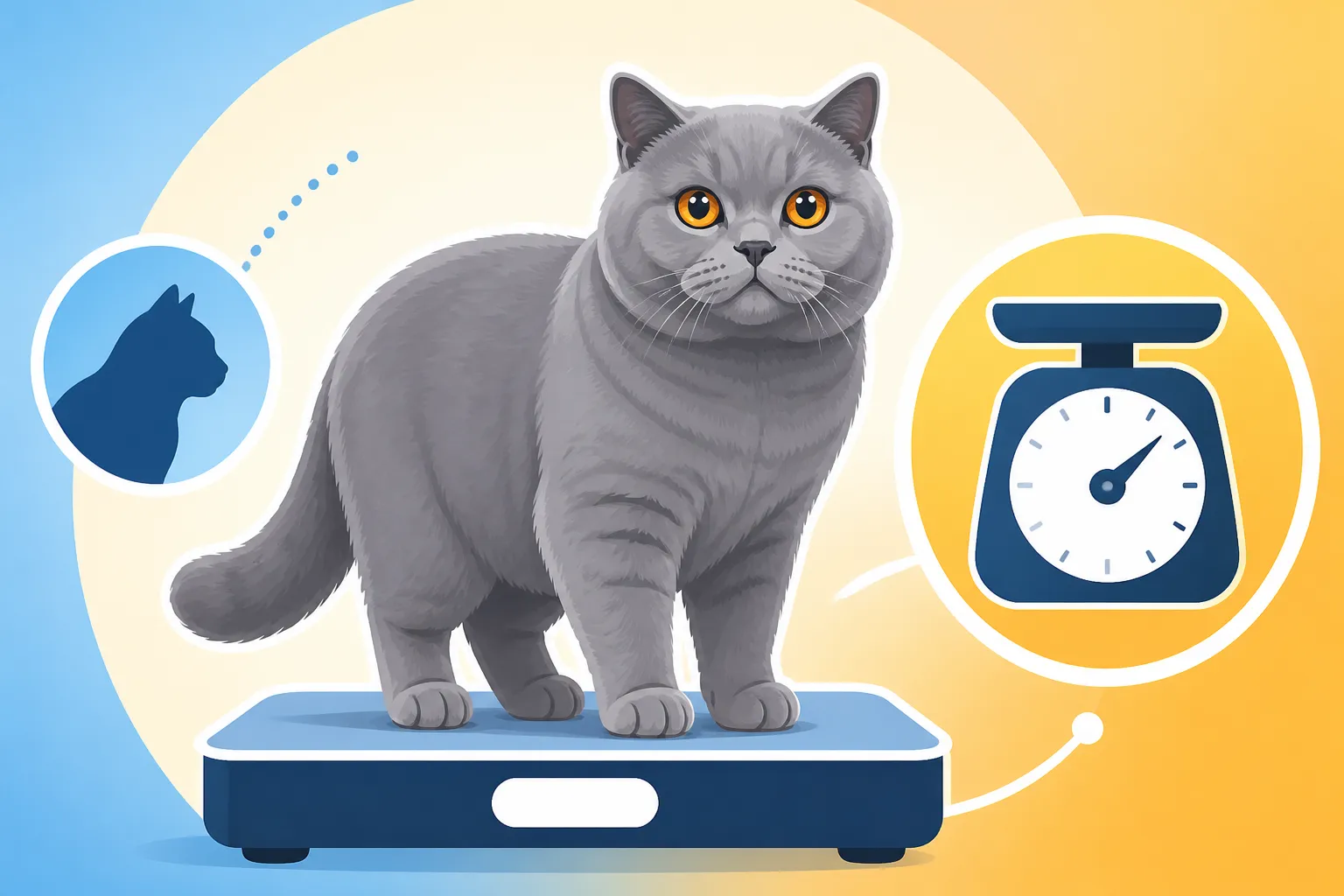
If your cat will stand still on a household scale, weigh him at a similar time and under similar conditions each time. For a small or uncooperative cat, weigh yourself first, then weigh yourself holding him, and subtract your weight. This method is not as precise as a veterinary scale, but it can help show a trend if you repeat it consistently.
Write down each result with the date. A single reading can be affected by meals, bathroom habits, or a wiggly cat, so look for a pattern rather than reacting to one measurement. If you use an online retailer such as Chewy to compare feeding supplies or food options, remember that product information does not replace a veterinarian’s assessment of your cat’s body condition.
For more tips on repeatable home measurements, see How to Weigh a British Shorthair at Home. If the scale readings seem inconsistent or he is difficult to handle, ask your clinic whether they can help you get a reliable baseline.
Measure food rather than guessing
British Shorthairs can be persuasive about food. A cat who sits near the bowl, follows you into the kitchen, or asks for another serving may seem genuinely hungry, but begging does not tell you whether his daily intake is appropriate. Scooping food by eye can also lead to portions gradually getting larger.
Check the feeding guidance on the food package, but treat it as a starting point rather than a personalized prescription. Calorie content varies between foods, and your cat’s needs depend on factors such as age, activity, health, and body condition. If you’re comparing labels from Chewy or another retailer, check the calorie information and serving guidance on the specific product rather than assuming that equal-looking scoops provide equal energy.
A kitchen scale can make portions more repeatable than a scoop, particularly when several people feed the cat. Count treats as part of his overall intake, too. If he lives with other pets, separate feeding may help prevent food sharing from making his intake hard to track.
Make changes safely and ask for help when needed
If your cat needs to lose weight, gradual, veterinarian-guided changes are safer than a sudden cut in food. Cats should not be put on crash diets; rapid or excessive restriction can cause serious health problems. Your veterinarian can set an appropriate goal and recommend a plan that accounts for his current diet and health.
You can support that plan with short play sessions, food puzzles, and small changes that encourage movement without forcing him to exercise. Choose activities he will actually engage with, such as a wand toy moved at floor level or a toy rolled across the room. A few brief, consistent sessions may be more realistic than expecting a low-energy cat to play for a long stretch.
If the food or portion questions are confusing, take the packaging or a photo of the feeding instructions to your appointment. Retail listings, including those on Chewy, can help you compare product labels, but your veterinarian is the right person to help decide whether a particular food and portion suit your cat.
Disclaimer
This article is for general informational purposes only and does not constitute professional advice. Laws, prices and regulations vary by location and change over time. Consult a qualified professional for guidance on your specific situation.